
Research & Education

Understanding the Evidence

Health information is everywhere, but not all information carries the same weight.
Claims about pain, massage, rehabilitation and treatment should be considered in relation to the quality of the evidence supporting them.

A published study does not automatically prove that a treatment works, and scientific understanding can change as better evidence becomes available.

From Research to Practice

Evidence-based practice is not simply following research papers.

It involves integrating the best available research evidence, clinical expertise and the individual person’s needs and preferences.

Understanding study design, limitations and uncertainty allows both practitioners and readers to distinguish stronger evidence from assumptions, marketing claims and unsupported conclusions.
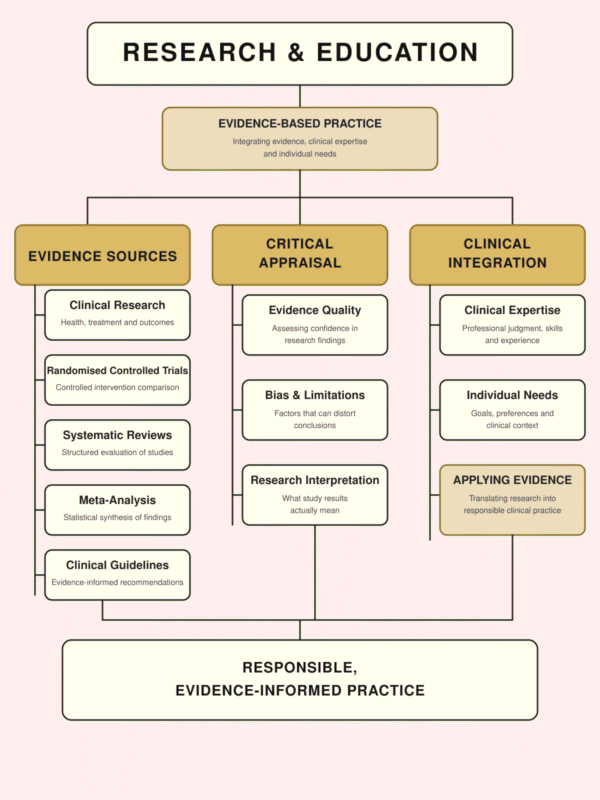

What You Need to Understand

Evidence-Based Practice — integrating evidence, clinical expertise and individual needs
Clinical Research — research involving health, treatment and patient outcomes
Randomised Controlled Trials (RCTs) — evaluating interventions through controlled comparison
Systematic Reviews — structured evaluation of multiple studies
Meta-Analysis — statistical synthesis of research findings
Clinical Guidelines — evidence-informed recommendations for healthcare practice
Evidence Quality — assessing confidence in research findings
Bias & Limitations — recognising factors that can distort conclusions
Research Interpretation — understanding what study results actually mean
Applying Evidence — translating research into responsible clinical practice


Build Your Understanding

Research should help us ask better questions, not simply provide statements to repeat.

Explore Research & Education

Explore the articles below to examine evidence behind massage therapy, pain, assessment, treatment and recovery and learn how to interpret health information critically.

Explore Research & Education →