Case Study
Learning Through Clinical Cases
Theory becomes more useful when we can see how it applies to a real clinical situation.
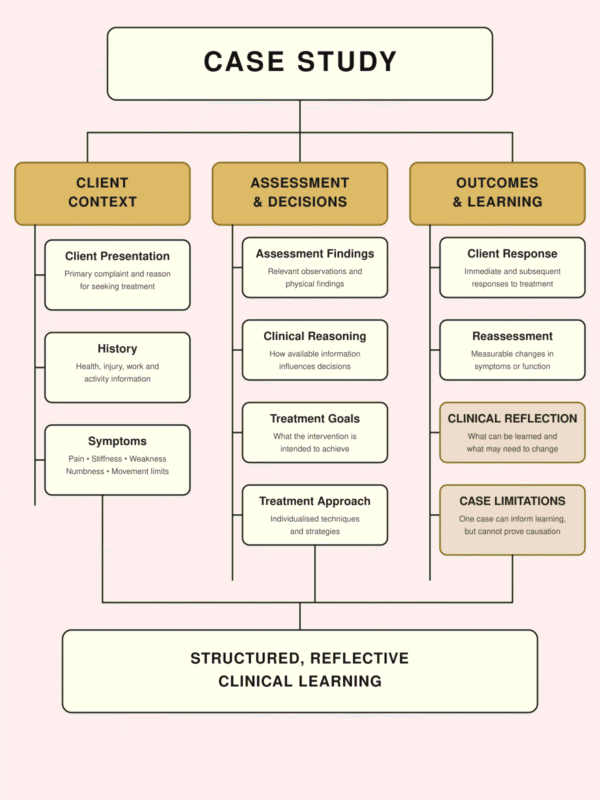
Case studies allow us to follow the process from a person’s symptoms and history through assessment, clinical reasoning, treatment decisions and reassessment.
Their purpose is not to demonstrate a “perfect treatment,” but to show how information can be interpreted and decisions can evolve over time.
A case study cannot prove that a treatment will work for everyone. Instead, it provides a practical opportunity to examine clinical reasoning and learn from individual responses.

From Presentation to Outcome
Two people reporting the same area of pain may require very different approaches.
A useful case study therefore considers more than the diagnosis. It examines symptoms, functional limitations, relevant history, assessment findings, treatment goals, interventions and measurable changes.