
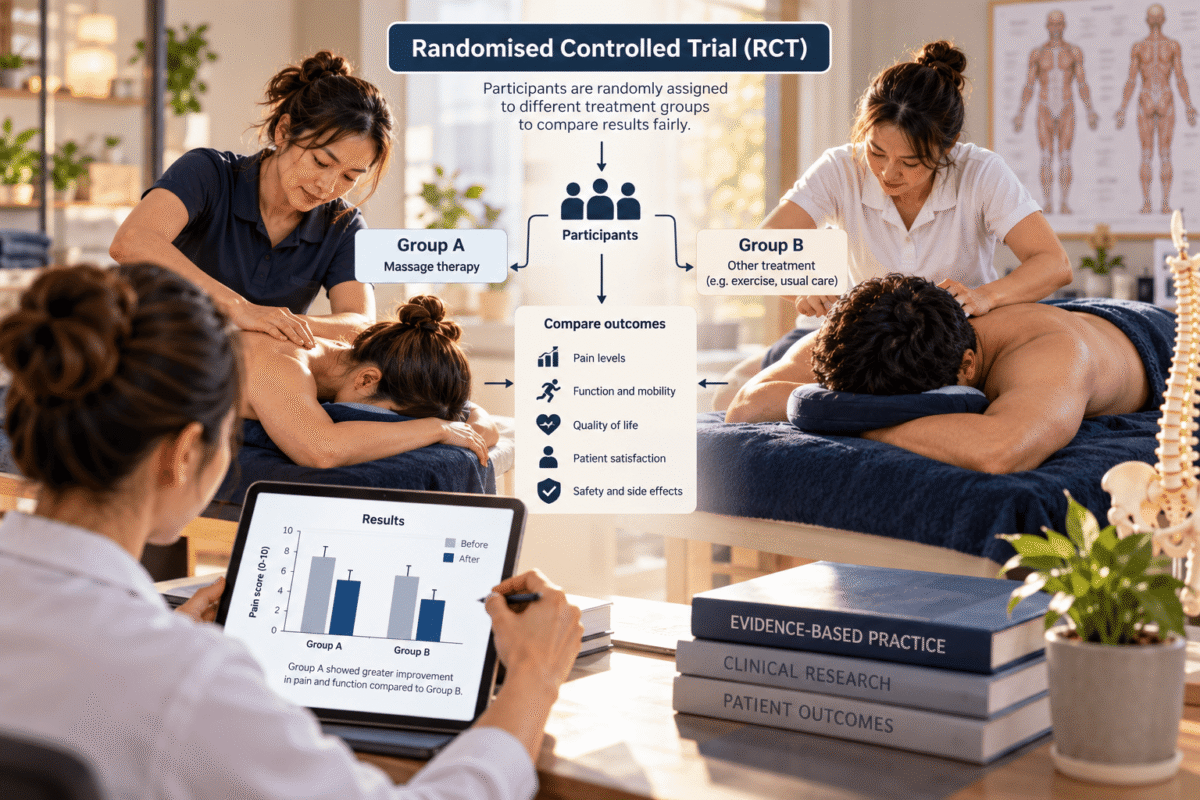
Randomised Controlled Trial
Example Case
A client visits the clinic after several weeks of shoulder discomfort.
After treatment, the pain has reduced and movement feels easier.
From the client’s perspective, the conclusion seems obvious:
“My shoulder felt much better after three massage sessions, so massage must have fixed the problem, right? If it worked for me, doesn’t that prove the treatment works?”
Treatment happened. Pain improved. Therefore, the treatment worked. However, research has to ask a harder question. Would the client have improved anyway? That is where a Randomised Controlled Trial begins.
Subjective Symptoms
The client reports:
- Reduced shoulder pain
- Improved movement
- Better sleep
- Greater confidence using the arm
- Improvement occurring after treatment began
These changes are meaningful. However, they do not tell us exactly why the improvement occurred. For example, symptoms may also change because of:
- Natural recovery
- Reduced activity
- Exercise performed at home
- Expectation of improvement
- Changes in sleep or stress
- Other treatments received at the same time
Therefore, observing improvement in one person cannot establish that a treatment caused it.
What It May Feel Like
When people read health research, they often encounter statements such as:
- “This treatment reduced pain.”
- “Participants improved after six weeks.”
- “The therapy was effective.”
- “Patients reported better mobility.”
At first, these statements sound convincing. However, improvement after treatment is not the same as improvement because of treatment. To answer that question more confidently, researchers need something to compare against.
Objective Findings
Imagine researchers recruit 120 people with similar shoulder pain. Before treatment begins, they record outcomes such as:
- Pain intensity
- Range of motion
- Strength
- Daily function
- Quality of life
Then, instead of allowing researchers or participants to choose the treatment group, participants are assigned randomly. For example:
- 60 receive the treatment being studied.
- 60 receive another treatment, usual care, placebo, or another appropriate comparison.
Both groups are then followed over the same period. Now researchers can ask: Did one group improve more than the other? That comparison is the foundation of an RCT.
What Could It Be Related To?
A Randomised Controlled Trial (RCT) is an experimental study in which participants are allocated randomly to two or more comparison groups. Usually, one group receives the intervention being studied, while another receives a comparator such as:
- Usual care
- Another treatment
- Placebo or sham treatment
- No additional intervention
Random allocation helps reduce systematic differences between groups at the beginning of the trial. As a result, researchers can be more confident that later differences may be related to the intervention rather than pre-existing differences between participants. However, randomisation improves the study design. It does not automatically make every RCT trustworthy.
Common Contributing Factors
Several features can influence the reliability of an RCT:
- How participants were randomly allocated
- Whether group allocation was concealed
- Whether participants or assessors were blinded where possible
- The number of participants
- Whether many participants dropped out
- How outcomes were measured
- Whether both groups received similar care apart from the intervention
- Whether all planned outcomes were reported
For example, imagine a trial contains only 20 participants. Even if the study is randomised, the result may still be uncertain. Likewise, if researchers know which treatment is coming next and influence who receives it, selection bias can enter the study. Therefore, seeing the letters “RCT” is not enough. The quality of the trial still needs to be examined.
Assessment Goals
When reading an RCT, we should ask:
- Was allocation genuinely random?
- Were the groups similar at the beginning?
- Was the comparison appropriate?
- Were important outcomes measured?
- Was follow-up long enough?
- Were participants lost during the study?
- Was the difference statistically convincing?
- More importantly, was the difference large enough to matter clinically?
This final question is essential. A study may find a statistically significant difference. However, if the improvement is extremely small, the patient may barely notice it. Therefore, statistical significance and meaningful clinical improvement are not always the same thing.
Suppose an RCT finds that an exercise programme improves shoulder function more than usual care. That information can help guide treatment. However, the therapist should still consider:
- Does the study population resemble this client?
- Is the intervention practical?
- Are there risks or disadvantages?
- How large was the benefit?
- How long did the benefit last?
- What does the client prefer?
- Does the client have other conditions that affect treatment?
Therefore, evidence from an RCT should inform clinical reasoning rather than replace it. In practice, the treatment plan may combine:
- Research evidence
- Clinical expertise
- Individual assessment findings
- The client’s goals and preferences
- Ongoing reassessment
The evidence tells us what may work on average. The individual response tells us whether it is working for this person.
How Does It Usually Influence Recovery?
An RCT does not directly make someone recover. Instead, it helps clinicians choose treatments with a more reliable estimate of benefit and harm. For our shoulder client, the question changes from: “Did I feel better after treatment?” to: “Does this treatment consistently help people like me more than an appropriate alternative?” That is a much stronger question. Over time, high-quality trials can help healthcare professionals:
- Avoid ineffective treatments
- Compare different interventions
- Understand potential harms
- Estimate how large a benefit may be
- Improve clinical guidelines
- Make more informed decisions with patients
However, one RCT should rarely be treated as the final answer. Instead, its findings should be considered alongside other trials and, ideally, systematic reviews. One trial gives us evidence. A body of evidence gives us confidence.
Your Body Talks. Learn to Listen.
Personal experience tells us what happened to one person. A Randomised Controlled Trial asks whether the same result still appears when chance, comparison and bias are taken more seriously. Both matter. But they answer different questions. Experience starts the question. Good research tests the answer.

Ask it. Even if you think it’s a ridiculous question.
Someone else has probably wondered exactly the same thing.
