
You wake up and turn your head.
Ouch!
Yesterday your neck was fine. Today, reversing the car suddenly requires your entire upper body.
Neck pain is extremely common, and in many cases it settles with time and appropriate management.
But “my neck hurts” isn’t a diagnosis.
And not every painful neck needs the same treatment.
Why Does Neck Pain Happen?
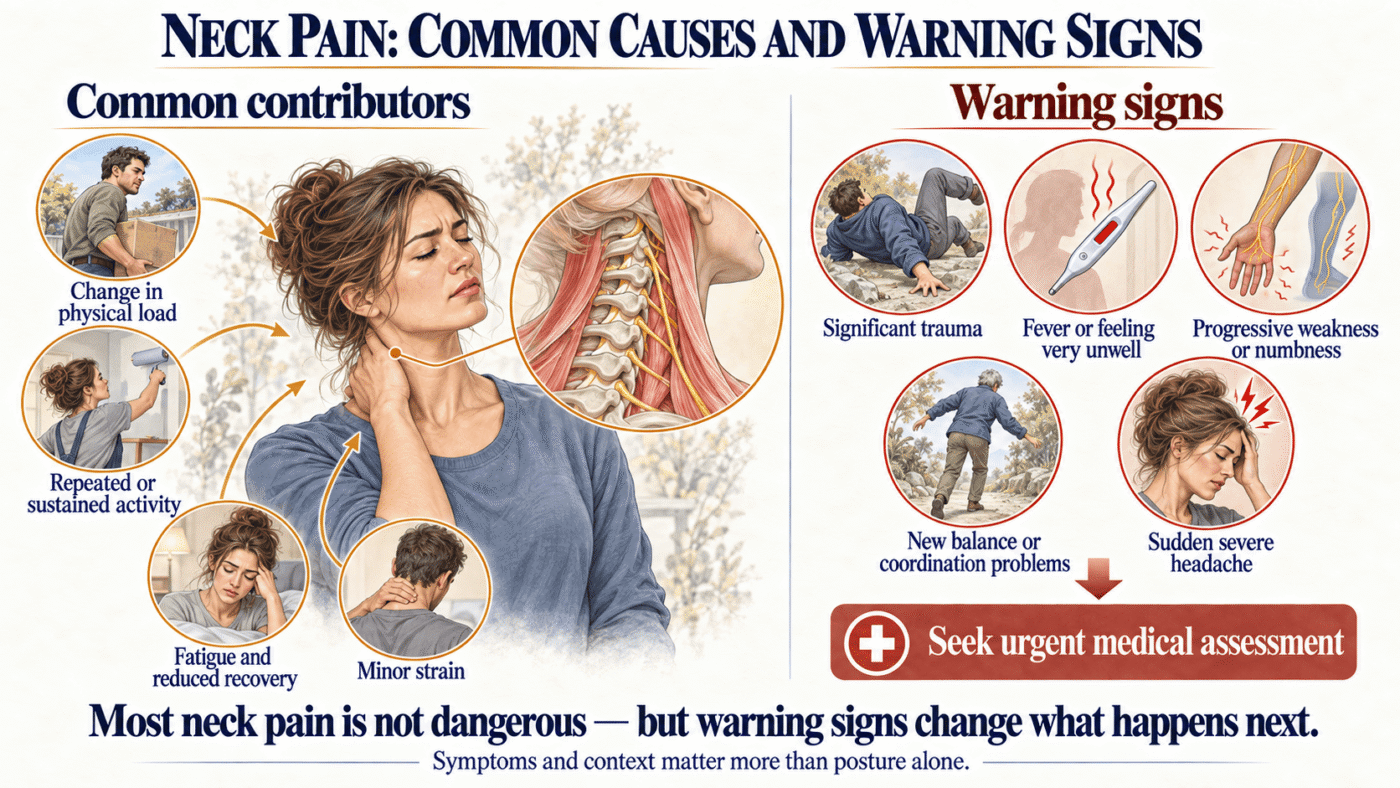
Sometimes there’s an obvious reason. You slept in an unusual position. You increased your training. You spent hours doing unfamiliar work. You turned quickly and felt something suddenly become painful. Other times, there’s no single moment you can blame.
Neck pain can involve muscles, joints and other structures around the neck, while workload, previous injury, physical activity and sensitivity of the nervous system may also influence how the area feels. And yes, spending a long time in one position may contribute to discomfort for some people.
But blaming everything on “bad posture” is usually too simple.
Your neck was designed to move.
Often the better question is:
“What has changed recently?”
Where it hurts matters.
But what the pain is changing can tell us even more.
Can you turn your head normally?
Does looking up or down hurt?
Has the pain started travelling into your shoulder or arm?
Are you experiencing numbness, tingling or weakness?
Can you work, sleep and drive normally?
Instead of only giving pain a number from 0–10, look at what it is stopping you from doing. That gives us something useful to assess and later reassess.
If neck pain appears to have a musculoskeletal component, massage and other manual techniques may help some people reduce discomfort and move more comfortably.
But treatment shouldn’t simply be:
Find tight muscle → press harder → hope for the best.
We may need to consider neck movement, surrounding muscles, the shoulder region and other factors relevant to the person’s presentation.
Then we check again.
Did movement change?
Did the pain change?
Can you do something more comfortably?
If nothing is changing, repeating the same treatment indefinitely probably isn’t a very interesting plan.
Most neck pain isn’t an emergency. But some symptoms deserve prompt medical assessment rather than simply booking a massage. Seek appropriate medical care if neck pain occurs with concerning symptoms such as:
- significant trauma, such as a serious fall or vehicle accident
- sudden or progressive weakness, numbness or loss of coordination
- difficulty walking or significant balance changes
- severe or unusual headache, particularly if sudden
- fever or feeling seriously unwell with significant neck stiffness
- new problems controlling the bladder or bowel alongside neurological symptoms
- severe, rapidly worsening or otherwise unusual symptoms
This isn’t a complete diagnostic checklist. The point isn’t to make you afraid of neck pain. It’s to recognise when the situation doesn’t look like ordinary musculoskeletal pain. Sometimes the correct treatment decision is:
“Let’s not massage this yet.”
If your neck repeatedly becomes painful, ask why. Has your workload changed? Has your movement changed? Does it keep returning after treatment? Are there neurological symptoms?
Does something need further investigation? Pain relief can certainly be useful.
But if the warning keeps coming back, don’t spend months simply turning the volume down.
Find out why the alarm keeps ringing.
Your Body Talks. Learn to Listen.
And here’s today’s question:
When your neck hurts, what’s the first thing you do?
Stretch it? Massage it? Take something for the pain?
Or rotate your head aggressively twelve times just to make absolutely certain it still hurts?
We’ve all tested something one more time than necessary.

Ask it. Even if you think it’s a ridiculous question.
Someone else has probably wondered exactly the same thing.
