
Range of Motion Assessment
“Turn your head to the right.”
“Now to the left.”
“Raise your arm as high as you comfortably can.”
It looks almost too simple to be an assessment.
But those movements can tell us quite a lot.
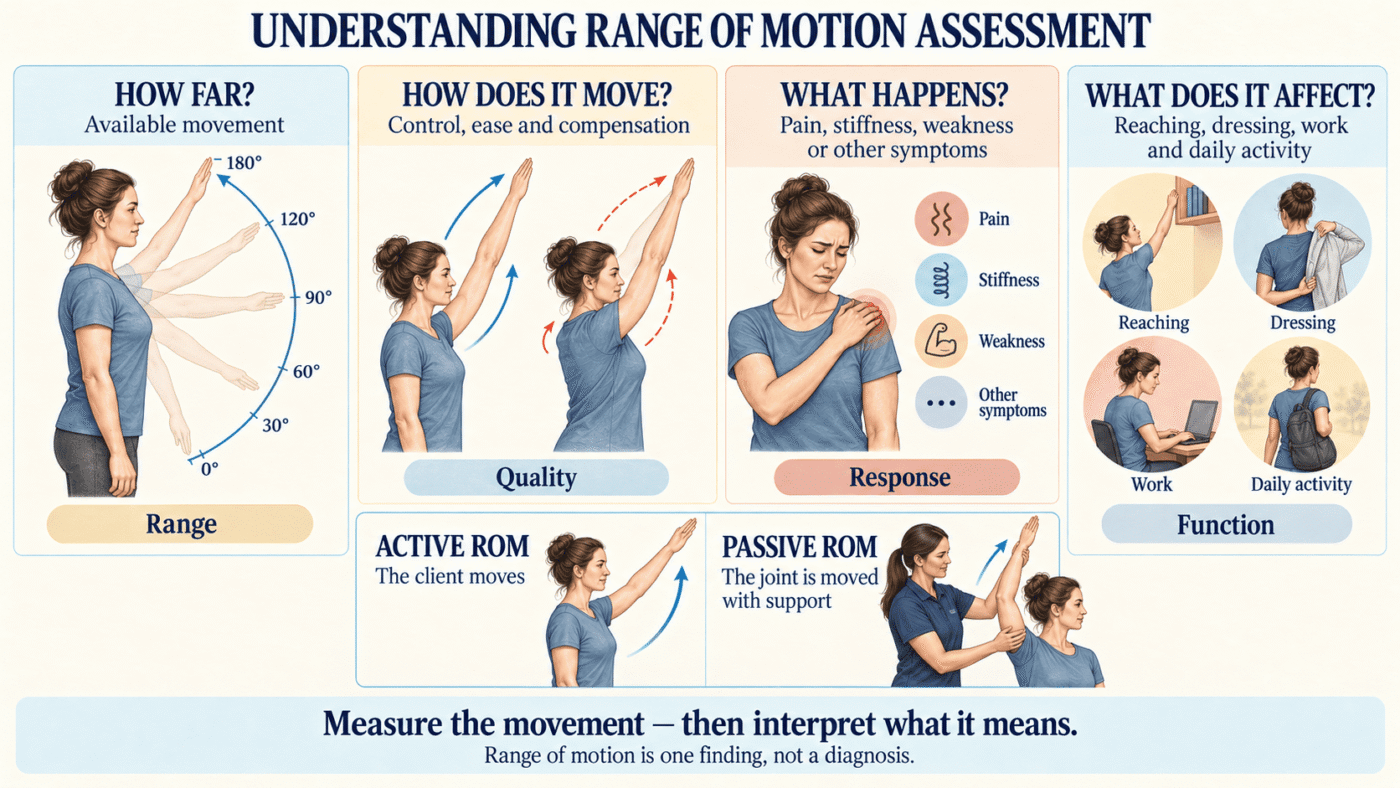
Range of Motion or ROM describes how much movement is available at a joint or through a particular movement.
Better movement for the things you actually need to do. So when a therapist asks you to perform the same movement before and after treatment, they’re not necessarily running out of ideas. Hopefully, they’re checking whether something actually changed.
Assess → Treat → Reassess
Simple.
But incredibly useful.
Imagine you have neck pain. Before treatment, you turn your head to the right comfortably. To the left? Halfway there, it feels stiff and painful. That gives us more information than simply:
“My neck hurts.”
During a ROM assessment, we may observe:
- how far you can move
- whether the movement is comfortable
- differences between directions or sides
- where symptoms appear
- how the movement is performed
- whether movement has changed from your usual ability
Sometimes ROM can be estimated visually. When greater precision is useful, it can also be measured with appropriate tools. But the number alone isn’t the whole assessment.
There are different ways to assess movement.
Active Range of Motion (AROM) is what happens when you move the body part yourself.
For example:
“Raise your arm.”
Now your muscles, joints and nervous system are working together to perform the movement.
Passive Range of Motion (PROM) is different.
The therapist moves the body part while you remain relaxed.
Comparing active and passive movement can sometimes provide additional clues about what may be influencing the restriction. But ROM alone doesn’t give us a diagnosis. It gives us information that needs to be interpreted alongside your history, symptoms and other findings.
This is an important one. If you can’t turn your neck fully, it’s tempting to say: “That muscle must be tight.” Maybe. But movement can be influenced by many things.
Pain.
Joint mobility.
Muscle function.
Previous injury.
Swelling.
The nervous system.
Or simply your individual anatomy.
So finding reduced ROM doesn’t automatically tell us: “Massage this muscle.” It tells us: “Something is influencing this movement. Let’s investigate.”
Suppose one person can comfortably rotate their shoulder much further than another. Does that automatically mean their shoulder is healthier?
No.
People naturally have different ranges of movement. Different activities also require different amounts. A competitive gymnast and someone working at a desk probably don’t need identical shoulder mobility.
The goal isn’t to achieve the largest number possible. The better question is: “Do you have enough comfortable, controlled movement for what you need to do?” That’s function.
This is where ROM assessment becomes particularly useful in treatment. Before treatment: Neck rotation is limited and uncomfortable. After treatment:
Try it again.
Can you move further?
Does it feel easier?
Has the pain changed?
Nothing changed?
That’s useful information too. We now have something to compare. Without that starting point, it’s very easy to finish treatment with: “Feels better?”
“Yes.”
Great.
But what changed?
ROM gives us one way to make that answer more meaningful.
A ROM measurement can be useful. But we’re not trying to turn everyone into a textbook diagram. If your shoulder moves five degrees further but you still can’t comfortably put on your shirt, have we achieved the outcome that matters?
Maybe not. That’s why ROM should be considered alongside pain, strength, symptoms and function. The goal isn’t simply: More ROM.
Your Body Talks. Learn to Listen.
Quick experiment: Turn your head comfortably to each side.
Exactly the same?
Probably not. Before declaring yourself crooked, remember humans aren’t manufactured with factory specifications.
Ask it. Even if you think it’s a ridiculous question.
Someone else has probably wondered exactly the same thing.
