“This treatment is evidence-based.”
Sounds reassuring.
Professional.
Scientific.
Maybe even slightly intimidating.
But what does evidence-based practice actually mean?
Does it mean therapists should only do things that have been tested in research?
Does one scientific paper prove that a treatment works?
Does clinical experience still matter?
And what happens when research says one thing, but the person sitting in front of you needs something different?
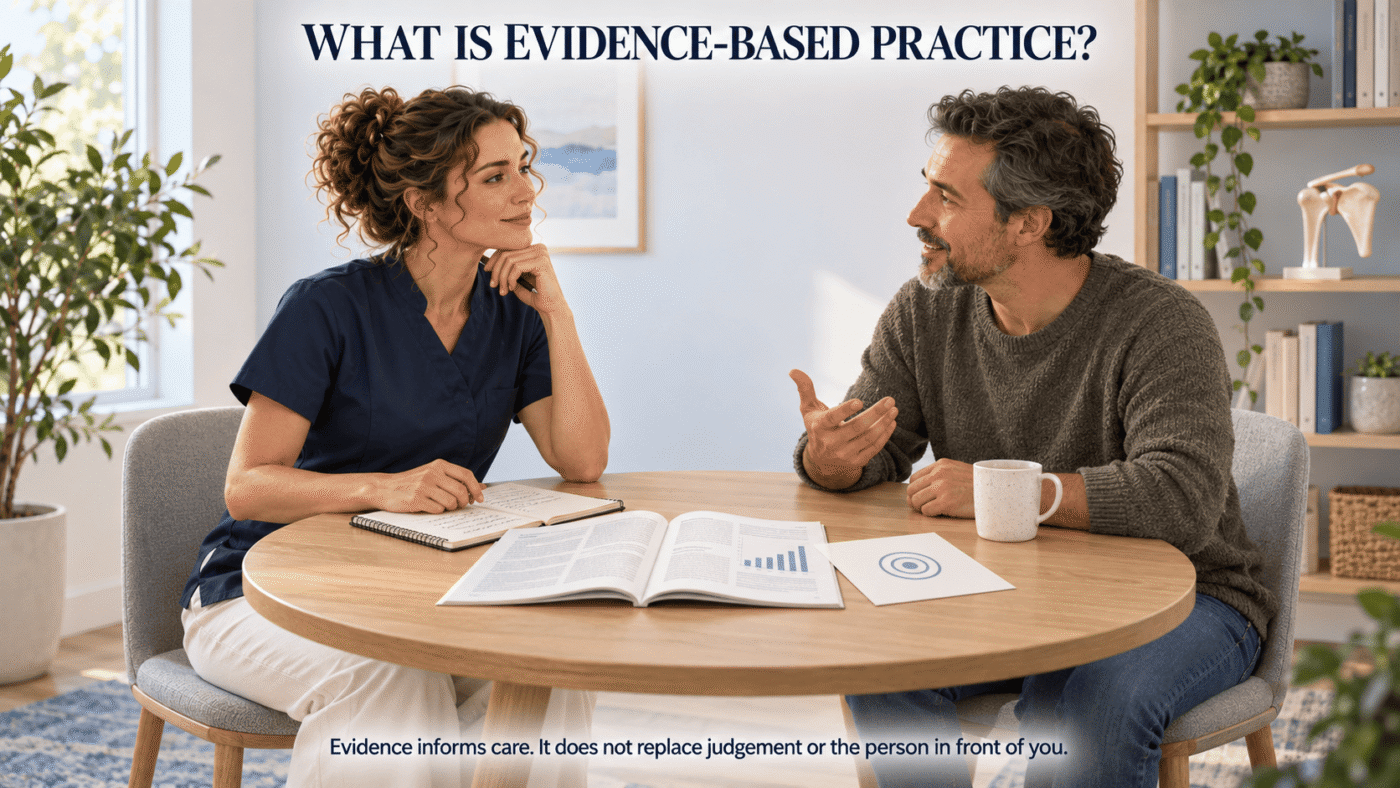
Evidence-based practice is not simply: “Research says this, so everyone should do it.” It is a way of making better-informed decisions.
Best available research evidence
Clinical expertise
Individual needs, values and preferences
These elements work together. Research helps us understand what has been studied, what may be effective, what may be ineffective and where uncertainty still exists.
Clinical expertise helps a practitioner interpret that information in the context of the person in front of them. And the individual matters because healthcare isn’t happening to an average participant in a research paper. It’s happening to you.
Research Matters
Without research, healthcare can easily become: “I’ve always done it this way.” “My teacher told me.” “My clients seem to like it.” “I saw it on Instagram.” Or everyone’s favourite: “Trust me.” Experience can be valuable. But experience alone has limitations.
Humans are very good at noticing when something supports what we already believe. We’re not always as good at noticing when it doesn’t.
Does this treatment actually help?
How large is the effect?
How confident are we?
What are the risks?
Who was studied?
Compared with what?
Those questions help us move beyond belief.
This is an important distinction. You may see a headline: “NEW STUDY PROVES MASSAGE REDUCES PAIN!”
Interesting. But before changing clinical practice, we need more information.
How many people participated?
What condition did they have?
What treatment was used?
What was it compared with?
How was improvement measured?
How large was the difference?
How long did the benefit last?
Was the study well designed?
Have other studies found similar results?
A published study is evidence. It isn’t automatically strong evidence. That’s why understanding research quality matters.
Not every research design answers the same question equally well. You may encounter:
- randomised controlled trials
- systematic reviews
- meta-analyses
- observational studies
- case reports
- clinical guidelines
- expert opinion
Each can provide useful information in the right context. But they have different strengths and limitations. Even systematic reviews and meta-analyses aren’t automatically perfect.
If the studies included are poor quality, highly inconsistent or measuring different things, combining them doesn’t magically make the evidence excellent.
More papers do not automatically mean more certainty.
This is why evidence needs interpretation. Not just collection.
Imagine research suggests that a particular approach may help some people with a certain condition. Does that mean every person with that condition should receive exactly the same treatment? No. A clinician still needs to assess the individual.
What symptoms are present?
What is their health history?
What can they currently do?
What are they struggling to do?
Are there precautions or contraindications?
How did they respond to previous treatment?
Does this presentation even resemble the population studied in the research?
Research informs the decision. It doesn’t make the decision by itself.
Evidence gives us information. Clinical reasoning helps us use it.
This part is sometimes forgotten. A treatment may have research support and still not be appropriate for a particular person. Maybe they dislike the technique. Maybe it doesn’t fit their goals. Maybe another option is more practical. Maybe their previous experience changes what they’re comfortable with. Maybe cost, time or accessibility matters. Maybe they simply don’t want it.
Evidence-based healthcare should not mean:
“The research says this, so you don’t get a choice.”
The client’s values, preferences and circumstances belong in the decision. That’s part of good healthcare.
*********
We don’t need questionable explanations to justify useful treatment.
If massage helps reduce pain for someone, that’s worth observing. If movement becomes easier, measure it. If function improves, that’s meaningful. If nothing changes, that’s meaningful too.
The treatment should be judged by relevant outcomes not by how impressive the explanation sounds.
Experience matters. A therapist who has assessed and treated many people develops practical skills that can’t be learned entirely from reading papers. Observation. Communication. Palpation. Technique selection. Recognising unusual presentations. Knowing when to modify treatment. Knowing when not to treat. These skills matter.
But experience needs humility. A therapist may say: “I’ve used this technique for 15 years and it works.” Perhaps it helps some clients. But we still need to ask:
How do we know?
What changed?
Compared with what?
Would the person have improved anyway?
Was the improvement temporary?
Did function actually change?
Could another explanation fit?
Experience becomes more useful when we’re willing to question it.
This distinction is important. Evidence-based practice isn’t the same as blindly following research. Research studies involve particular populations, interventions and conditions. The person in front of us may not fit perfectly into that study.
Sometimes evidence is strong.
Sometimes limited.
Sometimes conflicting.
Sometimes the exact clinical question simply hasn’t been studied well enough yet.
In those situations, we don’t need to pretend certainty exists. We can say: “We don’t know yet.” That’s not weakness. That’s scientific honesty.
Healthcare knowledge isn’t finished. New studies appear. Old explanations are challenged. Some treatments become better supported. Others become less convincing.
Sometimes mechanisms we once confidently taught turn out to be much more complicated. That’s normal. Science isn’t a collection of permanent answers. It’s a process of improving our understanding.
A good practitioner should therefore be willing to say: “I used to explain this differently. The evidence has changed.” Changing your mind when better information becomes available isn’t inconsistency. It’s learning.
Massage therapy contains plenty of claims. Some are reasonably supported. Some have limited evidence. Some are uncertain. And some sound scientific without having much scientific support at all.
You may hear that massage: “flushes toxins.” “breaks up fascia.” “removes lactic acid.” “puts joints back into alignment.” “releases every trigger point.” “increases circulation and therefore heals injuries faster.”
Some of these explanations are oversimplified. Others aren’t well supported. That doesn’t mean massage has no value.
Research can tell us what may happen across groups of people. But clinical practice still needs to ask: What happened to this person? That’s why reassessment matters. A simple process might look like:
Assess → Form a hypothesis → Treat → Reassess → Adapt
Did pain change?
Did range of motion change?
Did movement become easier?
Did function improve?
What happened later?
Did the improvement last?
If the expected outcome doesn’t occur, evidence-based practice doesn’t mean repeating the same treatment indefinitely because research said it should work. It means reconsidering the decision.
*********
Be Careful With Certainty
One of the easiest ways to sound knowledgeable is to speak with absolute certainty.
“This muscle is causing your pain.”
“This technique releases the fascia.”
“This is definitely coming from your posture.”
“This treatment will fix it.”
Certainty sounds impressive. But the human body doesn’t always cooperate with confident explanations.
“This may be contributing.”
“This is one possibility.”
“Let’s test that idea.”
“Let’s see what changes.”
“We may need to reconsider.”
That isn’t indecision. That’s recognising uncertainty and working with it intelligently.
The goal of evidence-based practice isn’t to collect research papers so we can prove someone else wrong. It’s to make better decisions. Research matters. Clinical experience matters. The individual matters. And uncertainty matters too.
Put them together:
Research Evidence + Clinical Expertise + Individual Needs & Preferences
Then:
Assess → Decide → Treat → Reassess → Learn
Not perfect certainty. Not blindly following studies. Not ignoring experience. And not accepting every confident health claim because someone used an anatomical diagram behind it.
The goal is simpler: Use the best information available, apply it thoughtfully, observe what happens and be willing to change your mind.
Because good healthcare isn’t about always being right. It’s about continually becoming less wrong.
Learn to Ask Better Questions
You don’t need to become a researcher to think critically about health information. Start with a few questions:
What is the claim?
What evidence supports it?
How strong is that evidence?
Who was studied?
How meaningful was the outcome?
What are the limitations?
Does this apply to the person in front of us?
And perhaps the most useful question we’ve used throughout OLO: “How do we know?” That question isn’t cynical. It’s curious. And curiosity is where good learning begins.
Your Body Talks. Learn to Listen.
And if a social-media post begins with: “Scientists have finally proven the ONE technique that fixes every type of pain…” excellent. We’ve already found something to practise our critical thinking on.
Ask it. Even if you think it’s a ridiculous question.
Someone else has probably wondered exactly the same thing.
