“A study found that this treatment works.”
Okay.
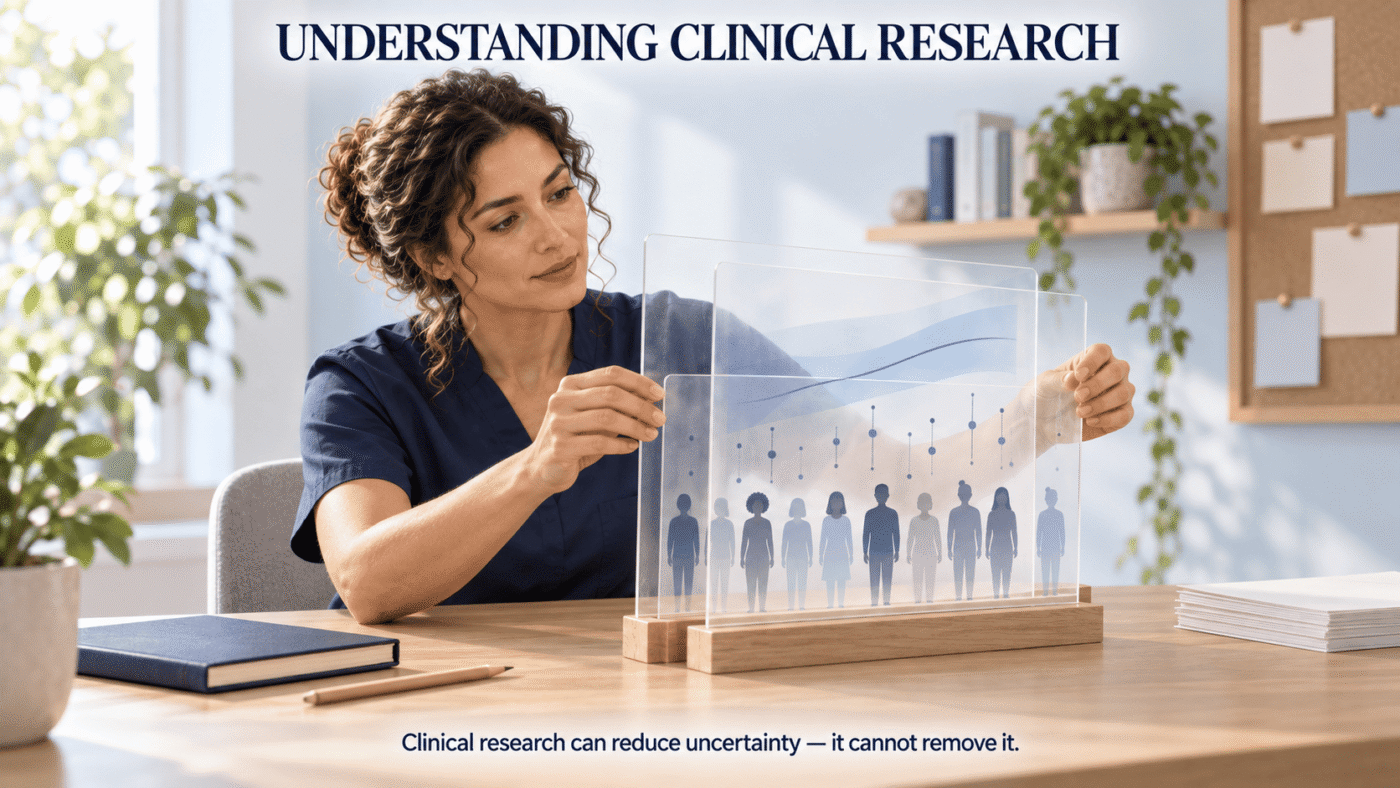
That’s interesting. But before we completely redesign healthcare around one sentence…what did the study actually find? Clinical research can sound intimidating. Randomisation. Control groups. Statistical significance. Confidence intervals. P-values. By the third paragraph, many perfectly intelligent people have decided they’ll just read the conclusion.
Fair enough.
Clinical research studies health, symptoms, conditions, treatments and outcomes involving people or information related to human health.
But you don’t need to become a researcher to understand the basic idea. At its heart, clinical research is about asking health-related questions in a structured way.
It may ask questions such as:
Does this treatment reduce pain?
Does exercise improve function?
Is one treatment better than another?
How common is a condition?
What factors are associated with recovery?
Are there risks or adverse effects?
Different questions require different types of research. That’s important because there isn’t one research design that is “best” for everything. The method should match the question.
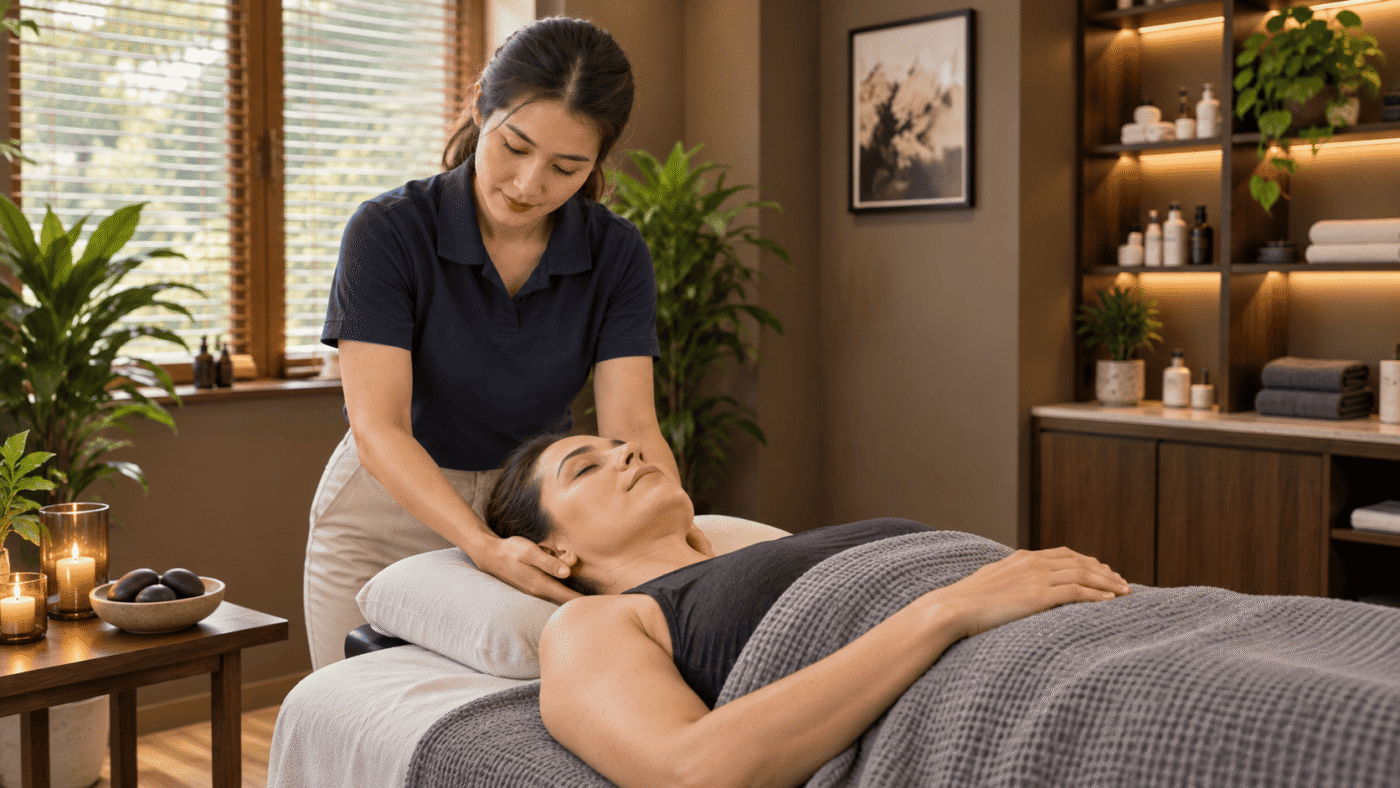
Imagine we want to know whether massage helps people with neck pain. That sounds simple. But immediately we have more questions.
What kind of neck pain?
How long have they had it?
What type of massage?
How many treatments?
Compared with what?
No treatment?
Exercise?
Another manual therapy?
Usual care?
And what does “helps” mean?
Less pain?
Better range of motion?
Better sleep?
Improved function?
Return to work?
And for how long?
Now our simple question has become much more precise. That’s a good thing. Good research starts by defining what we’re actually asking.
This is one of the first things to check. Suppose a study finds that a treatment helped 30 competitive runners aged 18–30. Interesting. But can we automatically assume the same result applies to an 82-year-old with several medical conditions?
Probably not. Research participants have characteristics.
Age.
Health status.
Condition.
Activity level.
Symptom duration.
Inclusion and exclusion criteria.
These details affect how confidently we can apply the findings to other people. So whenever you hear: “Research shows…” one useful response is: “Research on whom?”
This matters particularly in massage and manual therapy research. “Massage” isn’t one identical intervention. Treatment could vary in:
- technique
- pressure
- duration
- frequency
- body area
- therapist
- treatment goals
- combination with other interventions
If one particular protocol was studied, we shouldn’t automatically assume the result applies to every form of massage. The same applies to exercise. “Exercise works” isn’t very specific.
What exercise?
How much?
How often?
At what intensity?
For whom?
Clinical research becomes useful when we understand what was actually tested.
A treatment result doesn’t exist in isolation. Imagine 70% of people improved after receiving a treatment. Sounds excellent. But what if 68% of people receiving another treatment also improved? Or 65% improved without that particular intervention? Suddenly the interpretation changes.
That’s why comparison groups can be so important. Researchers may compare an intervention with:
- usual care
- another treatment
- education
- exercise
- a sham or placebo intervention
- waiting-list or no-treatment conditions
The comparison helps us ask: What difference did the intervention actually make?
This is one of my favourite questions. A study may report that something “worked.” But:
What changed?
Pain?
Range of motion?
Strength?
Function?
Quality of life?
A laboratory measurement?
A questionnaire score?
These aren’t interchangeable. For example, a treatment might produce a small change in range of motion. But did the person actually function better?
Could they return to work?
Could they sleep more comfortably?
Could they perform the activity that mattered to them?
A measurable difference isn’t automatically a meaningful difference. This brings us back to one of our recurring principles: Measure what matters to your life.
*********
Statistical Significance Isn’t the Whole Story
You may see the phrase: “Statistically significant.” It sounds like: Important. Proven. Case closed. Not necessarily. Statistical significance helps researchers evaluate whether an observed difference is reasonably compatible with the assumptions of their statistical model rather than simply being dismissed as random variation.
But it doesn’t automatically tell us whether the difference is large enough to matter clinically. A study might identify a small difference between groups. Mathematically interesting.
Clinically? Maybe. Maybe not.
That’s why we also need to consider the size and practical importance of the effect, not just whether a statistical threshold was crossed.
Sample size matters. A study involving ten people usually gives us less certainty than a well-conducted study involving hundreds.
But size alone doesn’t determine quality. A very large poorly designed study can still produce misleading conclusions. A smaller carefully designed study may provide useful information.
We need to consider the whole design:
How were participants selected?
How were groups created?
Was there an appropriate comparison?
How were outcomes measured?
How many participants dropped out?
How were the results analysed?
Research quality isn’t simply a competition for the biggest number of participants.
Research is performed by humans. And humans are impressively talented at introducing bias without necessarily intending to.
Bias can enter through:
Participant selection.
Treatment allocation.
Outcome measurement.
Missing data.
Expectations.
Selective reporting.
Study design.
Analysis.
Publication.
This doesn’t mean: “Research is biased, therefore research can’t be trusted.” Quite the opposite. Research methods are designed partly to identify and reduce these problems. The useful question is: “How much confidence should we have in this result?”
Some research methods are easier to apply to certain treatments than others. Imagine you’re studying a tablet. Researchers may sometimes be able to give one group the medication and another group a placebo that looks similar. Participants may not know which one they received. Now try doing that with massage.
It’s rather difficult to convince someone: “You may or may not currently be receiving a massage.” Manual therapy research therefore has particular methodological challenges. Participants may know what treatment they’re receiving.
Therapists certainly know what they’re doing. Expectations and contextual effects can influence outcomes. That doesn’t make the research useless. It means we need to understand its limitations.
Suppose researchers observe that people who exercise more report less back pain. Can we immediately conclude: Exercise prevents back pain?
Not necessarily.
An association tells us that two things are related within the data. It doesn’t automatically prove that one caused the other. Maybe people with less pain find it easier to exercise. Maybe another factor influences both. Maybe several explanations are involved.
This distinction is extremely important when reading health headlines. “Associated with” does not automatically mean “caused by.”
Science usually doesn’t move forward because one study delivers the final answer. Research accumulates. One study produces a result. Another tries to replicate it. Different researchers study different populations.
Results may agree.
They may conflict.
Methods improve.
Eventually, systematic reviews and meta-analyses may examine the wider body of evidence. That’s why: One study can be interesting without being definitive. This is especially important when a dramatic headline appears online. “NEW RESEARCH PROVES…” Maybe. Let’s read beyond the headline first.
*********
Research Can Be Wrong Without Being Useless
A study doesn’t need to be perfect to contribute something. Every study has limitations. The important question is whether those limitations meaningfully affect how we interpret the result. Science works partly through correction.
Results are questioned.
Methods are criticised.
Studies are repeated.
Evidence accumulates.
Recommendations change.
That’s not a failure of science.
That’s the process working.
Massage research can help us investigate questions about pain, soreness, movement, function, relaxation and other outcomes. But we should interpret the findings carefully. If a study reports that massage reduced pain in a particular group, we can say something like: “Massage may help reduce pain for some people in this context.” That’s very different from: “Massage fixes the cause of pain.”
The study may not have investigated the cause at all. Similarly, if range of motion improves immediately after treatment, that doesn’t automatically prove that fascia was “released,” scar tissue was broken down or a joint was realigned.
An outcome doesn’t automatically prove the mechanism used to explain it. That’s a crucial distinction.
Clinical research usually tells us what happened across a group. Clinical practice happens with an individual. That’s why evidence-based practice combines research with clinical expertise and the person’s needs, circumstances and preferences.
Research might tell us: “On average, this intervention produced this effect in this population.” Then clinical reasoning asks: “Does that information help us make a decision for this person?”
Those are related questions. But they aren’t identical.
You don’t need a PhD. Start here:
1. Who was studied?
Does the population resemble the people we’re trying to understand?
2. What was actually tested?
Not what the headline says — what intervention was really used?
3. What was it compared with?
Without context, improvement can be difficult to interpret.
4. What outcome changed?
Pain? Movement? Function? Something else?
5. How meaningful was the change?
Not simply: “Was it statistically significant?” But: “Did it matter?” Those five questions already make you a much more careful reader of health information.
Research shouldn’t tell us: “Do this technique.” It should help us make better decisions. A useful process is:
Ask → Study → Interpret → Apply → Reassess
Research asks what tends to happen across groups. Clinical reasoning considers whether that information applies to the individual. Treatment tests that reasoning in practice. Reassessment tells us what actually happened.
Then we learn. That’s the connection between Research & Education and everything we’ve discussed throughout OLO. We’re not trying to memorise papers. We’re learning how to think.
That’s not being difficult. That’s understanding clinical research. Good research doesn’t remove every uncertainty. It helps us understand how certain we should be. And sometimes the scientifically responsible answer really is: “We don’t know yet.” That’s okay. Because the purpose of research isn’t to make us sound certain.
It’s to help us become better informed.
Stay Curious
The next time someone says: “Research proves this works.” You don’t need to immediately believe them. You also don’t need to immediately reject them. Ask:
What research?
Who was studied?
What was compared?
What changed?
How large was the effect?
What were the limitations?
Your Body Talks. Learn to Listen.
And if the headline says: “Scientists prove one simple stretch eliminates back pain forever…” perhaps don’t reorganise your entire treatment plan until we’ve read past the headline.
Ask it. Even if you think it’s a ridiculous question.
Someone else has probably wondered exactly the same thing.
