“This treatment was tested in an RCT.”
Sounds impressive.
And often, it is useful information.
But what exactly is an RCT?
RCT stands for:
Randomised Controlled Trial. It’s one of the most important study designs used to investigate whether a healthcare intervention produces a meaningful difference. But an RCT isn’t automatically perfect.
And it certainly doesn’t mean: “Science has proven this treatment works for everyone.” Let’s take it apart. Not literally, obviously.
Start With a Simple Question
Imagine researchers want to investigate whether a particular treatment helps people with neck pain. They recruit a group of participants who meet specific criteria. Then they need something important: a comparison.
For example:
Group A: receives the treatment being studied.
Group B: receives another intervention, usual care, education, a sham treatment or another appropriate comparison.
Researchers then measure what happens.
Did pain change?
Did movement improve?
Did function change?
Was one group meaningfully different from the other?
That’s the basic idea behind a controlled trial. But the word randomised is particularly important.
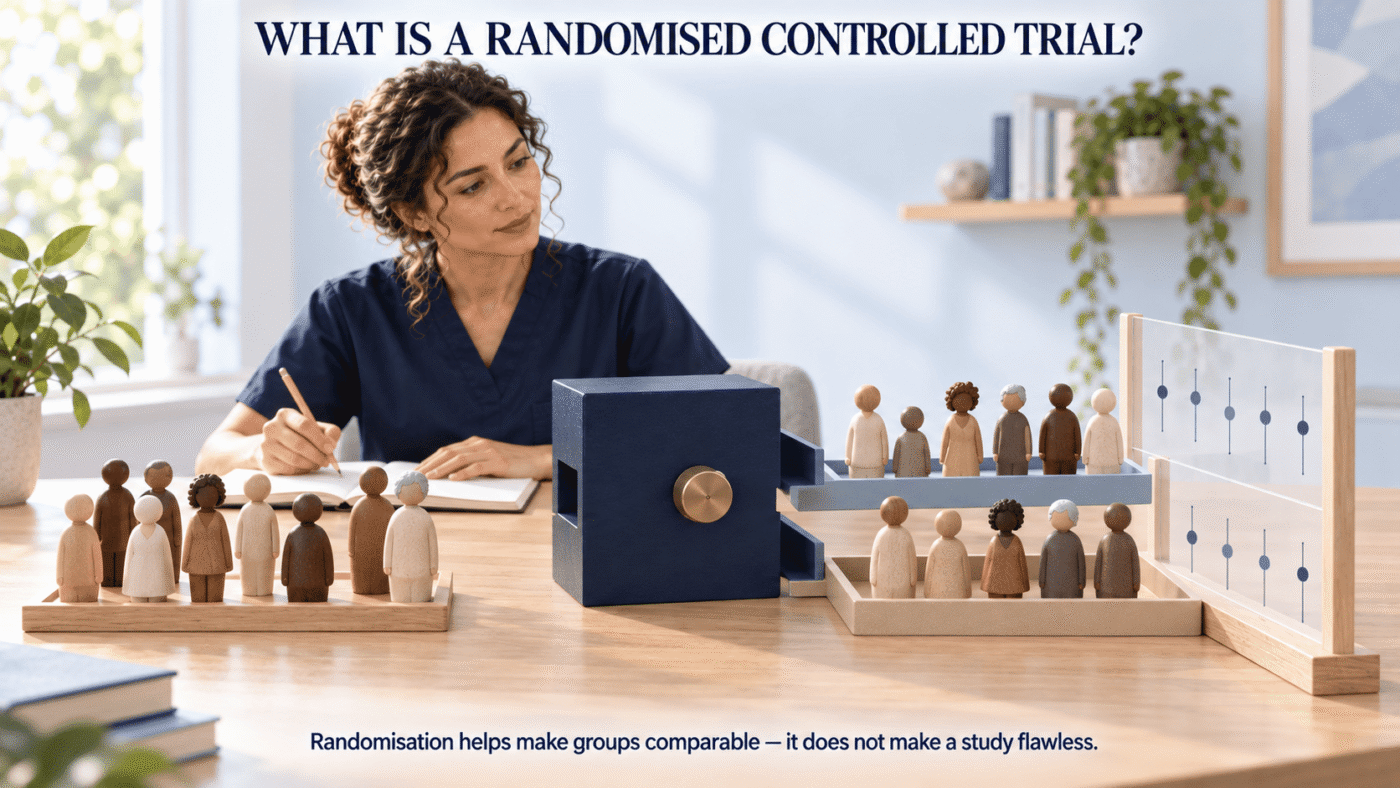
Randomisation means participants are assigned to groups using a random process rather than allowing the researcher or participant to simply choose the group.
Why?
Because without randomisation, the groups might be systematically different before treatment even begins. Imagine a therapist decides: “The healthier participants can go into the massage group.” And: “The more complicated cases can go into the comparison group.”
If the massage group later performs better, was it because of massage?
Or because that group had an advantage from the beginning?
Randomisation helps reduce this problem. With enough participants and good study design, random allocation helps make groups more comparable.
The goal is to create a fairer comparison.
The control part refers to having something to compare the intervention against. Suppose 70% of participants improve after massage.
Excellent.
But what if 68% improve with exercise?
Or 70% improve with usual care?
Or many improve over time regardless of the intervention?
Without a comparison, it’s difficult to know how much of the observed improvement can reasonably be attributed to the treatment being studied. People can improve for many reasons.
Natural recovery.
Changes in activity.
Expectations.
Other treatments.
Lifestyle changes.
Fluctuation in symptoms.
So researchers ask: “What happened compared with something else?” That’s much more informative than simply: “Did people feel better afterwards?”
Imagine 100 people with similar presentations enter a trial. Fifty are randomly allocated to one intervention. Fifty to another. Researchers then compare their outcomes.
Because allocation was random, we have a better chance of distributing important characteristics between the groups rather than deliberately placing certain people into one treatment.
Randomisation doesn’t guarantee perfectly identical groups. Chance can still create differences. But it reduces an important source of selection bias. That’s one reason well-designed RCTs can provide strong evidence when we’re asking questions about treatment effects.
This matters enormously. An RCT may report: “The intervention was effective.”
But effective at what?
Reducing pain?
Improving range of motion?
Increasing strength?
Improving sleep?
Returning people to work?
Changing a laboratory measurement?
An intervention could improve one outcome without meaningfully changing another. For example:
Pain decreases slightly.
But function doesn’t change.
Or range of motion improves immediately.
But the difference disappears later.
So whenever you read an RCT, ask: “What outcome did they actually measure?” Don’t let the word effective do all the thinking for you.
Researchers often use statistical tests to compare groups. You may see: p < 0.05 and conclude: “Excellent. It works.” Not so fast.
A statistically significant result doesn’t automatically mean the effect is large or clinically important. Imagine a treatment changes a pain score by a very small amount. The statistical analysis may detect a difference.
But would the patient actually notice or care about that difference?
That’s why we need to consider: Statistical significance and Clinical importance
They aren’t necessarily the same thing. Ask: “How large was the difference — and did it actually matter?”
*********
Blinding Can Make Trials Stronger
Another important concept is blinding. In some trials, participants may not know which treatment they’re receiving. Sometimes the people measuring outcomes can also be kept unaware of which group a participant belonged to.
This can help reduce certain forms of bias. But blinding becomes difficult with physical treatments. Imagine trying to conduct a massage trial and telling someone: “We’re not going to tell you whether you’re currently receiving a massage.”
They may have suspicions. The therapist also obviously knows whether they’re performing the treatment. This creates challenges for research into massage, exercise and many manual therapies.
It doesn’t make the research worthless. It simply means: We need to interpret the study with those limitations in mind.
This can dramatically change what a trial tells us. Imagine massage is compared with: No treatment. Now imagine massage is compared with: A well-designed exercise and education program.
Those are very different questions. A treatment may outperform doing very little but perform similarly to another active treatment. That doesn’t necessarily mean it “doesn’t work.”
It may mean several approaches produce similar outcomes. This is why reading only: “Massage was effective.” isn’t enough. Ask: “Compared with what?”
Sample size matters too. An RCT involving 18 people may provide useful preliminary information. But a small sample can produce uncertain estimates and results that may not generalise well.
Larger studies can often provide more precise estimates. But remember: Large doesn’t automatically mean good. A poorly designed trial involving thousands of people can still have serious problems. Study quality depends on much more than participant numbers.
Did Everyone Finish the Study?
People drop out of research.
Maybe the treatment was inconvenient.
Maybe symptoms changed.
Maybe they experienced adverse effects.
Maybe life simply happened.
Researchers need to account for this.
If many participants disappear from one group, the results can become harder to interpret. So another useful question is: “How many people completed the trial?” And: “What happened to those who didn’t?” The people missing from the final results may matter.
Suppose massage reduces pain immediately after treatment. Useful.
But what happens tomorrow?
Next week?
Three months later?
Different follow-up periods answer different questions. An immediate improvement tells us something about the short-term response. It doesn’t automatically tell us whether the intervention changes long-term outcomes.
This distinction matters particularly in manual therapy. Immediate change can be valuable without being permanent. We simply need to describe it accurately.
Not necessarily. This is one of the most important lessons. Suppose an RCT finds that a manual therapy intervention improves pain compared with a control.
Can we conclude: “It worked because the therapist broke up fascia.” No. Unless the study actually investigated and demonstrated that mechanism, the outcome doesn’t prove the explanation.
The trial may tell us: Something changed. It doesn’t automatically tell us: Exactly why it changed. Remember: An outcome doesn’t automatically prove the mechanism used to explain it.
No. One RCT contributes evidence. That’s different from providing the final answer. Another trial may produce a different result.
Another may study a different population.
Another may use a different treatment protocol.
Another may find that the effect is smaller.
This is why research eventually needs to be considered as a body of evidence, rather than selecting one study that supports what we already believe. One RCT can be important. But: One study isn’t the whole conversation.
When reading an RCT, consider:
- Who participated?
- How were participants randomised?
- What treatments were compared?
- Was allocation handled appropriately?
- Could participants or assessors be blinded?
- How many people dropped out?
- What outcomes were measured?
- How large were the effects?
- How long did researchers follow participants?
- Were adverse effects reported?
- Does the study population resemble the person we’re treating?
That’s a lot more useful than simply checking whether the paper contains the letters: RCT.
*********
What Does This Mean for Clinical Practice?
Suppose several good-quality RCTs suggest a treatment may help certain people with a particular condition. Excellent. That information can help guide treatment decisions. But evidence-based practice still requires us to combine that information with: Clinical expertise and Individual needs and preferences.
Then we assess the actual person.
Maybe the treatment is appropriate.
Maybe another approach fits better.
Maybe there are precautions.
Maybe the client doesn’t want that treatment.
Maybe the person’s presentation doesn’t resemble the population studied.
Research informs clinical reasoning. It doesn’t replace it.
When you encounter an RCT, start here:
1. Who was studied?
Does the population match the people we’re interested in?
2. What was the intervention compared with?No treatment? Usual care? Another active treatment?
3. What outcome changed?
Pain? Function? Range of motion? Something else?
4. How large and meaningful was the difference?
Not simply whether it was statistically significant.
5. How long did the effect last?
Immediate improvement and long-term improvement aren’t the same thing.
These five questions won’t tell you everything. But they’ll stop you from being impressed by the letters RCT alone.
Randomised controlled trials are powerful because they help researchers make fairer comparisons between interventions. They can reduce important forms of bias and help us estimate treatment effects.
But they still require careful interpretation. So when someone says: “There’s an RCT proving this treatment works.” Don’t immediately accept it. Don’t immediately dismiss it either.
Ask:
Who was studied?
Compared with what?
What changed?
By how much?
For how long?
A useful way to remember it is:
Randomise → Compare → Measure → Interpret
That’s the basic logic of an RCT.
The purpose isn’t to create certainty where none exists.
It’s to make the comparison more trustworthy.
And that brings us back to the question at the centre of this entire category:
How do we know?
Your Body Talks. Learn to Listen.
And if someone tells you: “This treatment is definitely proven because I found one RCT…” excellent. Now we know which paper we’re reading first.

Ask it. Even if you think it’s a ridiculous question.
Someone else has probably wondered exactly the same thing.
