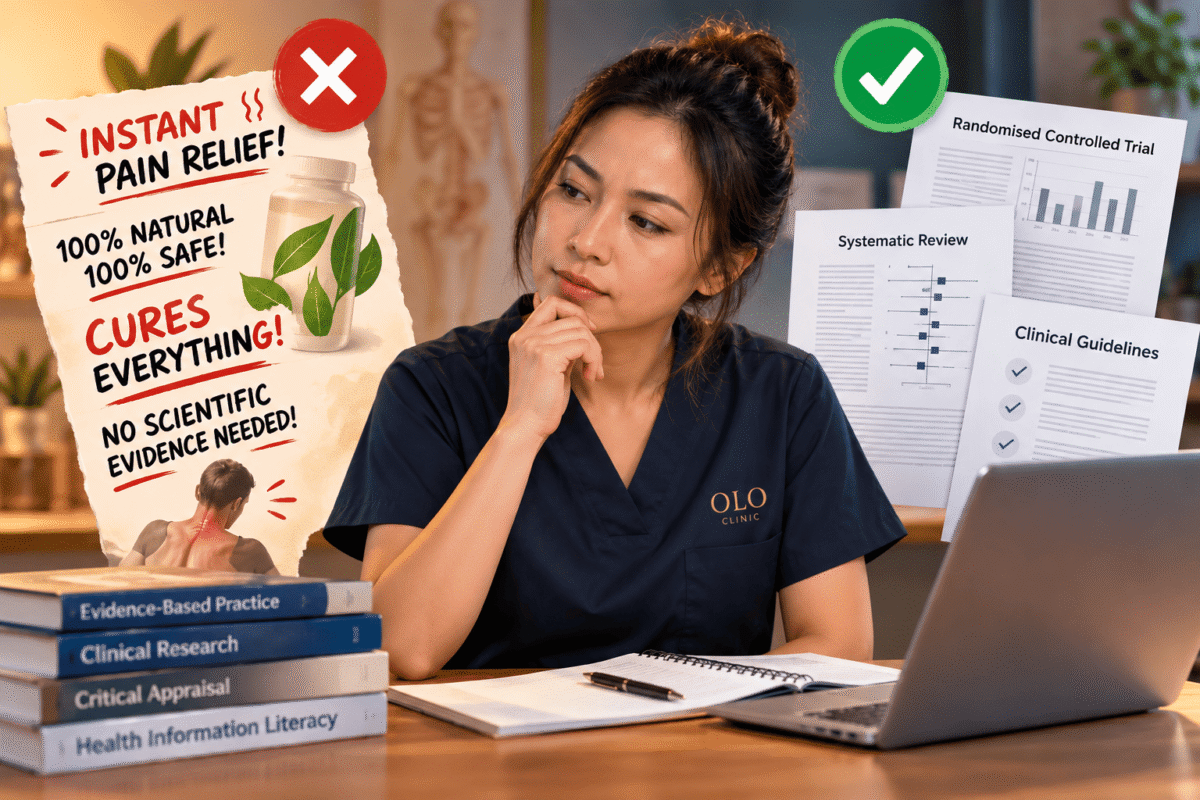
Doctors don’t want you to know this.
And, of course:
“This one technique fixes the root cause of pain.”
“Flush toxins from your body.”
“Scientifically proven.”
“Works for everyone.”
Health information has never been easier to find. Unfortunately, neither has health misinformation.
A professional-looking website, an anatomical diagram or someone wearing scrubs can make a claim sound convincing.
But sounding scientific and being supported by good evidence are not the same thing. So how can you tell the difference? You don’t need a medical degree. You need better questions.
Start With the Claim
Before looking at the evidence, identify exactly what someone is claiming. Consider: “Massage may help reduce pain for some people with low back pain.” Now compare it with: “Massage fixes the root cause of low back pain.”
Those statements are very different. The first is cautious and testable. The second makes a much larger claim.
What is the “root cause”?
How was it identified?
Was it actually changed?
Does this apply to every type of low back pain?
A useful rule is: The bigger the claim, the stronger the evidence should need to be.
Watch for words such as:
Always
Never
Guaranteed
Cure
Permanent
Instant
Everyone
Human health is rarely that cooperative. People differ. Conditions differ. Responses differ. And many symptoms have multiple contributing factors. Absolute language isn’t automatically false. But it should make you ask: “Can the evidence really support a claim this certain?”
This phrase appears everywhere. Scientifically proven. Clinically tested. Research-backed. Doctor recommended. Sounds excellent.
But where is the research?
A meaningful evidence claim should survive questions such as:
What study?
What type of study?
Who participated?
What was tested?
Compared with what?
What outcome changed?
How large was the effect?
How certain was the evidence?
One small study doesn’t automatically justify:
“Science proves it.”
Neither does putting a photograph of someone in a laboratory next to the product.
This is one of the most useful skills you can develop. Imagine a study finds that massage temporarily improves range of motion. Someone then claims: “This proves massage permanently breaks down fascial adhesions.” Wait. The study measured range of motion.
Did it actually measure fascial adhesions?
Did it demonstrate that they were broken down?
Did it measure permanent change?
If not, the explanation has travelled much further than the evidence. Remember: Evidence for an outcome is not automatically evidence for the mechanism used to explain it.
If pain decreased, we know something about pain. That alone doesn’t prove why it decreased.
Imagine research finds that people who sleep poorly tend to report more pain. Can we conclude: Poor sleep causes all their pain? No. The relationship may run in both directions. Pain may disrupt sleep. Sleep may influence pain sensitivity.
Stress, health conditions, activity and other factors may influence both. An association can be important. But: “These things are related” is not the same as: “This caused that.” Be particularly careful when a health headline quietly changes one into the other.
Suppose someone says: “90% of our clients improved after treatment.” Sounds excellent.
But improved compared with what?
What would have happened over time anyway?
Were they receiving other treatments?
Did activity change?
How was improvement measured?
How long did it last?
Who collected the information?
Without an appropriate comparison, it’s often difficult to know how much of the change should be attributed to the treatment itself. Before and after can be useful clinically. But: After doesn’t automatically mean because of.
*********
Testimonials Are Powerful and Limited
“I couldn’t walk without pain. After one treatment, I felt amazing.” That person’s experience may be completely genuine. Testimonials can tell us something important: Someone had a positive experience. But they can’t reliably tell us: Why they improved.
They also don’t tell us how many people received the same treatment and didn’t improve. Or became worse. Or experienced no change. This doesn’t make personal experience meaningless. It means: A story is evidence of an experience not proof of a universal treatment effect.
Before-and-after images can be persuasive. Posture looks straighter. Swelling looks reduced. Shoulders appear more level. Movement looks different. But photographs can change because of: Position. Lighting. Camera angle. Effort. Instructions. Timing. Natural variation.
A photograph can document something. It doesn’t automatically explain why it changed or whether the change is clinically meaningful. Ask: What exactly are we measuring? And: Does this change matter?
Your pain is caused by your posture. Your headache is caused by this muscle. Your back pain is caused by your pelvis being rotated. Your fatigue is caused by toxins. Your shoulder pain is caused by fascia. Simple explanations are attractive. Unfortunately, biology often isn’t simple.
Pain and health can be influenced by multiple factors: Tissue health. Previous injury. Physical capacity. Workload. Movement. Sleep. Stress. Medical conditions. Nervous system processes. Environment. Behaviour. And many others.
A single factor may sometimes be important. But be cautious when one explanation claims to account for nearly everything. Simple explanations can be useful. Oversimplified explanations can be misleading.
The phrase root cause is extremely persuasive. It suggests everyone else has been treating symptoms while this person has discovered the hidden answer. Sometimes identifying an underlying contributor is genuinely important.
But human health doesn’t always have one neat root cause. So when someone claims to treat the root cause, ask: How was the cause established? Not: “Does the explanation sound convincing?” But: “How do we know?”
Detox is another word that can sound medical while remaining remarkably vague.
What toxin?
How was it measured?
What concentration was present before treatment?
How does the proposed treatment remove it?
Where does it go?
Was it measured afterwards?
The body already has systems involved in processing and eliminating substances, including the liver, kidneys, lungs and gastrointestinal system. This doesn’t mean every use of the word “detoxification” is scientifically meaningless medical toxicology is very real.
But vague wellness claims about “flushing toxins” deserve much more specific evidence. If someone can’t identify the toxin, explaining how they removed it becomes rather difficult.
Consider: “This technique stimulates mechanoreceptors, releases fascia, improves lymphatic drainage, increases circulation and resets the nervous system.”
That’s a lot of biology in one sentence. Some of those concepts may relate to real physiological processes. But using real anatomical words doesn’t automatically make the entire explanation correct. This is sometimes how misleading health claims become convincing:
Take legitimate scientific terminology. Connect it with assumptions. Present the whole story with confidence. The question remains: Has the proposed mechanism actually been demonstrated? Scientific vocabulary is not a substitute for scientific evidence.
*********
Be Suspicious When One Treatment Fixes Everything
Pain. Fatigue. Poor sleep. Digestion. Headaches. Hormones. Posture. Inflammation. Immunity. Stress.
And apparently your personality by Thursday. One intervention may influence several outcomes.
That’s possible. But the broader the claimed benefits become, the more evidence we should expect.
If one technique supposedly fixes almost every unrelated condition, ask: What evidence supports each claim? Not: “Is there one study somewhere mentioning this treatment?” Different claims require different evidence.
Natural products and treatments can be useful. They can also have side effects. Interact with medication. Cause allergic reactions. Be inappropriate during pregnancy or certain health conditions.
Or simply not work. Likewise: Synthetic doesn’t automatically mean dangerous. Natural doesn’t automatically mean beneficial.
Those are marketing categories. Safety and effectiveness require evidence.
Almost any intervention capable of producing biological effects may also have unwanted effects under some circumstances. That doesn’t mean every treatment is dangerous.
It means responsible health information should acknowledge: Benefits. Risks. Limitations. Contraindications. Uncertainty.
When someone discusses only benefits and claims there are absolutely no risks, you’re probably receiving marketing rather than balanced health information.
A conflict of interest doesn’t automatically make a claim false. A therapist can accurately discuss a treatment they provide. A company can conduct useful research on its own product.
But you should know when the person making the claim benefits financially from you believing it. Ask:
Who is making the claim?
What are they selling?
What evidence are they using?
Are limitations discussed?
Are alternative explanations acknowledged?
The goal isn’t automatic distrust. It’s transparency.
Imagine 15 studies investigate a treatment. Three are positive. Twelve show uncertain, mixed or minimal effects. A promotional website discusses only the three positive studies.
Technically, they can say: “Research supports our treatment.” But they’re not showing you the whole picture. This is called cherry-picking.
Instead of asking: “Can I find a study supporting this?” ask: “What does the overall body of evidence suggest?” That’s one reason systematic reviews can be so valuable.
“This famous doctor recommends it.”
“This therapist has 25 years of experience.”
“Thousands of athletes use it.”
“This celebrity swears by it.”
Interesting. But none of those statements demonstrates that the treatment works. Expertise matters. Experience matters. But authority isn’t a replacement for evidence. Even experts can be wrong. Including us. That’s why one of the healthiest habits in clinical practice is: Be willing to be wrong.
*********
Look for Uncertainty
This may sound strange, but responsible health information often contains uncertainty. Words such as: May, Can, In some people, Evidence suggests, The mechanism remains uncertain, Further research is needed. These aren’t necessarily signs that someone doesn’t know what they’re talking about.
Sometimes they’re signs that the person understands the limits of the evidence. Compare: “Massage may provide short-term pain relief for some people.” with: “This technique permanently eliminates the underlying cause of pain.”
Which one sounds more exciting? Probably the second. Which one might better reflect uncertain evidence? Often the first. Confidence should match the evidence.
Critical thinking has another trap. Once people learn that research has limitations, they sometimes conclude: “You can’t trust any research.” That’s not the goal. Research isn’t perfect. Neither is clinical experience. Neither are testimonials. Neither is intuition. Critical thinking means evaluating information according to its strengths and limitations.
Not believing everything. Not rejecting everything. Instead:
Ask → Check → Compare → Interpret
When you encounter a health claim, ask:
1. What exactly is being claimed?
Is it specific enough to test?
2. How strong is the language?
Does the certainty match the evidence?
3. What evidence supports it?
A testimonial? One study? Several trials? A systematic review?
4. Does the evidence actually test the claim?
Outcome and mechanism are not the same thing.
5. Compared with what?
Improvement alone doesn’t establish treatment effect.
6. How large and meaningful was the effect?
Statistical significance isn’t enough.
7. What are the risks and limitations?
Balanced information should discuss both.
8. Who benefits from me believing this?
Financial interests don’t prove dishonesty, but transparency matters.
And finally: “How do we know?” That one question can dismantle an impressive amount of nonsense.
A treatment doesn’t need to: “flush toxins.” “reset the body.” “break up fascia.” “realign everything.” or “fix the root cause” to be useful.
Perhaps it reduces discomfort.
Perhaps it helps someone move more comfortably.
Perhaps it supports relaxation.
Perhaps it creates an opportunity to exercise.
Perhaps it doesn’t help this particular person.
Those outcomes can be evaluated without inventing a dramatic biological story. A treatment doesn’t need a magical explanation to have clinical value.
When you encounter a new health claim, try this:
Claim → Evidence → Quality → Meaning → Application
Claim
What exactly are they saying?
Evidence
What information supports it?
Quality
How trustworthy is that evidence?
Meaning
How large and clinically important is the effect?
Application
Does it actually apply to this person and situation?
This won’t eliminate uncertainty. That’s not the goal. It gives us a better way to work with uncertainty.
The internet doesn’t need more people shouting: “That’s misinformation!” without understanding the evidence themselves. We need people willing to ask better questions. Maybe the claim is supported. Maybe partly supported. Maybe exaggerated. Maybe we don’t have enough evidence yet.
Or maybe it’s complete nonsense wearing an anatomy diagram. Find out. The goal isn’t to win an argument. It’s to make better-informed health decisions. So when someone tells you: “This treatment has been scientifically proven to fix the root cause by detoxifying your fascia…” you don’t need to argue. You only need to ask: “Interesting. How do we know?” Then follow the evidence.
Your Body Talks. Learn to Listen.
And remember: If one treatment claims to fix your back pain, improve your digestion, balance your hormones, boost your immunity and transform your sleep…we may have accidentally wandered out of healthcare and into the marketing department.
Ask it. Even if you think it’s a ridiculous question.
Someone else has probably wondered exactly the same thing.
