
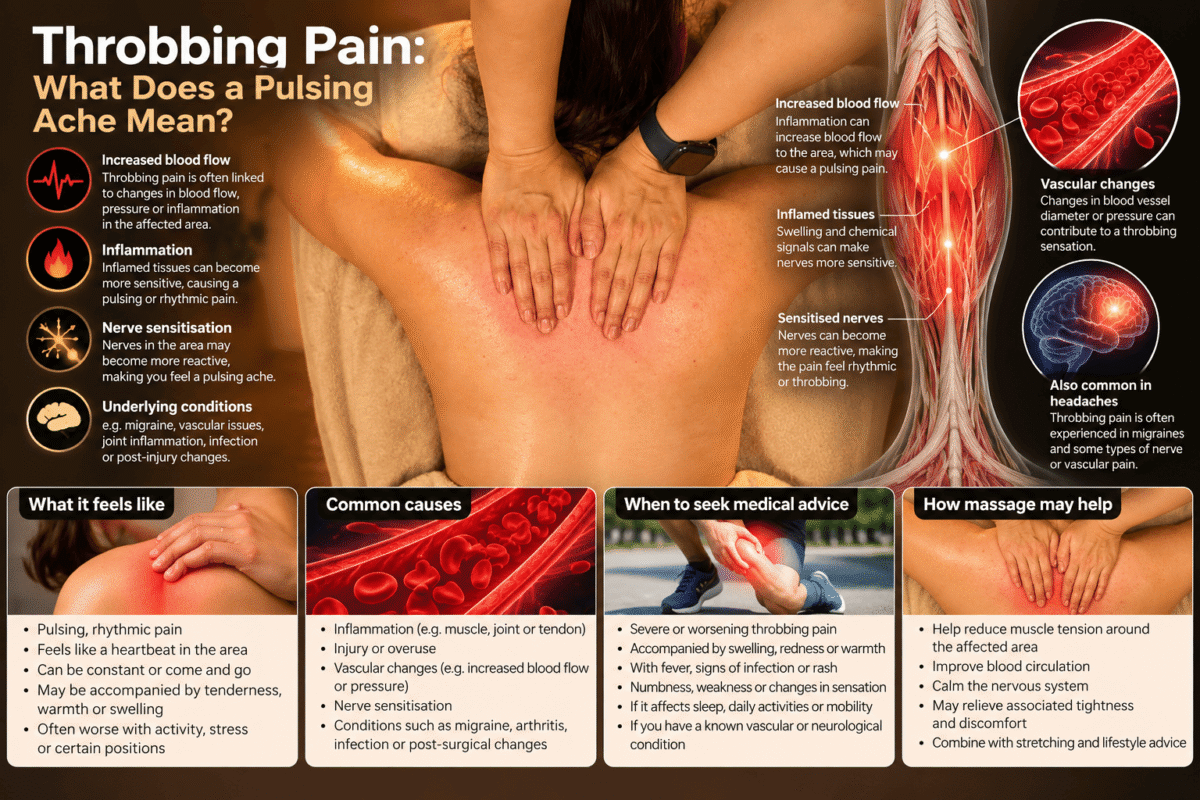
Throbbing Pain
What Does a Pulsing Ache Mean?
You may notice the pain in your head, an injured finger or a swollen joint. Sometimes it comes in waves; sometimes it feels as though it follows your pulse.
“It feels like it’s beating.”
As a therapist, I would ask where it is, when it started and what else is happening in that area. A throbbing feeling describes the pattern of pain. It does not prove that circulation is blocked, that inflammation is present or that massage will help.
What does throbbing pain feel like?
Throbbing pain rises and falls in intensity, often described as pulsing, pounding or beating. It can be mild or strong, brief or persistent.
When describing it, note:
- Where do you feel it head, tooth, muscle, joint or another area?
- Did it start suddenly or gradually?
- Is there swelling, redness, warmth or an injury?
- Does movement, bending over or activity change it?
- Are there other symptoms, such as fever, nausea or sensitivity to light?
The accompanying symptoms matter. For example, migraine often involves a throbbing headache and may also cause nausea or sensitivity to light and sound. That does not mean every throbbing headache is migraine.
What may cause throbbing pain?
There is no single cause. A headache, a recent injury, a painful joint or a dental problem may all be described as throbbing. An area that is also red, hot, swollen and painful raises different concerns from a familiar headache without those changes. Skin infection and some joint conditions require medical assessment rather than pressure over the painful spot.
It is easy to hear “pulsing” and conclude that massage should “improve circulation.” That skips the most important step: finding out why the area hurts. The rhythm of the pain alone cannot answer that question.
When should you seek medical care?
A sudden, severe headache needs emergency assessment. In Australia, call 000, particularly if a headache also comes with concerning symptoms such as confusion, vomiting, neck stiffness or changes in vision.
Seek prompt medical advice for a new red, hot, swollen joint, especially with fever, or painful skin that becomes increasingly red, warm and swollen. Do not wait for a massage appointment to assess these changes.
What are the treatment options?
Treatment follows the cause. A clinician may ask about the pain’s onset and other symptoms, examine the area and recommend care for the underlying problem. Migraine, a joint infection, an injury and toothache do not share one treatment simply because they all may throb.
If the pain is new or unusual, write down when it began, how long it lasts and what comes with it. That record can make an assessment more useful. For recurring pain, it also helps to track whether episodes are becoming more frequent, stronger or different from your usual pattern.
Can massage help throbbing pain?
Massage may help some people with certain musculoskeletal pain conditions, but the evidence varies and any benefit may be short term. Research on massage for headaches remains preliminary. Massage is not a treatment for every type of throbbing pain.
A therapist should avoid working directly over an unexplained hot, swollen or acutely injured area. If your throbbing pain has already been assessed and massage is suitable for associated muscle discomfort, treatment should remain comfortable and be adjusted if symptoms increase.
From the therapist: “The fact that it throbs tells me how it feels. The location, timing and other symptoms tell us what needs attention.”
Your Body Talks. Learn to Listen.
Throbbing describes a pain pattern, not its cause. Assess new or concerning symptoms first; consider massage only when the presentation makes it appropriate.

Ask it. Even if you think it’s a ridiculous question.
Someone else has probably wondered exactly the same thing.
