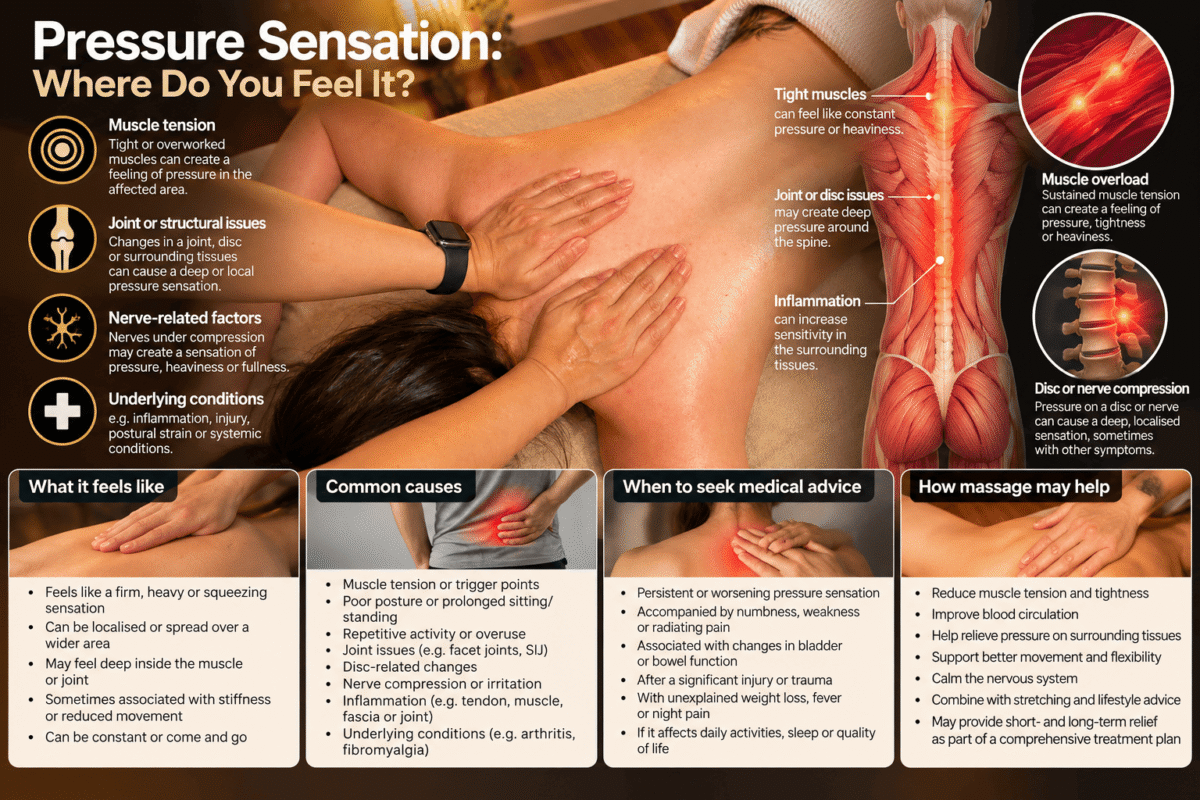
Pressure Sensation
Where Do You Feel It?
If that pressure is across your shoulders after a long day, we might discuss movement and muscle discomfort. If it is in your chest, the conversation changes immediately.
“It feels like something is pressing on me.”
Pressure is a description of how something feels not a diagnosis. As a therapist, the first question I need answered is where you feel it. Then I need to know when it began, whether it is getting worse and what other symptoms came with it.
What does a pressure sensation feel like?
People may describe pressure as heaviness, tightness, squeezing, fullness or a band around an area. It might be constant, come in episodes or appear during a specific activity.
To describe it more clearly, notice:
- Location: Chest, head, face, jaw, limb or another area?
- Onset: Did it begin suddenly or gradually?
- Pattern: Does it stay, return or increase with activity?
- Spread: Does it move to the arm, back, neck or jaw?
- Other symptoms: Is there breathlessness, dizziness, nausea, fever or weakness?
Those details matter more than the word pressure on its own. For example, a tension-type headache can feel like pressure around the head, while a heart attack can involve pressure or squeezing in the chest.
What may cause a pressure sensation?
The possibilities depend heavily on the body area. Pressure around the head can occur with a tension-type headache. Facial pressure alongside a blocked or runny nose may occur with sinusitis. A sense of heaviness around a sore muscle may have another explanation that needs to be considered in the context of activity and examination.
Chest pressure must be treated differently. Heart-related problems can feel like tightness, squeezing or heaviness rather than a sharp pain. They may also involve shortness of breath, sweating, nausea, dizziness or discomfort in the arm, back, neck or jaw. It is unsafe to assume that chest pressure is “just a tight muscle.”
When should you seek urgent help?
In Australia, call 000 for an ambulance if chest pain or pressure is severe, worsening or lasts 10 minutes. Do not wait for a massage appointment to see whether it improves.
A sudden, severe headache, particularly with confusion, vomiting, neck stiffness or a change in vision, also needs emergency assessment.
What are the treatment options?
Treatment follows the cause. A clinician may ask about the location and timing, examine the relevant area and decide whether further testing is needed. Approaches for a tension-type headache, sinusitis and chest pressure are not interchangeable.
For a familiar, mild head-pressure pattern, options may include rest and other measures recommended by a health professional. For new or changing symptoms, the useful next step is an assessment not a guess based on where you feel “tight.”
Can massage help a pressure sensation?
Sometimes, after the cause and safety of treatment have been considered. Gentle massage may help some people who experience familiar muscle discomfort or a tension-type headache. However, evidence for massage in headache treatment is still limited, and any benefit should be judged by your own response.
Massage is not a way to test or treat unexplained chest pressure. If that symptom appears before or during a session, treatment should stop so you can get appropriate medical help.
From the therapist: “When you say ‘pressure,’ show me where. The location can change our decision from adapting a massage to seeking urgent care.”
Your Body Talks. Learn to Listen.
Pressure sensation has many possible meanings. Identify its location, onset and accompanying symptoms before choosing treatment.
Ask it. Even if you think it’s a ridiculous question.
Someone else has probably wondered exactly the same thing.
