
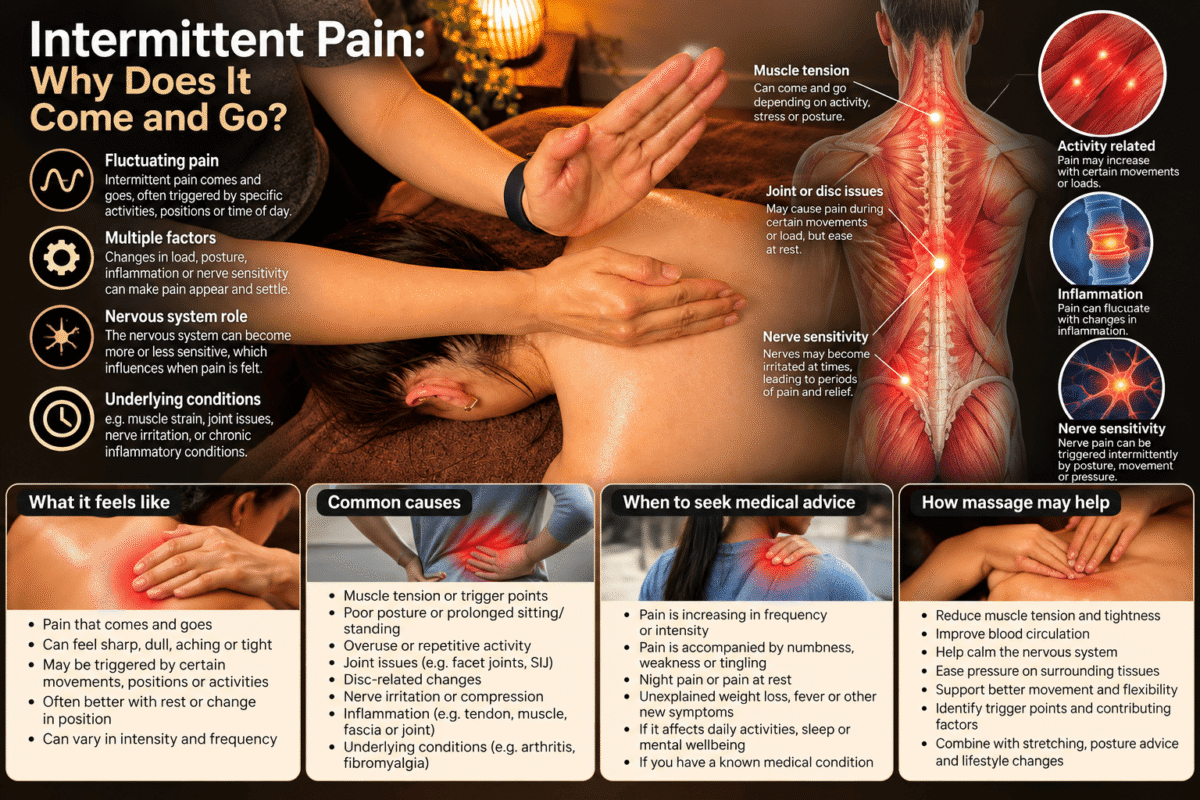
Intermittent Pain
Why Does It Come and Go?
By the time you reach an appointment, the pain may have disappeared. That does not make the experience less important. In fact, what brings it on and what makes it stop may be the most useful clues.
“It doesn’t hurt right now. It only happens when I walk.”
As a therapist, I would ask you to describe an episode rather than only show me where it hurts. Intermittent pain is a pattern over time not a diagnosis or a sign that nothing is wrong.
What does intermittent pain feel like?
Intermittent pain appears in episodes, with periods of less pain or no pain between them. An episode might last seconds, minutes or longer. It may recur with a movement, an activity or without a trigger you can identify.
Try to note:
- What were you doing when it began?
- How long did it last?
- Did it stop when you changed position or rested?
- Does it happen in the same place each time?
- Are episodes becoming more frequent or more intense?
- Do other symptoms occur with it?
A short record on your phone can be useful if the pain is absent when you see a health professional. “Every time I walk uphill, my calf hurts and settles when I stop” gives more information than “my leg hurts sometimes.”
What may cause intermittent pain?
There are many possibilities, and location changes the meaning of the pattern. Some musculoskeletal symptoms recur with particular movements or loads. However, leg pain that reliably appears with walking and settles with rest can also occur when blood flow to the leg is reduced. Healthdirect advises seeing a doctor for that pattern.
Chest discomfort that comes on during physical activity and improves with rest may be angina, a sign of a heart problem. Recurrent abdominal pain also deserves medical assessment. The fact that pain stops between episodes does not rule out a condition that needs care.
When should you seek medical help?
Do not treat recurring chest discomfort as a muscle problem. See a doctor if chest tightness comes and goes, even if it settles quickly. In Australia, call 000 if it is severe, worsening or lasts 10 minutes.
Arrange an assessment if intermittent pain is becoming more frequent, limits your activity, or follows a reliable pattern such as leg pain with walking that improves with rest. If a limb becomes numb, white or cold, call 000.
What are the treatment options?
Treatment depends on what is causing the episodes. A clinician may ask you to recreate the history of a typical episode, examine the relevant area and decide whether further investigation is needed.
For a musculoskeletal problem, management might involve changing an aggravating activity and gradually building capacity. A circulation or heart problem requires a different medical plan. Choosing a treatment before understanding the pattern can send care in the wrong direction.
Track a meaningful measure over time: How far can you walk before symptoms begin? Which movement brings them on? How quickly do they settle? That information helps assess whether a plan is working.
Can massage help intermittent pain?
Massage may be useful for some musculoskeletal pain conditions, although evidence is mixed and relief may be short term. A comfortable massage between episodes does not establish the cause of the pain.
Before treatment, a therapist should ask what triggers the symptoms. If pain appears in the chest with exertion, or calf pain reliably starts after walking and settles with rest, medical assessment should come before massage. When the presentation is suitable for massage, the therapist can agree on a functional goal and check whether episodes change afterward.
From the therapist: “The fact that it stops is part of the story. Tell me exactly what starts it and what makes it go away.”
Your Body Talks. Learn to Listen.
Pain that comes and goes can still be important. Its trigger, location and response to rest often tell us more than how the area feels between episodes.

Ask it. Even if you think it’s a ridiculous question.
Someone else has probably wondered exactly the same thing.
