Spinal and Cranial Nerves
Where Is That Sensation Coming From?
The honest answer is: we need more information first. A symptom in your finger could relate to a nerve farther up the arm, a nerve root near the neck, or another health issue. The place where you feel a symptom is not always the place where it begins.
“My little finger keeps going numb. Should you massage my hand or my neck?”
The same principle applies to pain travelling down a leg or an unusual sensation on the face. Understanding the difference between spinal nerves and cranial nerves helps us ask better questions before choosing treatment.
What are spinal and cranial nerves?
Nerves carry information between the body and the central nervous system. Some help you feel touch, temperature and pain. Others help control movement.
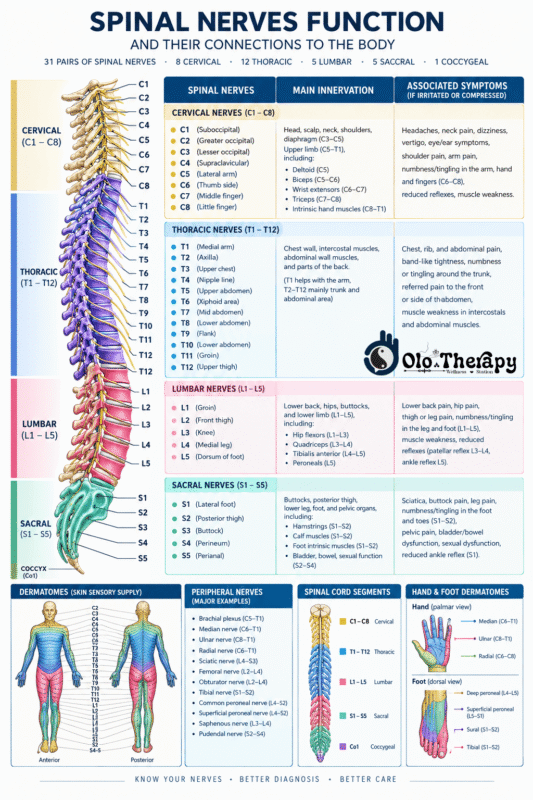
- Spinal nerves connect with the spinal cord. Their branches serve areas of the trunk, arms and legs. There are 31 pairs, including eight cervical nerve pairs, C1–C8, even though the neck has only seven cervical vertebrae.
- Cranial nerves are 12 pairs associated with the brain. Among their functions are facial sensation and movement, vision, hearing, balance, taste and swallowing. Their roles are not limited entirely to the face; the vagus nerve also extends to organs in the chest and abdomen.
For an arm or leg complaint, we usually consider spinal nerve roots and peripheral nerves. For facial sensation or facial movement, cranial nerves may be relevant. A knee symptom is not mapped to a cranial nerve.
Why does the path of a symptom matter?
Imagine two people who both say, “My fingers are numb.”
One has numbness mainly in the ring and little fingers, with symptoms near the elbow. That pattern may lead a clinician to consider the ulnar nerve. Another has neck pain with symptoms travelling down the arm; that history may prompt an assessment of the cervical nerve roots. Neither pattern proves a diagnosis on its own.
C8 matters, particularly when considering sensation toward the little-finger side of the hand and some finger movements. However, a diagram assigning one finger to exactly one nerve root is too neat for real clinical use. Nerve-root territories and peripheral-nerve territories are different maps, and symptoms must be checked against strength, sensation and the full history.
A similar question arises with leg pain. If someone feels pain around the knee, we assess the knee but may also need to consider the hip or lower back. Pain felt at the knee can sometimes be referred from those areas.
What happens during an assessment?
A therapist should begin by listening to what changed, rather than immediately pressing where it hurts. Useful questions include:
- Where did the symptom begin, and where does it travel?
- Is it pain, numbness, tingling, burning or weakness?
- Did it start suddenly or gradually?
- Does a position or movement change it?
- Are you losing the ability to grip, walk or perform a familiar task?
Depending on their training and scope of practice, a clinician may then check movement, sensation and strength. These findings help determine whether hands-on treatment is suitable or whether a medical assessment is needed. A sensory map provides a clue; it does not identify the exact site of a problem by itself.
What are the treatment options and where does massage fit?
Treatment depends on the cause. A nerve symptom may need medical assessment, physiotherapy, changes to aggravating activities or another form of care. For example, treatment for sciatica may involve exercise and physiotherapy, medicines or, in selected severe cases, other medical procedures.
Massage may help with associated muscle discomfort when an assessment indicates that it is appropriate. It cannot confirm which nerve is involved, “put a nerve back in place” or replace treatment for progressive weakness. The useful question is whether treatment improves comfort and function without worsening the nerve symptoms.
From the therapist: “Show me the whole path of the symptom. I want to know where it starts, where it ends and whether anything feels weaker not just which spot is sore.”
When should you seek urgent help?
Sudden facial drooping, one-sided arm or leg weakness or numbness, or difficulty speaking may be signs of a stroke. Call emergency services immediately 000 in Australia. These symptoms need urgent care even if they begin to improve.
For symptoms that develop more gradually, arrange an assessment if numbness persists, spreads or is accompanied by weakness. Do not keep increasing massage pressure to test whether a nerve symptom will disappear.
Your Body Talks. Learn to Listen.
The nerve map helps us ask better questions. The pattern of symptoms, movement and strength determines what should happen next.
Ask it. Even if you think it’s a ridiculous question.
Someone else has probably wondered exactly the same thing.
