
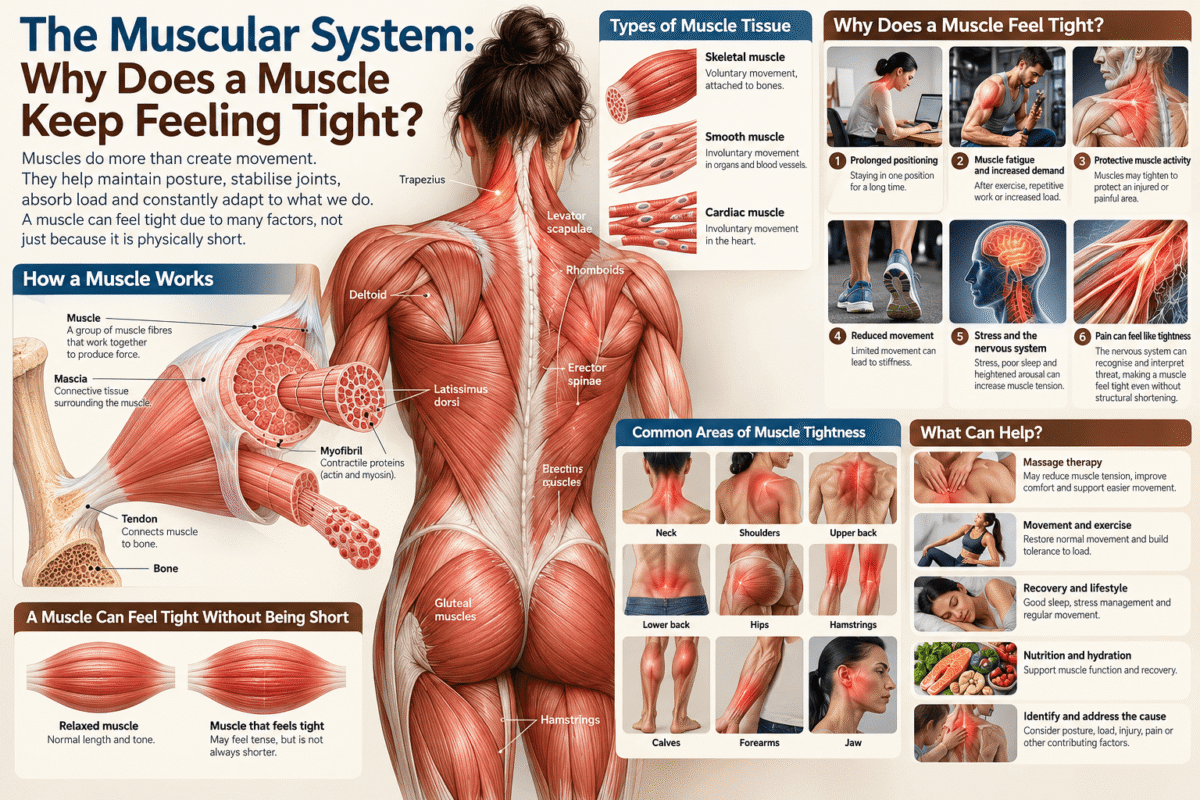
The Muscular System
Why Does a Muscle Keep Feeling Tight?
That does not necessarily mean you failed to stretch enough. The feeling may change with exercise, fatigue, a position you spend time in, or how your body responds to a movement.
“My hamstrings feel tight, so I stretch them. A few hours later, they feel tight again.”
As a therapist, I want to know what you can do, what brings on the feeling and whether strength or movement has changed. The muscular system helps create and control movement. Understanding how muscles attach and work together is more useful than assuming every tight or tender area needs harder pressure.
What is the muscular system?
Your body has three types of muscle tissue: skeletal, smooth and cardiac muscle. This article focuses on skeletal muscles the muscles involved in movements such as walking, lifting and turning your head. They work with bones, joints, tendons and the nervous system. Tendons connect muscle to bone.
A muscle can generate force by contracting. However, movement is rarely the job of one muscle alone. While some muscles produce a movement, others assist, control its speed or help stabilise the body.
Why do origin and insertion matter?
Origin and insertion describe a muscle’s attachments. In a basic anatomy description, the origin is the more stable attachment during a particular movement, while the insertion is the attachment that moves. These terms help us understand where a muscle can apply force and which joint movements it may influence. In real tasks, which end is stabilised can change.
Consider the front of your thigh. Its muscles help straighten the knee, so knowing their attachments and actions helps a therapist ask whether pain changes when you climb stairs, stand from a chair or straighten your leg against resistance.
But the anatomy is only a starting point. Pain near a muscle’s attachment does not prove that muscle is the cause. The joint, tendon, nearby tissues or another source may also need consideration.
What questions help us understand muscle symptoms?
If you say a muscle is “tight,” “weak” or “sore,” a useful assessment asks:
- When did it start? After unfamiliar exercise, an injury or gradually?
- What brings it on? Stretching, contracting, walking or resting?
- What can you still do? Has your strength or range of movement changed?
- What do you notice afterward? Does the symptom settle or last into the next day?
- Is there anything else? Swelling, bruising, numbness or pain that travels?
Muscle aches may follow overuse, physically demanding work or injury, but they can also occur with illness or other conditions. A tender spot and a description of tightness are therefore findings to interpret, not complete diagnoses.
What are the treatment options?
The plan depends on the problem. A recent injury may need protection and assessment. Discomfort linked to an activity may call for a change in workload followed by a gradual return to movement. If the goal is to tolerate more activity, strengthening and appropriate exercise may matter more over time than repeatedly treating the same sore spot.
Progress should be checked against something practical: Can you climb stairs more comfortably? Lift the same object with better control? Return to exercise without a prolonged flare-up?
Seek medical assessment for severe pain that does not improve, a significant injury or a notable loss of function. After intense exercise, muscle pain with marked swelling, weakness and dark urine needs urgent medical care.
Can massage help?
Massage may provide short-term relief for some musculoskeletal pain. It can be useful when it helps you move more comfortably or engage with a broader recovery plan. However, the evidence varies, and massage cannot tell us from touch alone which muscle is “the problem.”
A therapist should match pressure to your response and reassess the task that brought you in. If a hamstring feels better on the table but the same activity brings back the same complaint, we need to look again at the activity, strength, load and other possible contributors.
From the therapist: “Knowing where a muscle attaches tells me what it can do. Knowing what happens when you move tells me why that anatomy matters to your care.”
Your Body Talks. Learn to Listen.
Muscles work as part of a system. Origin and insertion help explain movement, while your symptoms and function guide what should be assessed and treated.

Ask it. Even if you think it’s a ridiculous question.
Someone else has probably wondered exactly the same thing.
