
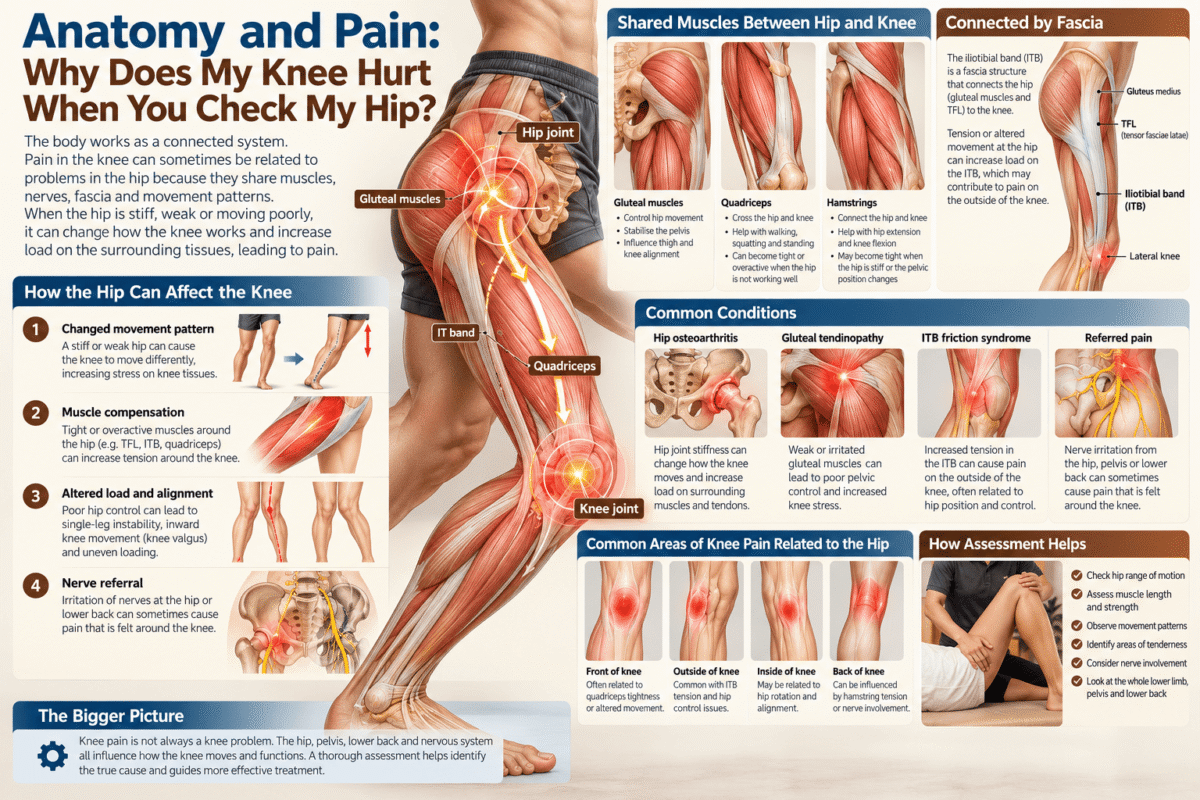
Anatomy and Pain
Why Does My Knee Hurt When You Check My Hip?
It is a fair question. When one place hurts, you naturally expect the assessment and treatment to focus there. Yet your knee does not work alone. Your hip, ankle, muscles, joints and nerves all play a part when you walk, climb stairs or exercise.
“My knee hurts. Why are you looking at my hip?”
Anatomy is a map of these structures and their connections. It helps a therapist ask better questions. However, the map alone cannot tell us exactly why you are in pain.
What structures are involved in movement?
Bones provide support, and joints allow movement. Muscles create force; tendons connect muscles to bones, while ligaments help support joints. Nerves carry information between the body and nervous system. Because these structures work together, a change in how you move one area can affect what you feel elsewhere.
Consider going down stairs. Your knee bends, but your hip and ankle also move and help control the task. If your knee hurts during that movement, a therapist may look at the whole activity before deciding what deserves attention.
Does pain show exactly which structure is injured?
No. The location of pain is a clue, not a diagnosis. Pain can occur with injury, but the experience of pain does not always reveal the type or extent of tissue damage. Likewise, feeling tight does not automatically mean a muscle needs stretching or deep massage.
This is why an assessment begins with your experience: When did the pain start? Was there an injury? Which movements bring it on? What makes it easier? Does it affect walking, sleep or exercise?
The answers help guide the next steps. They also help identify when an examination by another health professional would be more appropriate.
What should a therapist look at?
For knee pain, a therapist might observe how you walk, squat or step down. They may also ask about your hip, ankle and back, and check which movements you can perform comfortably. The aim is to understand what changes your symptoms and what you need to return to doing, rather than assume every painful knee has the same cause.
Tell your therapist if you also have numbness, tingling, weakness, swelling or a recent injury. Those details can change the assessment and the choice of care.
Where does massage fit?
Massage may help some people manage pain or feel more comfortable moving. Its benefit varies by person and condition, and the evidence does not support treating it as a way to identify or repair every underlying problem. A useful session should respond to your symptoms and goals, with pressure adjusted through conversation.
Depending on the findings, your options may also include modifying an aggravating activity, gradually returning to movement, or seeking assessment from a physiotherapist or doctor. If pain follows a significant injury, you cannot bear weight, or you develop new weakness or loss of sensation, seek medical assessment promptly.
From a therapist: “Tell me where it hurts, then show me what you were trying to do when it started. Both pieces of information matter.”
Your Body Talks. Learn to Listen.
Anatomy helps us understand how body parts connect. Your symptoms, movement and history help us decide which connections matter for you.

Ask it. Even if you think it’s a ridiculous question.
Someone else has probably wondered exactly the same thing.
