
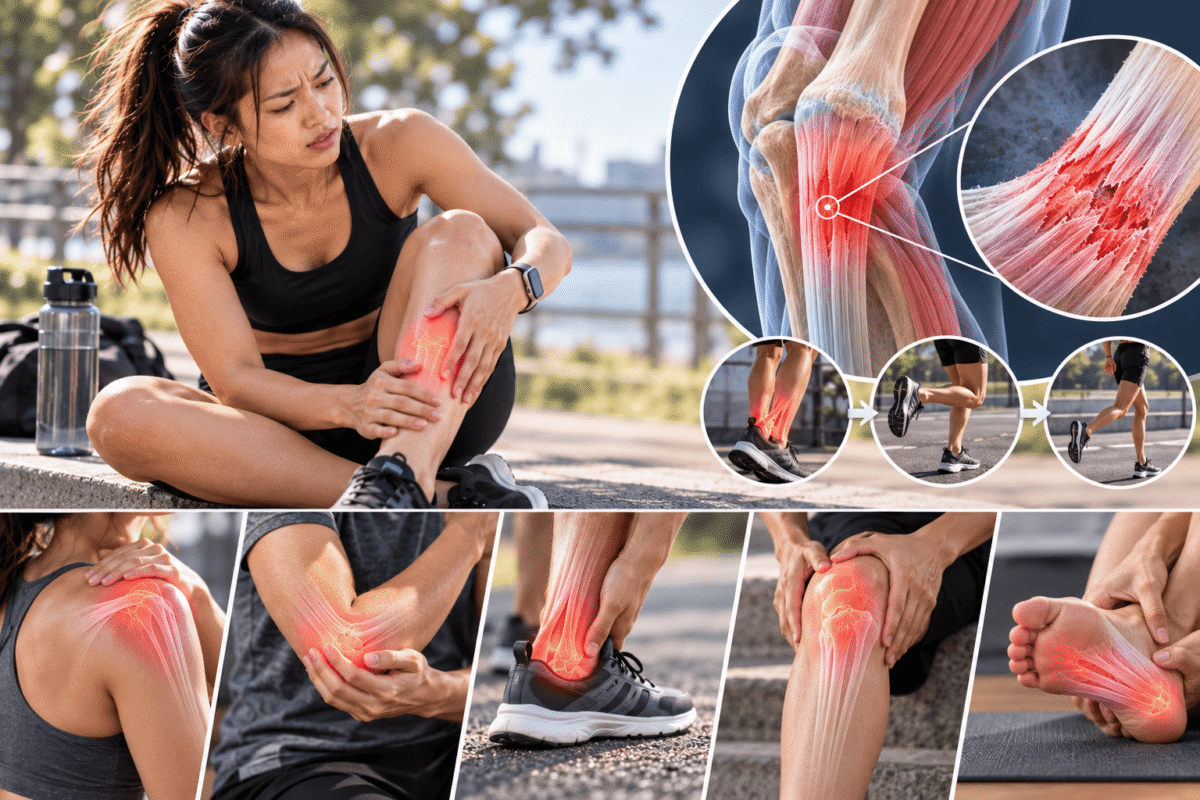
Tendinopathy
Example Case
A 42-year-old recreational runner visits the clinic with recurring pain around the Achilles tendon.
Initially, the discomfort appeared only after running. However, over the past few weeks, morning stiffness has become more noticeable, especially after longer training sessions.
“Every morning, the back of my heel feels stiff and painful when I take my first few steps. But after walking around for a while, it gets better. The strange thing is, whenever I go running, the pain comes back later. Does that mean my tendon is damaged?”
There was no sudden injury or accident. So, why does movement sometimes relieve the pain while repeated exercise makes it worse? That is the first clue.
Subjective Symptoms
The client reports:
- Pain around the Achilles tendon
- Stiffness during the first steps in the morning
- Discomfort at the beginning of running
- Temporary improvement after warming up
- Increased soreness after longer training sessions
- Gradually worsening symptoms without a specific injury
Interestingly, the client can still run. However, being able to continue an activity does not necessarily mean the tendon is tolerating the load well.
What It May Feel Like
People with tendinopathy may notice:
- Localised pain around a tendon
- Morning stiffness or discomfort after rest
- Pain when loading the affected area
- Tenderness when touching the tendon
- Reduced strength or movement confidence
- Symptoms that temporarily improve with activity
- Increased soreness later or the following day
These symptoms can occur in different regions, including the Achilles tendon, patellar tendon, shoulder and elbow tendons. Nevertheless, symptoms vary depending on the tendon involved.
Objective Findings
During assessment, the therapist may identify:
- Local tenderness around the affected tendon
- Pain reproduced during resisted muscle activity
- Reduced tolerance to repetitive loading
- Changes in strength or functional performance
- Possible local tendon thickening
- Reduced performance during tasks such as repeated heel raises
In this case, the client’s pain increases during repeated single-leg heel raises. Meanwhile, ankle movement remains relatively comfortable without significant loading.
This suggests that the problem may be related to how the tendon responds to force rather than movement alone.
*********
What Could It Be Related To?
Tendons connect muscles to bones and transmit force during movement.
Tendinopathy describes a clinical condition involving tendon-related pain and reduced function. In many cases, symptoms develop when the tendon struggles to adapt to repeated or changing physical demands. Possible mechanisms include:
- Changes in tendon structure
- Altered responses to mechanical loading
- Increased local pain sensitivity
- Reduced tolerance to repetitive activity
- Changes in muscle strength and tendon function
Although tendinopathy was traditionally described as tendinitis, persistent tendon pain is not simply explained by inflammation alone. Importantly, pain does not necessarily mean the tendon is torn or permanently damaged.
Possible factors include:
- Sudden increases in running or exercise volume
- Repetitive jumping, lifting or gripping
- Insufficient recovery between demanding sessions
- Reduced muscle strength or conditioning
- Changes in footwear or training surfaces
- Previous tendon problems
- Age-related, metabolic or medical factors
For example, increasing running distance too quickly may place unfamiliar demands on the Achilles tendon. However, excessive loading is not the only concern. Prolonged inactivity can also reduce physical capacity.
Therefore, finding the right amount of loading is often more important than simply avoiding movement.
The assessment aims to determine:
- Which activities reproduce tendon pain
- How much load the tendon currently tolerates
- Whether strength or function is reduced
- How symptoms change after activity
- Whether the presentation fits tendinopathy or another condition
- Whether further investigation is required
The therapist also wants to understand the relationship between training and recovery. For instance, does the pain settle after a short walk but return following a longer run?
The goal is not simply to identify where it hurts, but to understand what the tendon can currently tolerate.
Management may include:
- Temporarily reducing aggravating activities
- Maintaining comfortable daily movement
- Progressive resistance exercises
- Gradually increasing tendon-loading capacity
- Improving muscle strength and endurance
- Reviewing training frequency and recovery
- Manual therapy for short-term symptom relief when appropriate
- Reassessing pain and function over time
Initially, the client may need to reduce running distance or intensity while beginning an appropriate strengthening programme. As tolerance improves, resistance, repetitions and functional activities can gradually increase.
Eventually, running can be progressively reintroduced according to symptoms and performance. However, manual therapy alone is unlikely to restore long-term tendon capacity. The real treatment goal is to rebuild the ability to tolerate force.
How Does It Usually Recover?
Many people with tendinopathy improve through a combination of appropriate load management, progressive strengthening and sufficient recovery. Nevertheless, tendon rehabilitation often takes longer than expected.
For example, Achilles tendinopathy may require several months of consistent rehabilitation, and some cases take 3–12 months or longer. Recovery varies considerably depending on the tendon, symptom duration and individual circumstances. At first, symptoms may improve simply by reducing activities that provoke pain.
However, feeling better after rest does not necessarily mean that the tendon is ready for full activity. Therefore, strengthening and gradual reloading are important parts of rebuilding tolerance. Over time, successful recovery means returning to:
- Walking without persistent stiffness
- Climbing stairs comfortably
- Running or exercising with confidence
- Working without recurring tendon pain
- Managing normal physical demands
Some discomfort during rehabilitation may be acceptable, depending on the condition and exercise plan. However, substantial or prolonged worsening after activity suggests that the load may need adjustment.
Sudden severe pain or a popping sensation, major loss of strength, inability to bear weight or push off, or significant swelling requires prompt medical assessment to exclude a tendon rupture or other injury.
Your Body Talks. Learn to Listen.
Pain is not always a warning that something is tearing. Sometimes, it reflects a mismatch between what your body can tolerate and what you are asking it to do.
Rest may reduce the irritation.
Movement may restore confidence.
But lasting recovery often requires something more. Don’t just wait for the pain to disappear. Build the strength to keep it from controlling your life.

Ask it. Even if you think it’s a ridiculous question.
Someone else has probably wondered exactly the same thing.
