Case Study

Learning Through Clinical Cases

Theory becomes more useful when we can see how it applies to a real clinical situation.

Case studies allow us to follow the process from a person’s symptoms and history through assessment, clinical reasoning, treatment decisions and reassessment.
Their purpose is not to demonstrate a “perfect treatment,” but to show how information can be interpreted and decisions can evolve over time.

A case study cannot prove that a treatment will work for everyone. Instead, it provides a practical opportunity to examine clinical reasoning and learn from individual responses.

From Presentation to Outcome

Two people reporting the same area of pain may require very different approaches.

A useful case study therefore considers more than the diagnosis. It examines symptoms, functional limitations, relevant history, assessment findings, treatment goals, interventions and measurable changes.

What You Need to Understand

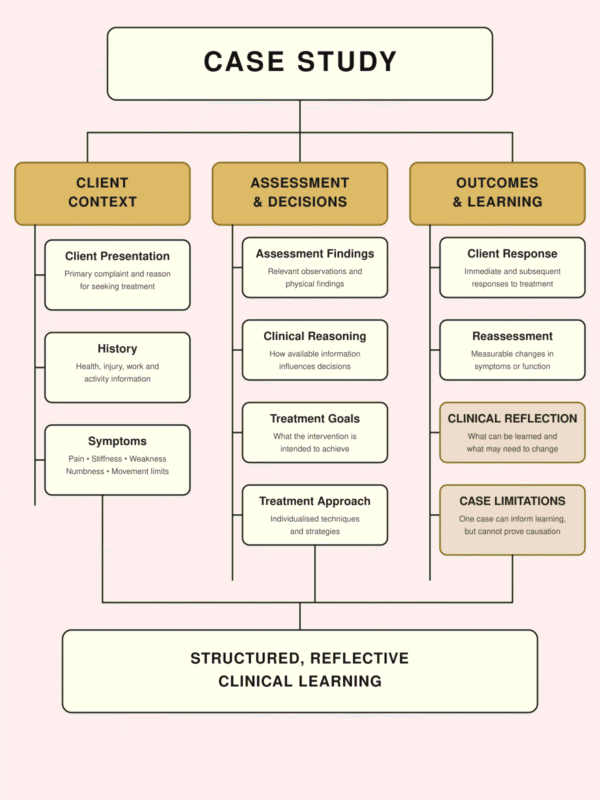
Client Presentation — the primary complaint and reason for seeking treatment
History — relevant health, injury, work and activity information
Symptoms — pain, stiffness, weakness, numbness or movement limitations
Assessment Findings — relevant observations and physical findings
Clinical Reasoning — how available information influences decisions
Treatment Goals — defining what the intervention is intended to achieve
Treatment Approach — techniques and strategies selected for the individual
Client Response — immediate and subsequent responses to treatment
Reassessment — identifying measurable changes in symptoms or function
Clinical Reflection — what can be learned and what may need to change


Build Your Understanding

Case studies connect anatomy, pain, assessment, treatment, movement and recovery in one place.

Explore Case Studies

Explore the cases below to see how clinical information can be organised, interpreted and reassessed — while recognising that every person and clinical presentation is different.

Explore Case Studies →