Most of us know these words.
Bones.
Muscles.
Joints.
But have you ever wondered how they actually work together every time you stand up, turn your head, lift a coffee cup or walk across the room?
That’s the musculoskeletal system at work.
And it’s much more connected than it first appears.
It’s Not Just Muscles and Bones
Your musculoskeletal system includes your:
Bones — providing structure and support.
Muscles — producing force and helping create movement.
Joints — allowing movement between bones.
Tendons — connecting muscles to bones.
Ligaments — helping connect and stabilise bones around joints.
Fascia and other connective tissues — supporting and connecting structures throughout the body. None of these works completely alone.
When you lift your arm, for example, it isn’t simply one shoulder muscle pulling one bone. Multiple muscles, joints and tissues have to work together. Your nervous system is coordinating the whole operation in the background.
Quite a team effort for something you probably didn’t even think about.
What else is involved in this movement?
Your Body Works as a System
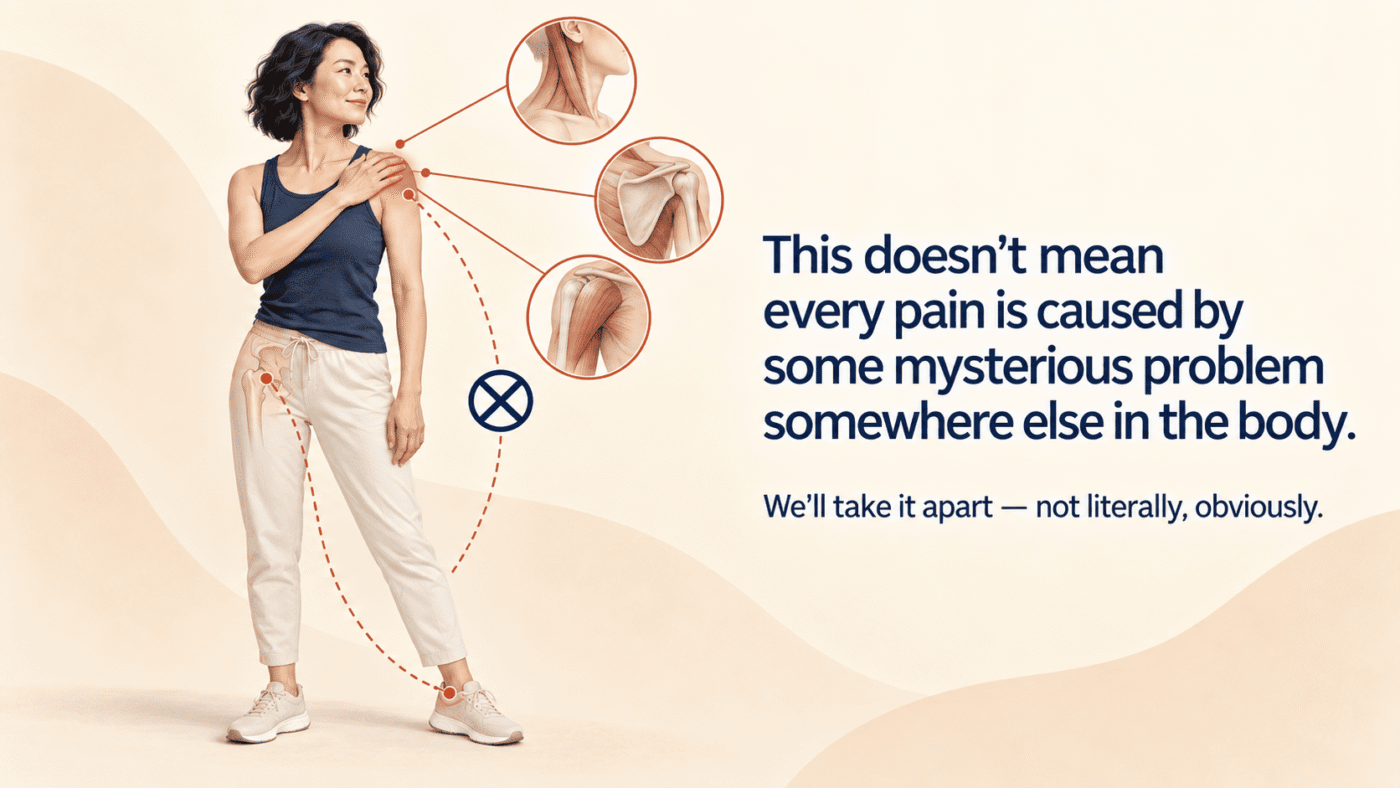
This doesn’t mean every pain is caused by some mysterious problem somewhere else in the body. We shouldn’t make it more complicated than it needs to be.
It simply means that movement is a shared job.
Let’s say your shoulder hurts.
Naturally, you point at the painful spot and say:
“It’s here.”
And you’re absolutely right — that’s where you feel it.
Not necessarily.
How your shoulder moves may be influenced by several muscles, the shoulder joint, shoulder blade, spine, surrounding tissues and the nervous system.
That’s why simply chasing the painful spot doesn’t always give us the whole picture.
Understanding which structures are involved — and what each one actually does gives us a better starting point for understanding pain, movement and treatment.
And that’s where anatomy becomes useful. Not because you need to memorise every muscle in the human body.
But because knowing a little more about what’s underneath your skin can completely change the way you think about your body.
How many things had to work together just to make that happen?
Probably more than you expected.
Your Body Talks. Learn to Listen.
Got a body part you’ve always wondered about?
Ask below. We’ll take it apart — not literally, obviously.

Ask it. Even if you think it’s a ridiculous question.
Someone else has probably wondered exactly the same thing.
