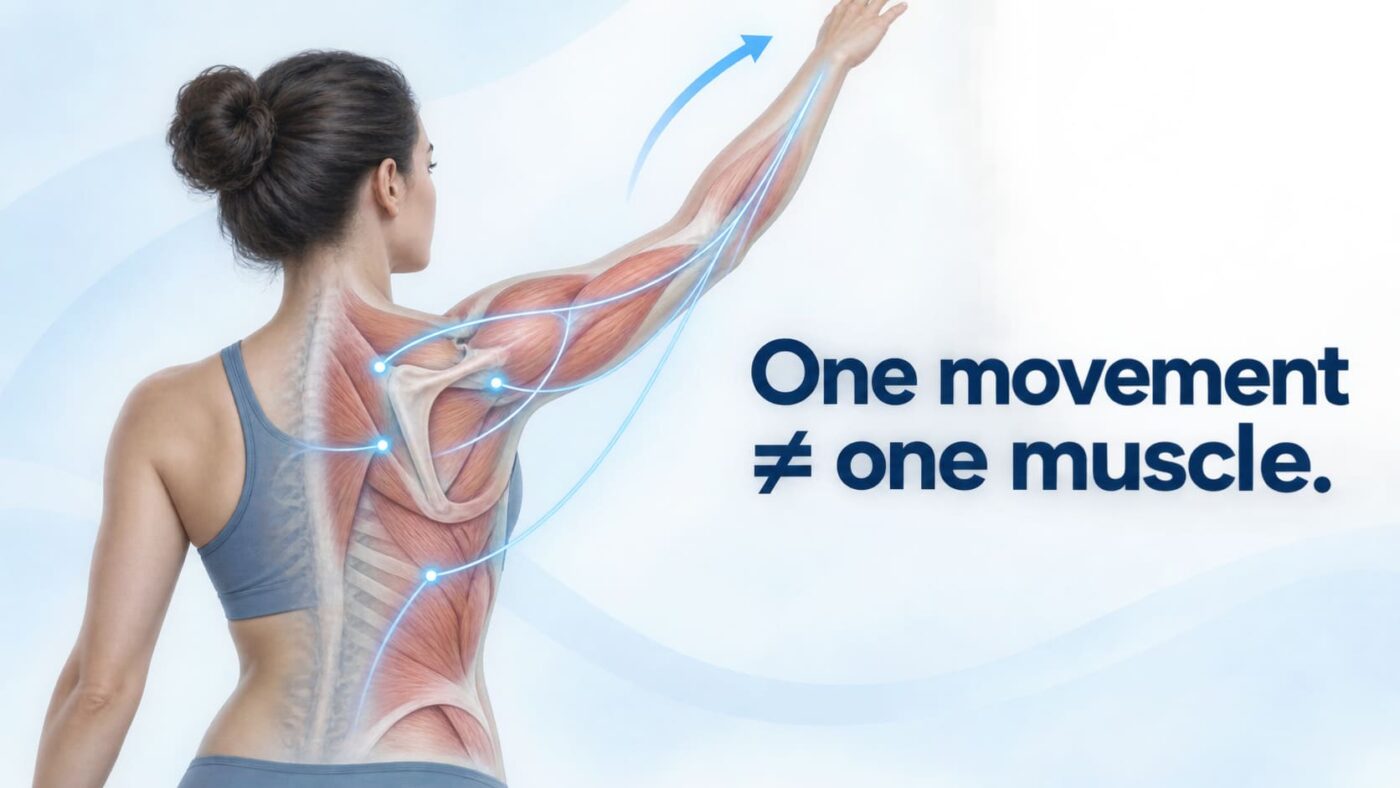
Raise your hand for a second.
Easy, right?
You probably didn’t have to think:
“Okay, biceps… contract now.”
Thankfully, your body handles that part for you.
But behind that simple movement, quite a lot is happening.
Muscles Pull — They Don’t Push
Here’s one of the simplest ways to understand muscles:
Muscles create force by contracting.
Many muscles attach to bones through tendons. When a muscle produces enough force, it can help move bones around a joint. But there’s a catch.
A muscle can pull in one direction, so movement often requires different muscles working together.
Think about bending and straightening your elbow. Your biceps can contribute to bending the elbow. Your triceps can contribute to straightening it.
Simple enough.
Except your body rarely uses just one muscle at a time.
Movement Is a Team Effort
Pick up a cup of coffee. Your fingers need to grip it. Your wrist needs control. Your elbow moves. Your shoulder helps position the arm. Other muscles help stabilise everything while this happens. And your nervous system is coordinating the whole thing.
All for one sip of coffee.
Rather dramatic when you think about it. Some muscles create movement, some help control it, and others help keep parts of your body stable enough for that movement to happen.
That’s why thinking:
“This movement = this one muscle”
What Happens When Something Isn’t Working Well?
Imagine raising your arm suddenly becomes painful or difficult.
The muscle might still be capable of contracting. But pain, weakness, injury, joint restriction, coordination or other factors may change how comfortably you perform the movement.
Your body may adapt too.
This is one reason assessment shouldn’t only ask:
“Which muscle feels tight?”
We also want to know:
“What movement are you having trouble doing?”
That question often tells us much more.
Unless you’re studying anatomy — then unfortunately, yes, you probably do.
For everyone else, start with something simpler:
Muscles don’t work alone. They work together to create, control and support movement.
Next time you reach for your coffee, open a door or stand up from a chair, notice the movement.
Something that feels completely automatic is actually a remarkably coordinated job.
Your Body Talks. Learn to Listen.
Which everyday movement would you like us to break down next?
Walking? Squatting? Turning your neck? Or the highly technical movement of getting out of bed on Monday morning?
Ask below.

Ask it. Even if you think it’s a ridiculous question.
Someone else has probably wondered exactly the same thing.
