
You’ve probably heard a massage therapist say:
“Your fascia is tight.”
And perhaps you nodded politely while thinking:
“Okay… but what exactly is fascia?”
Fair question.
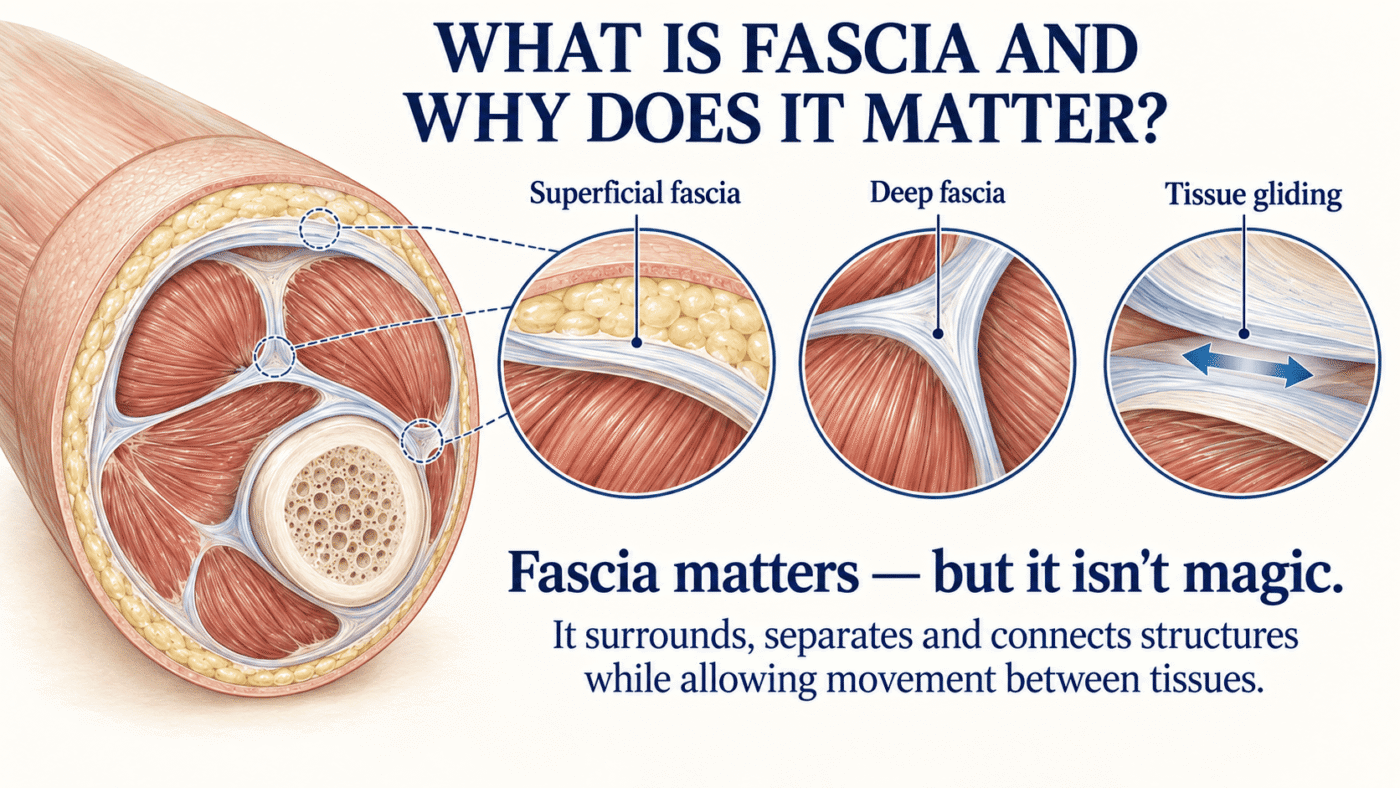
Fascia is a type of connective tissue found throughout your body. It surrounds, supports and connects muscles and many other structures.
But rather than imagining it as a mysterious sheet wrapped around everything, think of fascia as part of the body’s continuous network of connective tissues.
Why Do We Need Fascia?
Your muscles don’t simply float around underneath your skin.
They need support, organisation and connections with surrounding structures.
Fascia contributes to that environment.
It helps tissues interact with each other, transmits mechanical forces and allows layers of tissue to move in relation to one another.
So when you move, fascia isn’t sitting there doing nothing.
It’s part of the system.
This is where things get a little more complicated.
You may hear explanations such as:
“Your fascia is stuck.”
“We need to break up the fascia.”
Or:
“Your pain is coming from tight fascia.”
Fascia can be relevant to pain and movement, but pain is rarely explained by one tissue alone.
Muscles, joints, nerves, connective tissues, previous injury, activity, sensitivity and many other factors may all contribute.
The body is usually more complicated than one tight piece of fascia.
Annoying, I know.
A simple answer would be much easier.
Massage and other manual techniques can influence how an area feels and moves, and some approaches specifically focus on the muscle-and-fascia relationship — often described as myofascial treatment or myofascial release.
But that doesn’t necessarily mean we’re physically “breaking” or permanently reshaping fascia with our hands.
Does movement improve?
Does discomfort change?
Does the area feel easier to use?
Then reassess.
That’s much more useful than simply declaring:
“Your fascia was tight. I fixed it.”
Fascia Matters — But It Isn’t Magic
It helps connect, support and organise the structures that allow us to move.
But it doesn’t need to become mysterious.
Understanding fascia is simply another piece of understanding how your body works as a whole.
And the more pieces you understand, the easier the bigger picture becomes.
Your Body Talks. Learn to Listen.
Ever been told your fascia was “tight”, “stuck” or “knotted”?
What did you imagine was happening under there?
Tell us below.

Ask it. Even if you think it’s a ridiculous question.
Someone else has probably wondered exactly the same thing.
