
A Joint Is Where Bones Meet
Bend your elbow.
Turn your head.
Roll your shoulder.
Three simple movements — but have you ever wondered why your elbow bends differently from your shoulder?
The answer has a lot to do with your joints.
A joint is where two or more bones come together.
Some joints allow a lot of movement. Others allow very little. Their shape and surrounding structures help determine which movements are possible and how much movement is available.
Your elbow, for example, mainly bends and straightens. Your shoulder can move in many more directions. That’s not an accident. They’re built differently because they have different jobs.
But Joints Don’t Move Themselves
Here’s an important distinction.
A joint provides the place and structure for movement, but it doesn’t simply decide to move on its own.
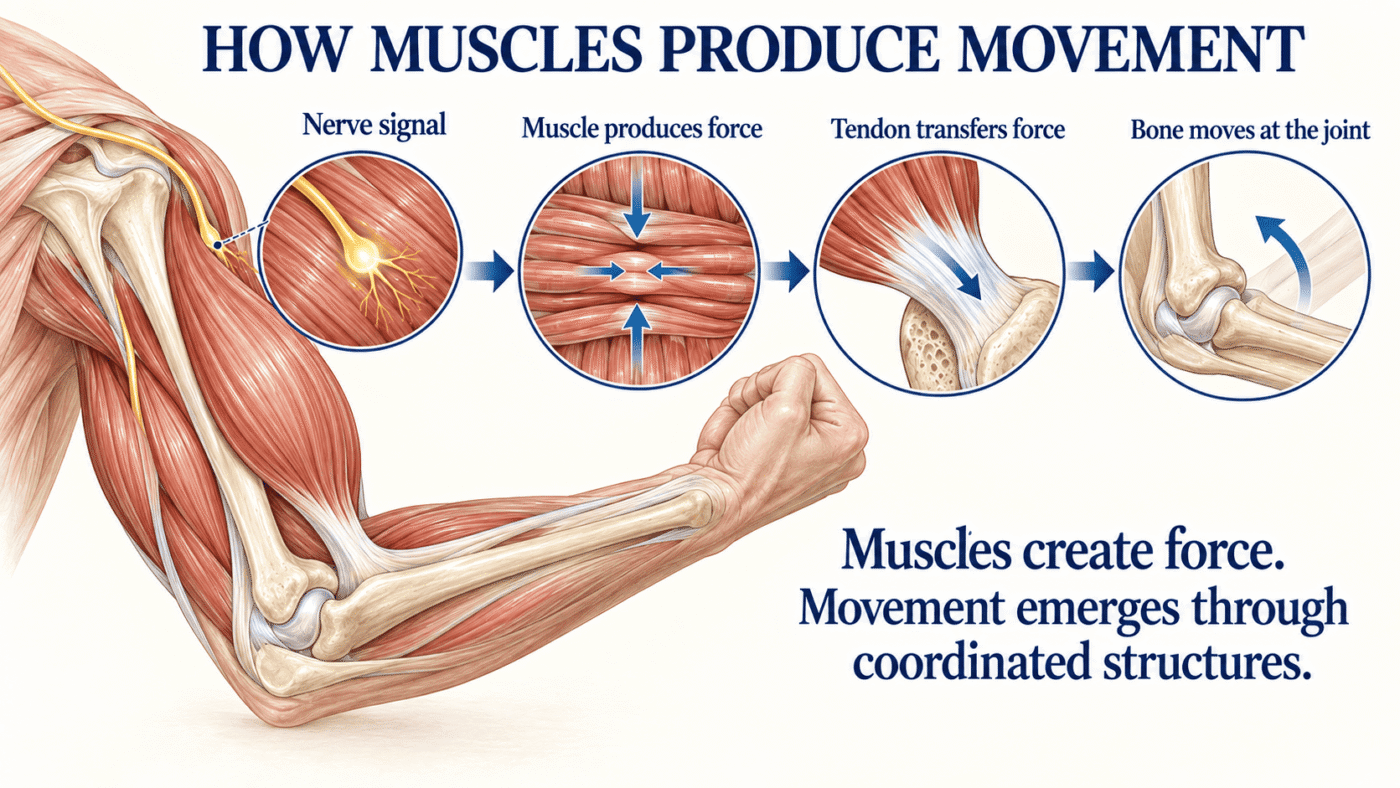
Muscles produce force.
Joints guide movement.
The nervous system helps coordinate and control it.
Ligaments, tendons and other surrounding tissues also contribute to stability and movement.
So even something as simple as raising your arm is actually a coordinated effort between several systems.
Your shoulder gets the credit, but there’s quite a team working behind the scenes.
But more movement isn’t automatically better. Imagine if your knee could move freely in every possible direction.
That would be… inconvenient. Your joints need enough mobility to perform their job, but they also need enough control and stability to manage the forces placed on them.
Different joints balance these requirements differently. That’s why the goal isn’t necessarily:
“Can this joint move well enough for what you need to do?”
When Movement Becomes Difficult
If a joint feels stiff or a movement becomes painful, it can be tempting to assume:
“The joint must be stuck.”
But muscles, pain, injury, the nervous system, previous experiences and other factors can also influence how you move.
This is why assessment matters.
Rather than immediately deciding what is wrong, first look at what has changed.
Can you move as far?
Does one direction hurt?
Does the movement feel weak, stiff or simply different?
Those little observations give us somewhere to start.
You need joints that allow you to do the things that matter to you.
Your Body Talks. Learn to Listen.
Which joint in your body makes the most suspicious noises?
Shoulder? Knee? Ankle?
No judgement. Bodies can be surprisingly noisy.

Ask it. Even if you think it’s a ridiculous question.
Someone else has probably wondered exactly the same thing.
