
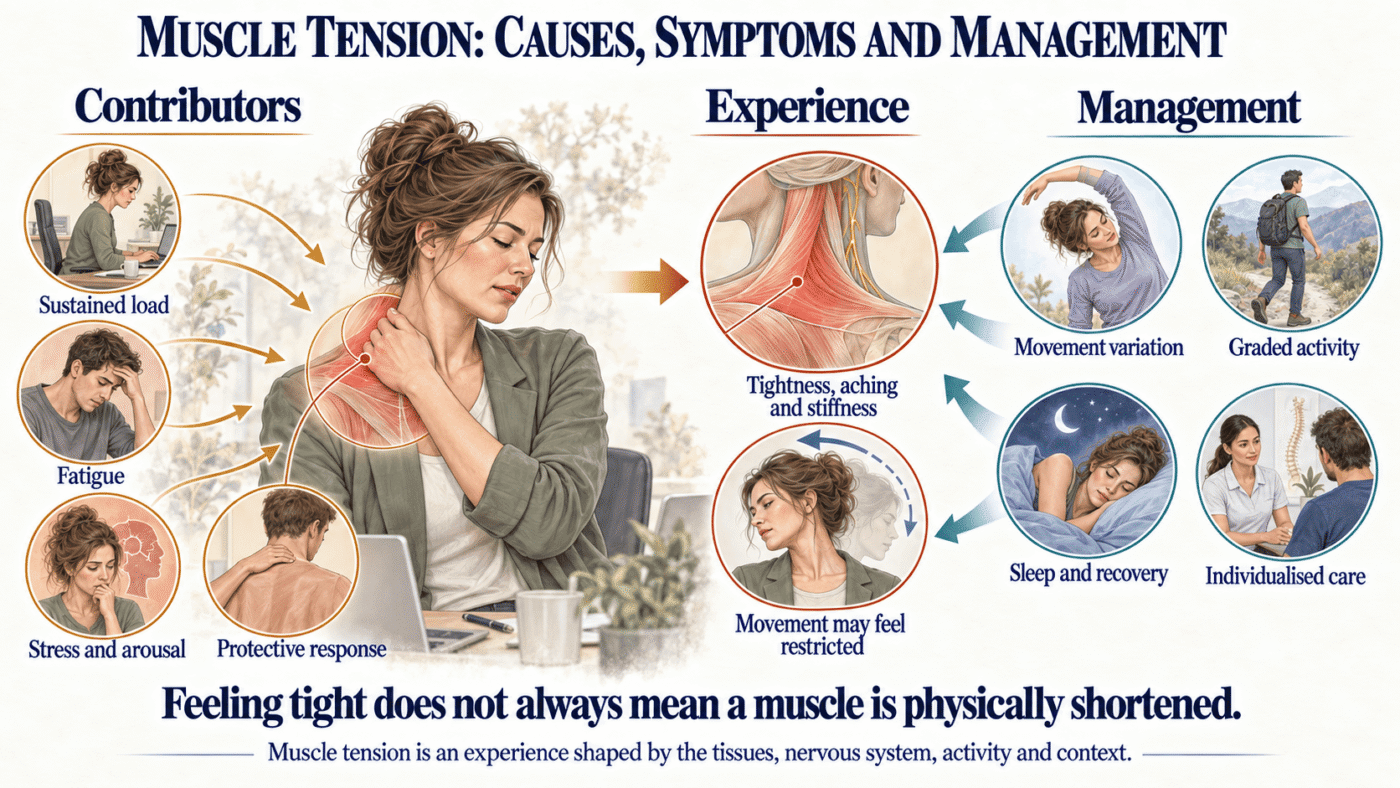
Sound familiar?
“My shoulders are always tight.”
“My neck feels like a rock.”
“I’ve got a knot right here.”
Muscle tension is one of the most common reasons people seek massage.
But here’s the interesting part:
Feeling tight doesn’t always mean a muscle is physically “stuck” or needs to be pressed harder until it gives up.
What Is Muscle Tension?
Muscles naturally create tension when they contract. You need this tension to stand, move, lift things and maintain positions. So muscle tension itself isn’t bad.
The problem is when an area feels persistently tight, uncomfortable, tired or difficult to move. You might notice:
- stiffness or aching
- tenderness when touched
- a feeling of tightness or pressure
- reduced or uncomfortable movement
- muscles that feel tired or overworked
Sometimes you can clearly identify why. Other times your shoulders apparently decided to move permanently closer to your ears.
Managing Muscle Tension
Management depends on what’s contributing to it. Massage may be useful.
But movement, exercise, changing workload, taking breaks from prolonged positions, recovery and improving strength or mobility may also be relevant.
And persistent or unusual symptoms may require further assessment.
There’s rarely one answer. Physical workload can contribute. So can repetitive activity, unfamiliar exercise, prolonged positions, pain, injury or changes in how you’re moving.
Stress may also influence muscle activity and how strongly we perceive tension. And sometimes the muscle that feels tight isn’t necessarily the whole problem. Imagine your shoulder becomes painful. You begin moving differently to protect it. Other muscles may start doing more work.
Eventually those muscles feel tired and tight too. So simply finding the tightest spot doesn’t always tell us why it became tight.
Not necessarily. This is where the famous sentence appears:
“You can go harder.”
But harder isn’t automatically better. Massage and other manual techniques may help reduce the feeling of tension or make movement more comfortable for some people.
Does movement improve?
Does the area feel easier to use?
Does the tension stay away?
Or is it back again tomorrow?
If the same tension repeatedly returns, we may need to look beyond the muscle itself.
“Make this muscle softer.”
A better goal might be:
“Help this area function more comfortably.”
Because your muscles aren’t supposed to be completely relaxed all day. They’re supposed to work. The question is whether they’re working well for what you’re asking them to do. So next time you find that incredibly annoying tight spot, don’t only ask:
“How do I loosen this?”
Try asking:
“Why does this keep becoming tight?”
That’s often the more interesting question.
Your Body Talks. Learn to Listen.
Where does your body store its favourite tension?
Neck? Shoulders? Lower back?
Or are you lucky enough to have the complete collection?
Tell us below.

Ask it. Even if you think it’s a ridiculous question.
Someone else has probably wondered exactly the same thing.
