“My shoulder hurts when I lift my arm.”
Is it the rotator cuff?
Maybe.
But shoulder pain has a habit of making everything sound like a rotator cuff problem. And the shoulder is a little more complicated than that.
What Is the Rotator Cuff?
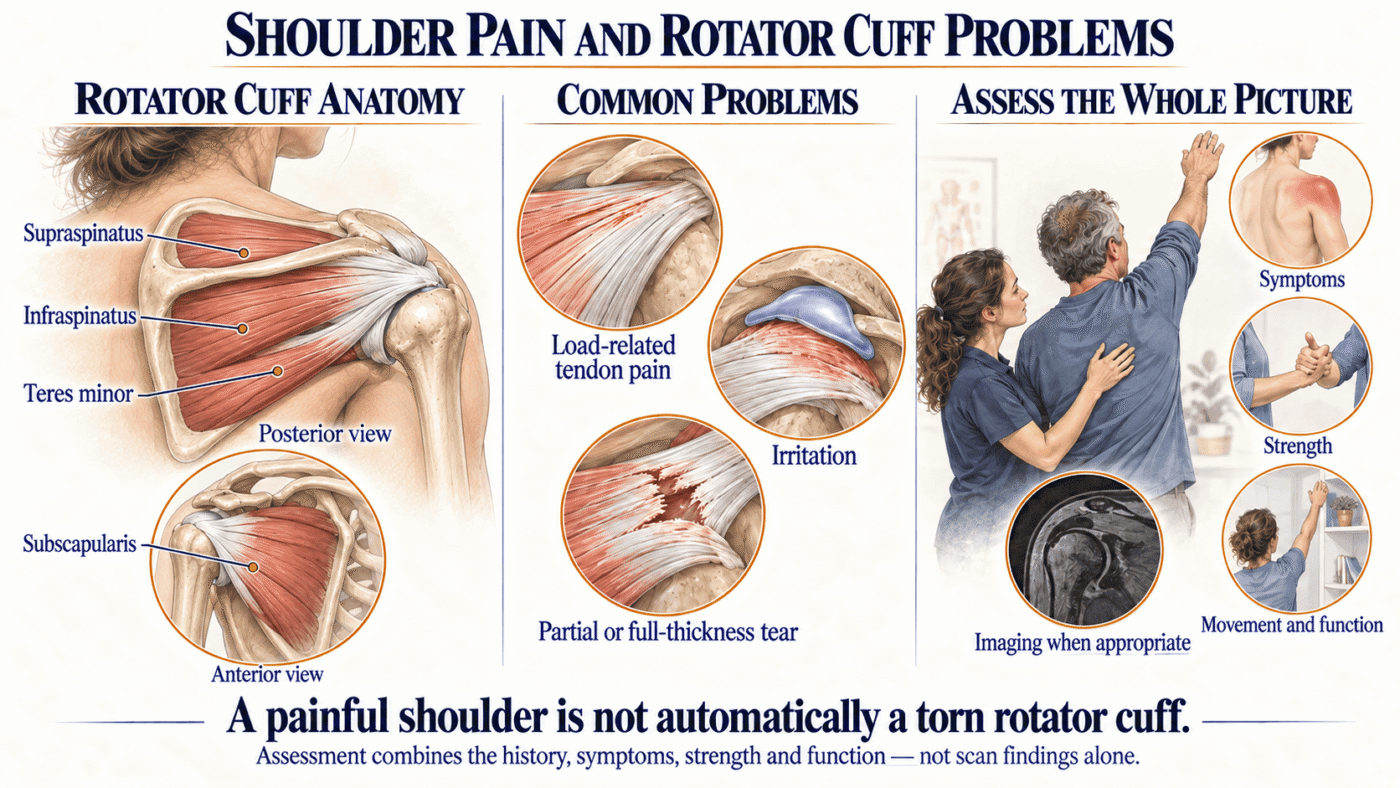
The rotator cuff is a group of four muscles and their tendons around the shoulder.
Together, they help control and stabilise the shoulder while you move your arm.
Think about reaching into a cupboard. Putting on a shirt. Lifting something overhead. Throwing a ball. Your shoulder needs plenty of movement — but that movement also needs control.
The rotator cuff is part of the team making that possible.
Rotator cuff-related problems may be associated with symptoms.
Several structures and factors can contribute to shoulder pain.
That’s why assessment matters.
Rotator cuff-related problems may be associated with symptoms such as:
- pain when raising or lowering the arm
- discomfort with reaching overhead
- pain when lying on the affected shoulder
- weakness or difficulty with certain movements
- pain during lifting or repetitive arm activity
But here’s the important part: Those symptoms don’t automatically prove that the rotator cuff is the cause. Several structures and factors can contribute to shoulder pain. That’s why assessment matters.
Sometimes pain begins after an obvious injury. Other times it gradually appears. Changes in training, repetitive work, unfamiliar activity, workload or a sudden increase in what you’re asking the shoulder to do may all be relevant.
And sometimes scans show changes in rotator cuff tendons even in people who don’t have shoulder pain. So finding something on a scan doesn’t automatically answer:
“Why does my shoulder hurt?”
The scan is one piece of information. Your symptoms, strength, movement, history and function are pieces too.
Not automatically. When movement hurts, protecting the shoulder for a while can be understandable. But avoiding movement completely for too long may not always be helpful. Depending on the problem, gradually restoring comfortable movement and strength can form an important part of recovery.
The goal isn’t:
“Never use the painful shoulder.”
It’s to understand what it can currently tolerate and how we can safely build from there.
Massage may help some people reduce discomfort, manage muscle tension or move more comfortably.
And treatment may involve more than pressing directly where the shoulder hurts. The muscles around the shoulder blade, upper back, neck and other areas involved in the movement may sometimes be relevant.
But massage cannot simply “repair a torn tendon.”
And if treatment temporarily feels good but the same problem continually returns, we need to ask what else may be missing.
Strength? Movement? Workload management? Rehabilitation? Further assessment?
Pain relief is useful. Restoring function is the bigger goal.
Shoulder pain deserves further assessment when there has been significant trauma, obvious deformity, sudden substantial weakness or inability to use the arm normally.
New numbness, tingling or neurological symptoms also deserve attention, particularly when they are significant or worsening. And if pain is severe, unexplained, progressively worsening, associated with feeling unwell, or simply isn’t behaving like an ordinary musculoskeletal problem, don’t assume it just needs a harder massage.
Sometimes the correct question isn’t:
“Which muscle should we treat?”
It’s:
“Do we understand what we’re treating yet?”
That’s a much better place to start.
Your Body Talks. Learn to Listen.
Can you lift your arm overhead comfortably?
Try it. Not twenty times, though. We already know what happens when humans discover a movement that hurts apparently we need to test it repeatedly just to make sure.

Ask it. Even if you think it’s a ridiculous question.
Someone else has probably wondered exactly the same thing.
