
You bend down to pick something up.
Then suddenly…“Oh no. My back!”
And within seconds your brain has already diagnosed you with a slipped disc, a damaged spine and possibly the end of your ability to bend forever. Lower back pain can feel frightening. But pain doesn’t automatically mean your back is seriously damaged.
Why Does the Lower Back Hurt?
The lower back is built to move, support load and transfer forces between different parts of your body. It contains bones, joints, muscles, ligaments, nerves and other tissues all working together.
Pain may begin after lifting, twisting, exercise or an unfamiliar activity. Sometimes it develops gradually. And sometimes…there is no obvious reason at all.
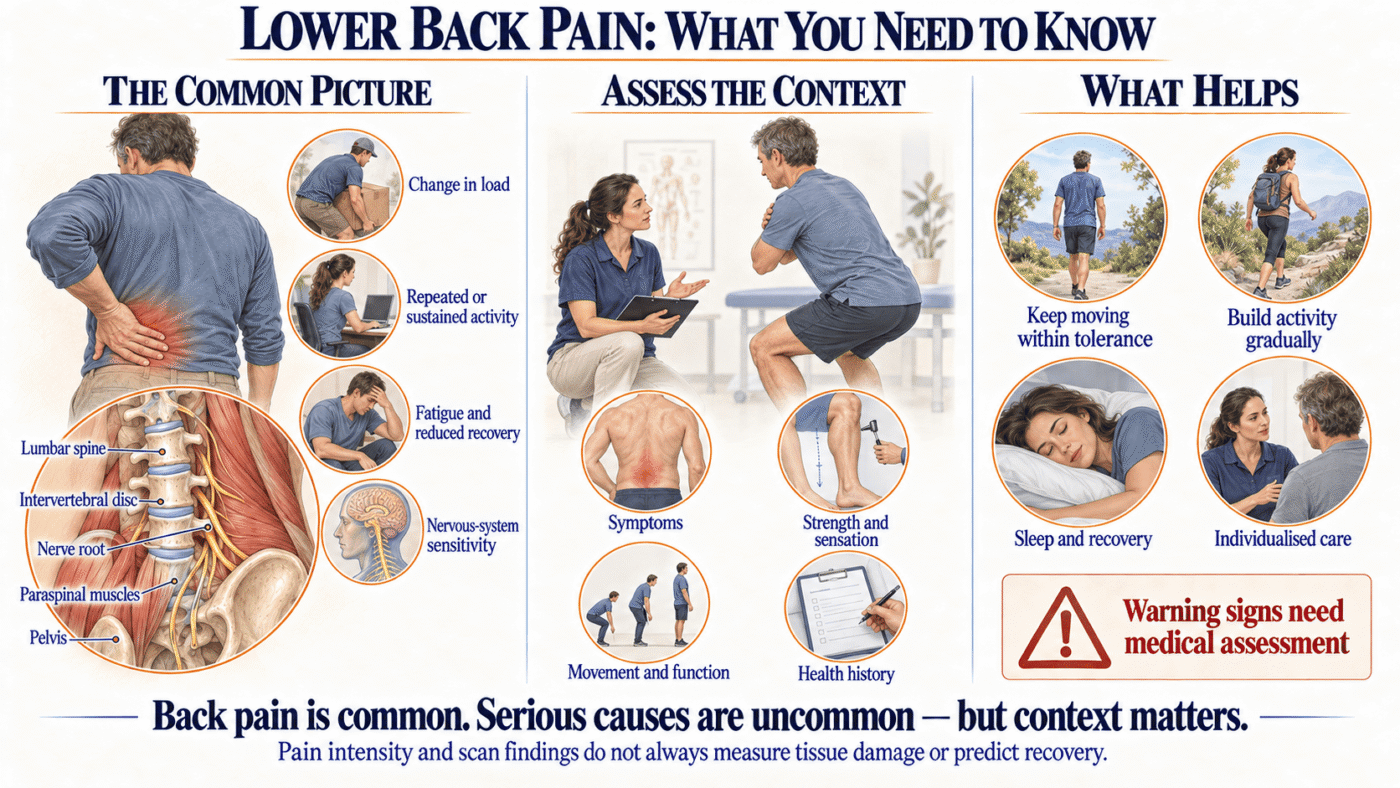
Workload, previous injury, changes in activity, sleep, general health and sensitivity of the nervous system may all influence how back pain is experienced. This is why:
“Which muscle is causing my back pain?” isn’t always an easy question to answer.
Does Back Pain Mean Something Is Damaged? Not necessarily.
Pain can certainly occur with tissue injury.
But the intensity of pain isn’t a direct measurement of how much damage exists. Changes seen on scans such as disc degeneration or other age-related findings also don’t automatically explain someone’s symptoms.
A scan is information. It isn’t the whole story. Your symptoms, movement, strength, history and function matter too.
A little rest or temporarily modifying painful activities may sometimes be reasonable. But prolonged bed rest usually isn’t the goal for uncomplicated lower back pain.
When appropriate, gradually returning to comfortable movement and normal activities can be an important part of recovery. That doesn’t mean:
“Push through everything that hurts.”
It means finding what you can currently tolerate and building from there. Your back isn’t something you need to keep perfectly still to protect forever. It’s designed to move.
Massage may help some people with lower back pain feel more comfortable, reduce the sensation of muscle tension or make movement easier. But simply finding the hardest muscle and attacking it isn’t much of an assessment.
We might ask:
Can you bend differently after treatment?
Is walking easier?
Can you sit or stand more comfortably?
And if the same pain keeps returning despite repeated treatment, that’s useful information too. Maybe we need to reconsider what is contributing to the problem.
Massage may be one part of management. Movement, exercise, rehabilitation, workload changes, recovery or further healthcare may also be appropriate.
Most lower back pain isn’t caused by a serious medical condition.
But some symptoms shouldn’t simply be treated as an ordinary muscular problem.
Seek prompt medical assessment if back pain is accompanied by concerning symptoms such as significant trauma, rapidly worsening weakness or numbness, major changes in walking or coordination, or feeling seriously unwell.
Changes in bladder or bowel control, or numbness around the groin, genitals or inner-thigh area, require urgent medical assessment. Severe, unexplained or progressively worsening symptoms also deserve appropriate investigation.
The purpose of knowing these signs isn’t to make every backache frightening. It’s to know when massage isn’t the first priority.
Don’t Be Afraid of Your Back
When your back hurts, it’s easy to stop trusting it. You avoid bending. You move cautiously.
But for many people, recovery involves gradually becoming comfortable and confident with movement again. So instead of asking only:
“How do I make this pain disappear?”
also ask:
“What can I safely start doing again?”
Because reducing pain matters. But getting your life back matters even more.
Your Body Talks. Learn to Listen.
And be honest:
When your back hurts, do you move carefully for a day… or suddenly walk around like your entire spine is made of glass?
Tell us below.

Ask it. Even if you think it’s a ridiculous question.
Someone else has probably wondered exactly the same thing.
