
Welcome to posture assessment.
“Your shoulders aren’t level.”
“Your head sits forward.”
“One hip looks higher than the other.”
And suddenly you’re standing in front of a mirror wondering whether you’ve been assembled incorrectly.
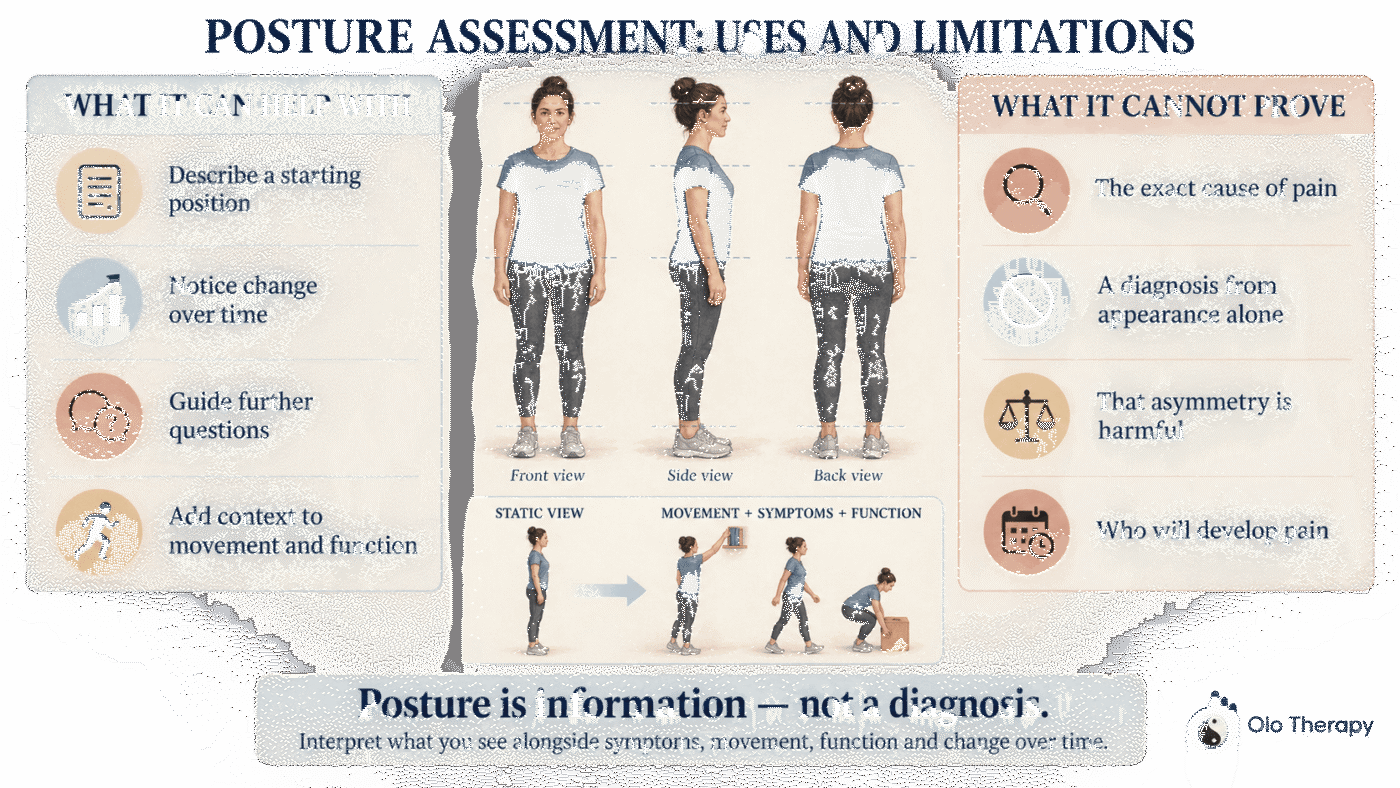
Posture can give us useful information.
But it can also become very misleading when we try to make it explain everything.
Perfect symmetry was never really part of the deal.
Posture Should Lead to Questions — Not Conclusions
If we notice something during posture assessment, the next step shouldn’t automatically be treatment. It should be another question. Does this position relate to the symptoms?
What happens during movement? Is there a meaningful restriction? Is strength affected? Does changing the position actually change the problem?
And most importantly:
Posture assessment is simply observing how someone positions their body. A therapist might look at the position of the:
- head and neck
- shoulders
- spine
- pelvis
- knees
- feet
We may notice differences between sides or how someone naturally chooses to stand or sit. Those observations can give us clues. But that’s exactly what they are. Clues.
Human bodies aren’t perfectly symmetrical. One shoulder may sit slightly higher. One foot may turn differently. The curves of your spine won’t look identical to someone else’s. And that doesn’t automatically mean something needs to be corrected. A posture that looks unusual may be completely comfortable for one person.
Meanwhile, someone who appears to have beautiful textbook posture can still experience pain. So we should be careful with statements like:
“Your posture is causing your pain.”
A photograph of how you stand for ten seconds usually can’t tell us that.
Because posture can provide context. Suppose someone has shoulder pain. We notice how the shoulder sits at rest.
Interesting. But then we ask them to raise their arm. Now we can see how the shoulder, shoulder blade and trunk behave during movement.
We compare that with their symptoms, history and function. Suddenly posture becomes one piece of a much bigger picture. That’s much more useful than drawing lines on someone’s photograph and announcing:
“There’s the problem.”
This distinction matters. Posture tells us how you are positioned at a particular moment. Movement assessment tells us what happens when you actually do something.
And life involves a lot more than standing perfectly still.
You reach.
Walk.
Lift.
Run.
Sit.
Turn.
Work.
Exercise.
Or perform the highly technical movement of getting off the sofa after watching three episodes instead of one. So if someone’s problem occurs during movement, we should probably assess the movement too.
Sometimes changing position can absolutely help. If you’ve been sitting in one position for hours and your neck feels uncomfortable, moving or changing position may feel much better.
But the answer isn’t necessarily:
“Find the perfect posture and hold it all day.”
Even a supposedly good posture can become uncomfortable if you stay there long enough. Sometimes the better advice is simply: Change positions. Move regularly. Give your body options. Your body isn’t a statue.
That’s clinical reasoning. Posture assessment can be useful. But it becomes much more useful when combined with history, movement, symptoms and function.
So don’t panic because one shoulder sits slightly higher than the other. You’re a human being. Perfect symmetry was never really part of the deal.
Posture is information — not a diagnosis.
Your Body Talks. Learn to Listen.
Take a look at yourself in the mirror.
Are your shoulders perfectly level?
Probably not. Congratulations. You may simply be human.

Ask it. Even if you think it’s a ridiculous question.
Someone else has probably wondered exactly the same thing.
