
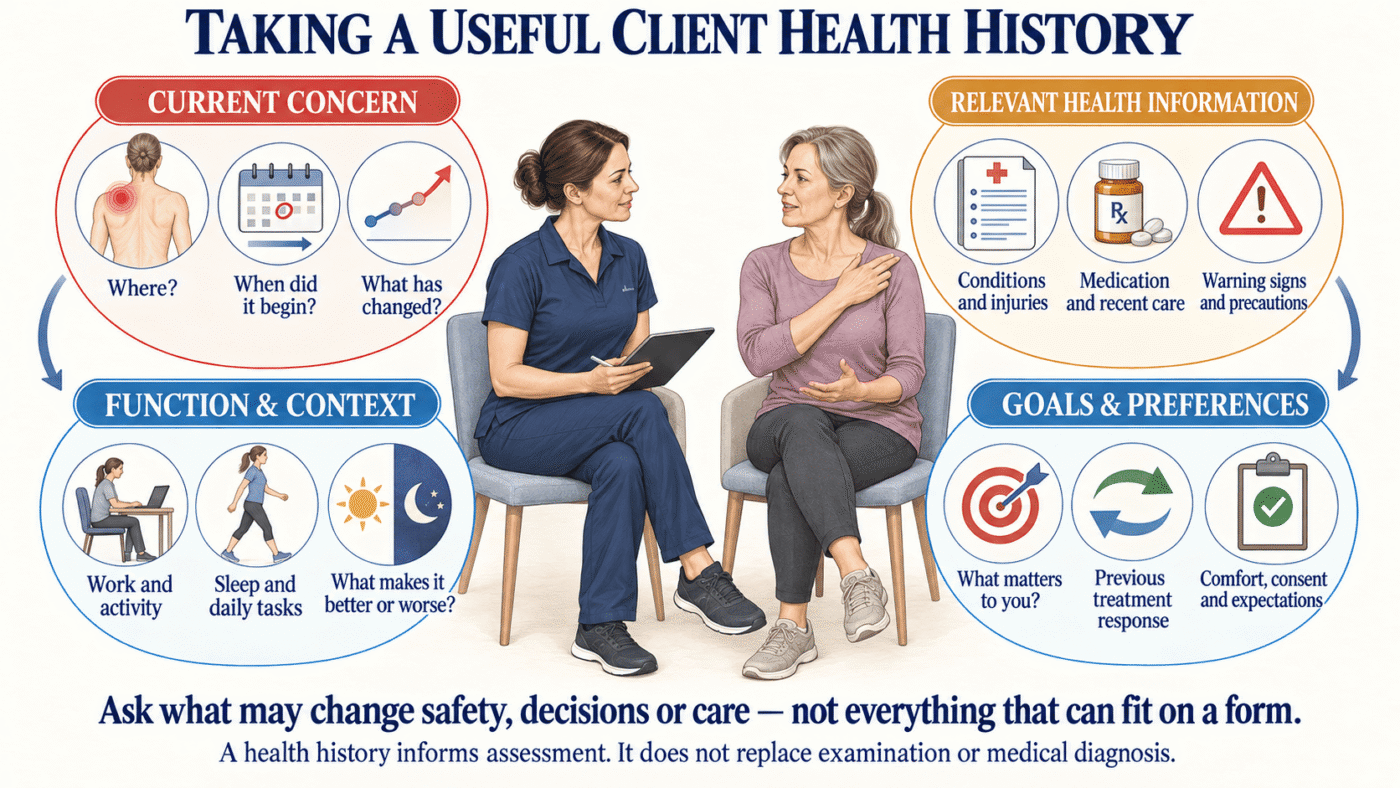
Before treatment begins, there’s usually a form.
Name.
Date of birth.
Medical conditions.
Medications.
Previous injuries.
And it’s tempting to rush through it thinking:
“I’m only here for a massage. Why do you need all of this?”
Fair question. Because a good health history form isn’t simply paperwork.
It’s the beginning of your assessment.
The Small Detail You Leave Out May Matter
Imagine you injured your foot years ago. It doesn’t hurt anymore, so when you’re asked about previous injuries you don’t mention it.
Why would you?
You’re here because of a completely different problem. That old injury may turn out to be irrelevant. But sometimes information that initially seems unrelated gives the therapist another piece of the puzzle perhaps because your movement, activity or symptoms changed after that event.
“Old foot injury = today’s problem.”
But if we never know it happened, we can’t even consider whether it’s relevant.
That’s why your history matters. Not because every old injury explains today’s pain. Because sometimes the timeline tells us where to start asking better questions.
A useful history isn’t just a list of diagnoses. We want to understand your story.
When did the problem begin?
What were you doing around that time?
Have you had previous injuries or surgery?
Has your work or exercise changed?
What makes the symptoms worse or better?
Have you noticed weakness, numbness, tingling or changes in movement?
What have you already tried?
And what happened afterwards?
Sometimes a detail you consider completely unimportant may change what we assess.
Because treatment doesn’t happen separately from the rest of your health. Certain medical conditions, medications, recent procedures and injuries may influence whether massage is appropriate, how treatment should be modified, or whether medical assessment should come first.
Medication is a good example. We aren’t asking because we want to interfere with your medical treatment. We’re asking because some medications may be relevant to bruising, bleeding, blood pressure, pain or other treatment considerations.
The question should have a clinical reason.
You have every right to care about your privacy. If you’re uncomfortable providing information such as your date of birth or other personal details, ask:
“Why do you need this?”
A healthcare professional should be able to explain why information is being collected and how it relates to your care or record keeping. But there’s an important distinction between personal identifying information and health information relevant to safe treatment.
If you choose not to disclose a previous injury, medication, surgery or significant symptom, your therapist may be making decisions without information that could matter. And sometimes that means treatment may need to be modified or postponed until we know enough to proceed safely.
A Form Shouldn’t Replace a Conversation
It’s the beginning.
Your therapist should still ask questions. Something written as: “Lower back pain 3 years” might lead to:
When did it first happen?
Was there an injury?
Does the pain travel into your leg?
Any numbness or weakness?
What movements are difficult?
Has anything changed recently?
Now we’re no longer reading boxes.
We’re beginning to understand the person behind them. Be Honest — Even When You Think It Doesn’t Matter You don’t need to remember every bruise you’ve had since childhood. And we don’t need your entire autobiography. But don’t deliberately leave out something because you assume: “That’s probably unrelated.”
Tell us.
Let us decide together whether it matters. A previous injury may be irrelevant. A medication may change nothing. An old surgery may have absolutely nothing to do with today’s problem.
That’s okay. Good assessment isn’t about forcing every piece of information to fit the problem. It’s about having enough information to know which pieces deserve attention.
So when you complete your health history, don’t think of it as the boring form standing between you and the massage table. Think of it as your first opportunity to tell us:
“This is what has happened to my body.”
Then we can start asking the right questions.
Your Body Talks. Learn to Listen.
And if there’s something on the form you don’t understand or don’t understand why we’re asking.
ask us.
That’s part of the conversation too.

Ask it. Even if you think it’s a ridiculous question.
Someone else has probably wondered exactly the same thing.
