
A therapist places their hands on your shoulder.
They pause for a moment.
Then say:
“This side feels different.”
Fair enough.
But what exactly are they feeling?
And perhaps the more interesting question is:
How much can someone’s hands really tell them?
Welcome to palpation.
“Hmm… this feels interesting.”
Don’t panic.
Interesting isn’t a diagnosis.
It’s an invitation to ask the next question.
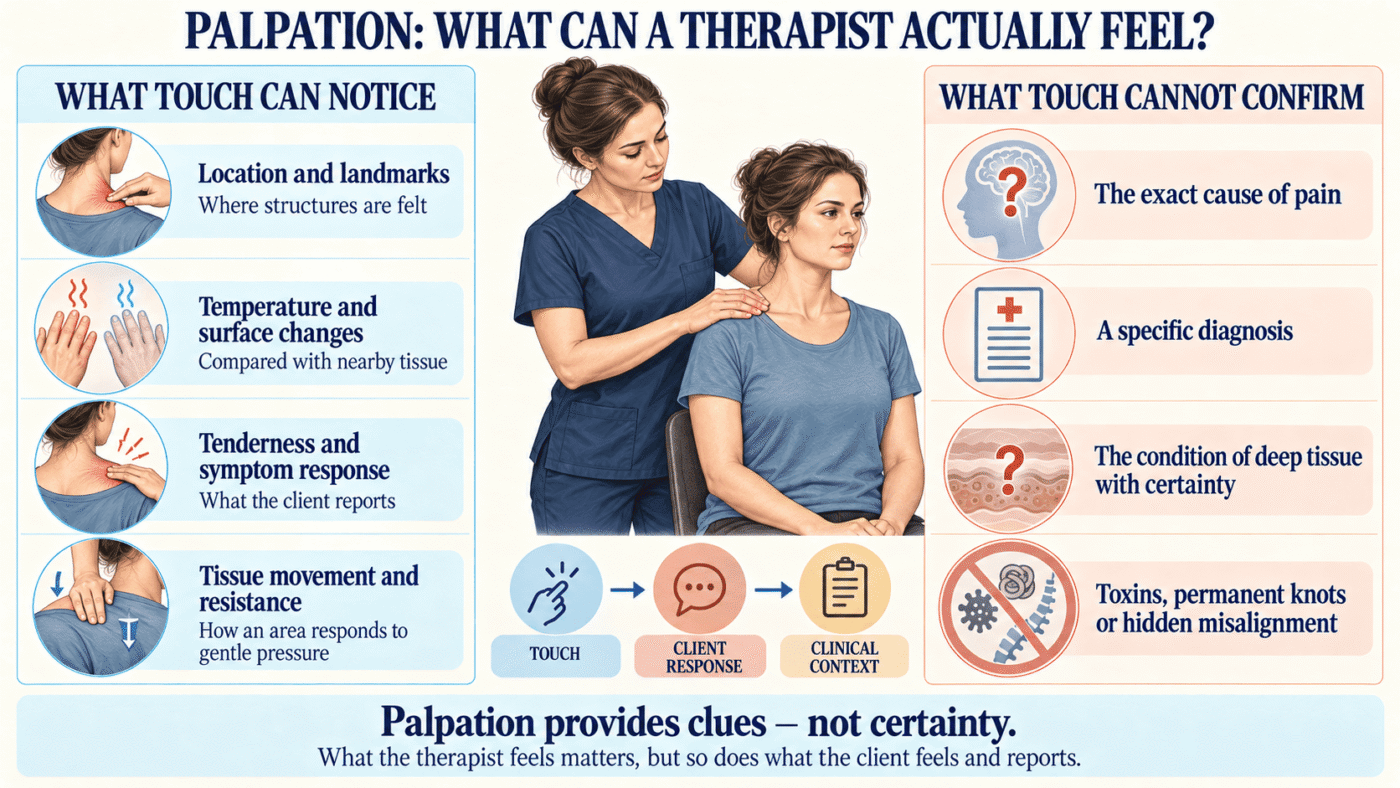
Palpation simply means using touch to examine the body. For a massage or manual therapist, the hands can provide useful information about things such as:
- the location of anatomical structures
- tenderness
- differences in tissue feel
- muscle activity or resistance
- swelling or unusual warmth
- how tissues respond to pressure
- differences between areas or sides
It can also help us answer a very practical question: “Is this the area you recognise as your symptom?” That’s useful information. But palpation has limitations.
Imagine I palpate both sides of your upper back. One side feels firmer than the other. What can I reasonably say?
“This side feels firmer.”
What should I be more careful about saying? “This muscle is tight because your pelvis is rotated, which is pulling your shoulder out of position and causing your headaches.”
That’s quite a journey from one pair of hands. Palpation gives us an observation. Clinical reasoning is what we use to decide whether that observation might matter. Those aren’t the same thing.
People often describe small tender or firm areas as muscle knots. And yes, therapists can sometimes identify areas that feel locally firm, sensitive or different from the surrounding tissue.
But feeling a firm area doesn’t automatically tell us exactly what is happening inside that tissue. It also doesn’t prove that we’ve found the cause of someone’s pain.
So instead of: “I found the problem.” A more useful thought might be: “I found something interesting. Does it relate to the problem?” Now we have something to investigate.
Sometimes the most useful information doesn’t come from the therapist’s fingers. It comes from the client. I press an area.
You say:
“That’s exactly the pain I’ve been feeling.”
That’s clinically interesting. But even then, tenderness doesn’t automatically identify the underlying diagnosis. We still need context.
Your history.
Your symptoms.
Your movement.
Your function.
And what happens when we reassess.
Hands can be highly trained. But they can’t see through the body. Palpation alone generally can’t prove exactly which structure is responsible for pain, determine the precise condition of deeper tissues, or establish a medical diagnosis.
And we should be particularly careful with confident claims about things we can’t directly verify. Confidence doesn’t make a finding more accurate. Good clinical practice means knowing the difference between:
What I felt.
What I think it might mean.
What I can actually demonstrate.
That’s an important distinction.
Good palpation isn’t simply the therapist silently searching for abnormalities. It can involve communication.
“Is this tender?”
“Does this feel familiar?”
“Is that the symptom you came in with, or does it feel completely different?”
Your response adds information that the therapist’s hands cannot provide alone. Treatment becomes a conversation between what we observe and what you experience.
Suppose an area feels firm and is tender. We treat it. Now what?
Does your neck turn more comfortably?
Can you raise your arm more easily?
Has the symptom changed?
Can you perform the movement that was difficult before?
If nothing changes, that’s useful information. Maybe the tissue we found wasn’t as important as we thought. And that’s okay. Assessment isn’t about proving the therapist was right.
It’s about getting closer to understanding the problem.
History → Movement → Palpation → Treatment → Reassessment
Palpation can be extremely useful within that process. But hands shouldn’t be treated like magical diagnostic scanners. They provide information.
The skill is knowing what that information can — and cannot — tell us.
Your Body Talks. Learn to Listen.
And yes if you’re wondering what your therapist can actually feel under their fingers…

Ask it. Even if you think it’s a ridiculous question.
Someone else has probably wondered exactly the same thing.
