
You can raise your arm to 170 degrees.
Excellent.
But can you put your shirt on without pain?
That’s where functional movement assessment becomes useful.
Range of motion can tell us how much movement is available.
Clinical reasoning means being willing to change direction when the evidence in front of us changes. Measure What Matters to Your Life
Functional movement assessment connects what we see in the clinic with what actually matters outside it.
Functional Movement Assessment
Functional assessment asks something slightly different:
Can you use that movement for what you actually need to do?
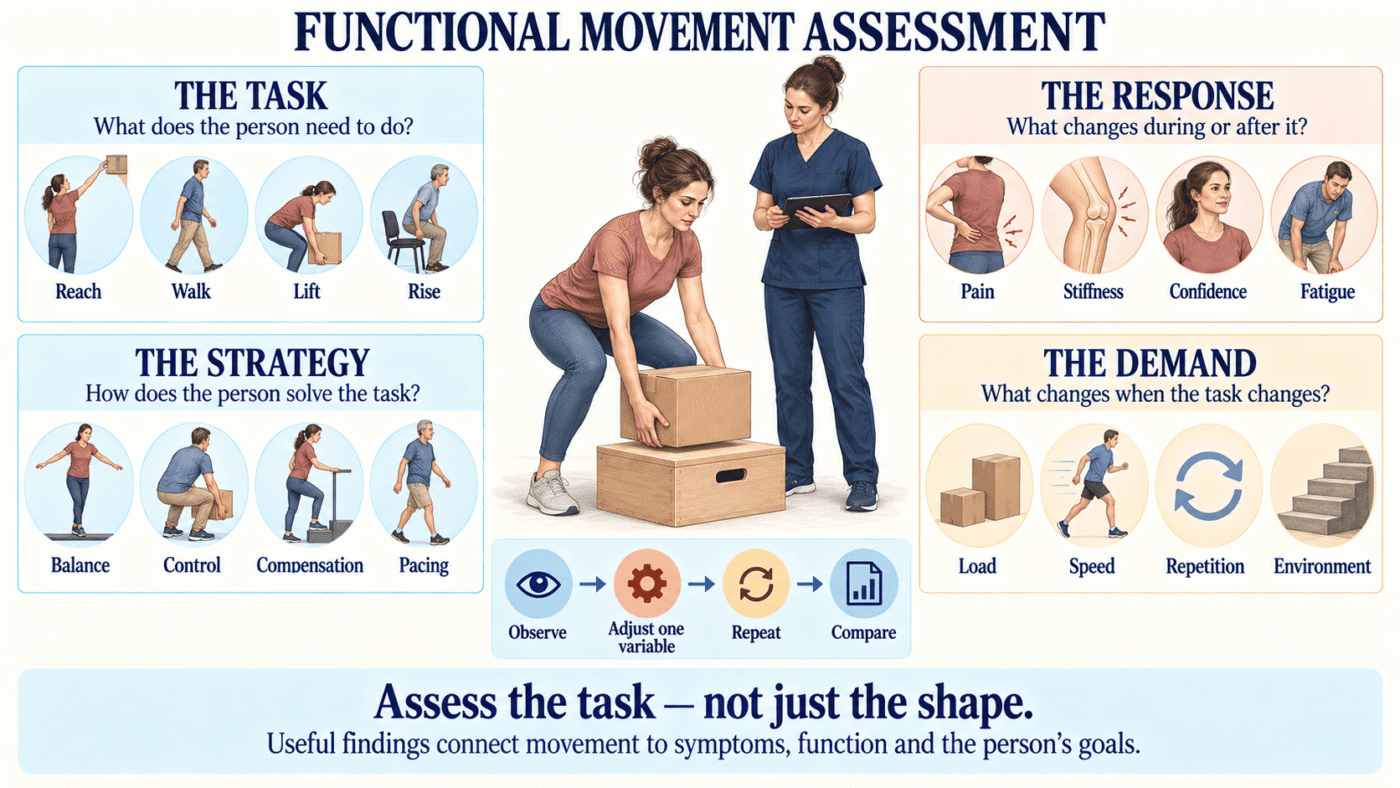
Functional movement assessment looks at movements that relate to everyday life, work, sport or the specific problem that brought you to treatment. Instead of assessing a joint only in isolation, we may ask you to perform something meaningful. For example:
- reaching overhead
- turning your head as if checking traffic
- bending to put on shoes
- getting up from a chair
- squatting
- walking
- lifting something
- reaching behind your back
- performing a movement from your work or sport
The movement we choose should have a reason. We’re not trying to see how many impressive tests we can fit into one appointment. We’re trying to understand your problem.
This may be one of the most useful questions in assessment. A client says: “My shoulder hurts.” Okay. But what does that mean for their life?
“I can’t sleep on that side.”
“I can’t reach the top shelf.”
“It hurts when I put my jacket on.”
“I can’t serve properly when I play tennis.”
Now we have something much more useful. The painful shoulder is important. But the activity affected by the shoulder gives us a functional baseline.
Consider standing up from a chair. It looks simple. But your hips, knees, ankles, trunk, muscles and nervous system all contribute to the task. If the movement is difficult, the answer isn’t automatically:
“Your quadriceps are tight.”
We need to observe what actually happens.
Is there pain?
Weakness?
Limited movement?
Poor confidence?
Does the person shift away from one side?
Does changing the position make the task easier?
One movement can give us several clues.
But again — a clue isn’t a diagnosis.
This is particularly important with movement assessment. People don’t all squat, walk, reach or bend in exactly the same way. There isn’t necessarily one perfect movement pattern that everyone must reproduce.
Your anatomy is different.
Your history is different.
Your sport is different.
Your job is different.
Your body has probably developed its own strategies over many years. So seeing an asymmetry doesn’t automatically mean:
“There’s the dysfunction.”
The better questions are:
Does it relate to the symptoms?
Does it limit function?
Does it matter to this person?
Clients sometimes try very hard to perform the movement “correctly” when they know they’re being watched. Please don’t. We’re not judging your squat.
There are no medals. We want to see how you normally move and what happens when you do.
If something hurts, tell us.
If you normally compensate, let us see it.
If you can’t perform the movement, that’s information too.
Assessment isn’t about passing or failing. It’s about understanding.
This is where functional movement becomes especially valuable. Before treatment:
“Reaching behind my back hurts.”
We assess it. We treat what appears clinically relevant.
Then:
“Try that movement again.”
Better?
Worse?
Exactly the same?
All three answers are useful. If treatment changes the movement, we’ve learned something. If it doesn’t, we’ve also learned something.
Maybe we need a different approach.
Maybe strength or rehabilitation matters more.
Maybe the problem needs further assessment.
Clinical reasoning means being willing to change direction when the evidence in front of us changes.
Perfect posture isn’t the goal. Maximum flexibility isn’t the goal. Passing every movement test isn’t the goal. If you’re a runner, perhaps the goal is running comfortably again.
If you’re a parent, maybe it’s lifting your child. If you work at a desk, perhaps it’s getting through the workday without your neck becoming increasingly uncomfortable. And sometimes the goal is beautifully ordinary:
“I just want to put my socks on without fighting with my back every morning.”
That’s a perfectly good outcome. Functional movement assessment connects what we see in the clinic with what actually matters outside it. So instead of asking only:
“How far can this joint move?”
we also ask:
“What do you need your body to do?”
That’s when assessment starts becoming personal. And treatment starts having a measurable purpose.
Your Body Talks. Learn to Listen.
Think about the problem that bothers you most. Now forget the pain score for a moment.
What is it stopping you from doing?
That answer may tell us more than you think.

Ask it. Even if you think it’s a ridiculous question.
Someone else has probably wondered exactly the same thing.
