
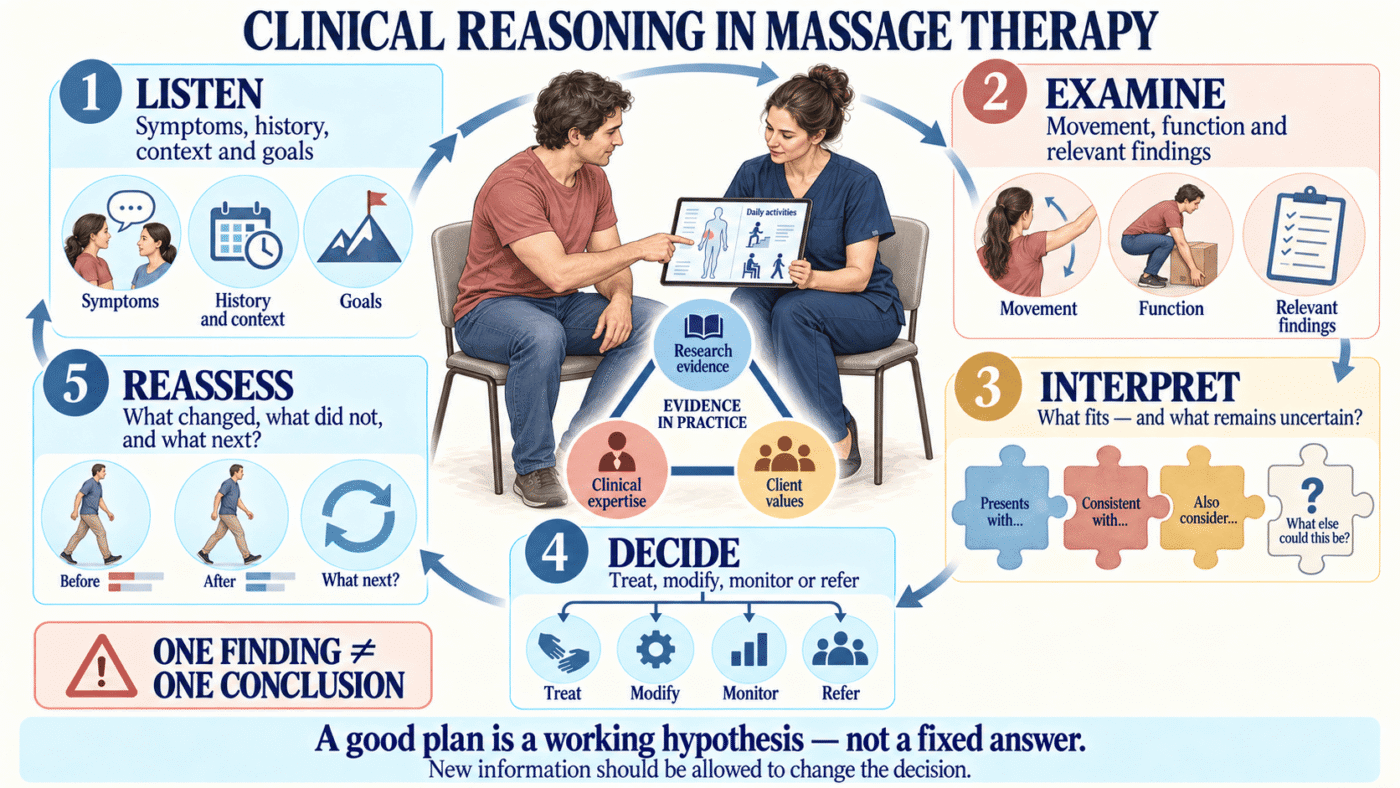
is that clinical reasoning?
Makes sense…
A client has shoulder pain.
The shoulder feels tight.
So we massage the shoulder.
Clinical reasoning is what happens between:
“This is what I found.” and
“This is what I’m going to do about it.”
And that gap matters.
A Simple Clinical Reasoning Process
It doesn’t need to sound complicated.
Listen → Assess → Form an idea → Treat → Reassess → Decide
Then repeat when necessary. And importantly: Be willing to be wrong.
Clinical reasoning is the process of collecting information, interpreting it and using it to make treatment decisions. In massage therapy, that information might come from:
- the client’s health history
- symptoms and how they developed
- range of motion
- functional movement
- palpation
- previous injuries or treatment
- the client’s goals
- response to treatment
- reassessment
But collecting information isn’t enough. The therapist has to ask: What does this information actually mean for this person?
Imagine we assess someone with neck pain. One shoulder sits slightly higher. Neck rotation is reduced to one side. Several muscles feel tender. There’s a previous shoulder injury from five years ago.
That’s a lot of information. But which finding explains the pain? Maybe none of them completely. The mistake would be choosing the most interesting finding and immediately declaring:
“That’s the cause.”
Clinical reasoning requires a little more discipline. We might ask:
Does this finding reproduce the symptoms?
Does it affect the movement that’s difficult?
Does it fit the history?
Does changing it change the person’s function?
Now we’re testing an idea rather than simply believing it.
This is something I think clients should understand. A therapist doesn’t always know exactly what will happen before treatment begins. We assess. We form a reasonable clinical hypothesis. We choose an appropriate treatment.
Then we observe the response. For example: Before treatment: turning your head left is painful and restricted. We treat what appears relevant.
Then:
“Turn your head again.”
Better?
Excellent. We’ve learned something.
No difference?
We’ve learned something too. Perhaps our original idea needs reconsidering. Good clinical reasoning allows the treatment plan to change.
Deep tissue. Trigger points. Stretching. Cupping. Joint mobilisation. Five techniques in one session can look impressive.
But the important question isn’t: “How many techniques did we use?”
It’s:
“Why did we choose them?”
A simple treatment with a clear reason can be far more meaningful than throwing every technique at the body and hoping something works.
The technique is a tool.
Clinical reasoning decides whether that tool makes sense.
Clinical reasoning also means recognising when the presentation doesn’t fit comfortably within what we should treat.
Perhaps the symptoms are unusual.
Perhaps neurological signs need further assessment.
Perhaps there has been significant trauma.
Perhaps something in the health history changes the risk.
Or perhaps repeated massage simply isn’t changing the problem.
The next step may be modification, exercise, rehabilitation, medical assessment or another healthcare professional. That isn’t treatment failure. Sometimes it’s exactly what good reasoning should lead to.
Clinical reasoning shouldn’t happen entirely inside the therapist’s head. You have information we can’t feel with our hands.
What does the pain feel like?
What activity triggers it?
What changed after the last treatment?
Did you sleep better?
Could you work more comfortably?
Did the improvement last two hours or several days?
Did something become worse?
These answers matter. Treatment should be a conversation.
It’s about getting closer to understanding what may actually help the client. That’s the difference between simply performing massage techniques and using massage as part of a thoughtful clinical process.
So next time someone says:
“Your muscle is tight. That’s your problem.”
there’s one very useful question you can ask:
“How do we know?”
That’s not being difficult. That’s clinical reasoning.
Your Body Talks. Learn to Listen.
And if your therapist can’t explain why they’re treating something?
Ask.

Ask it. Even if you think it’s a ridiculous question.
Someone else has probably wondered exactly the same thing.
