
Treatment is finished.
“How do you feel?”
“Better.” Great. But here’s the next question: What actually changed?
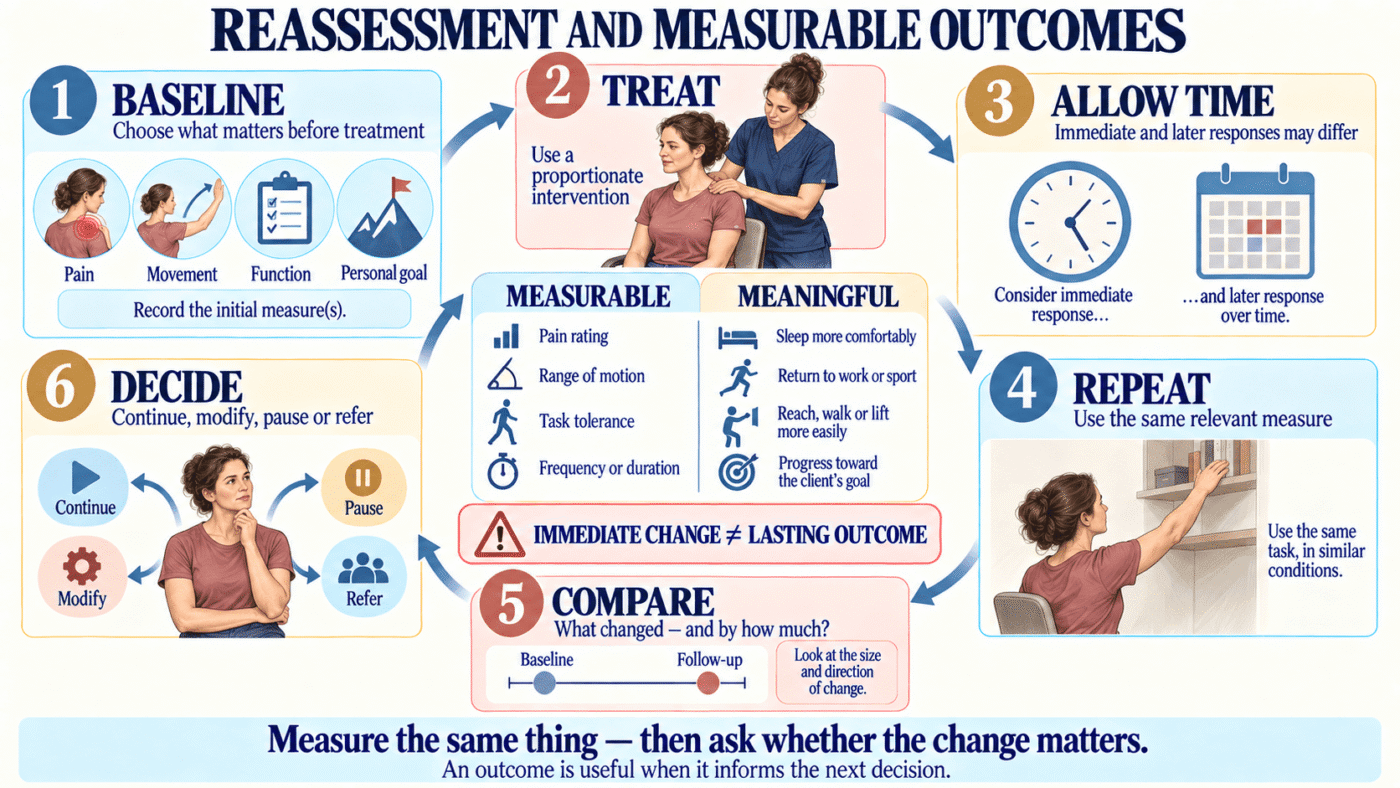
Feeling better matters. But if we want to understand whether treatment is helping, we need something to compare. That’s where reassessment comes in.
What Is Reassessment? Reassessment simply means checking something again after treatment. If we assessed your neck rotation before treatment, we check it again afterwards. If reaching overhead was painful, try it again. If bending to put on your shoes was difficult, let’s see what happens now.
The idea is simple:
Assess → Treat → Reassess
Without the first assessment, we don’t have a baseline. Without reassessment, we don’t know whether that baseline changed. What Should We Measure? Not everything needs a complicated measurement.
Sometimes useful outcomes are surprisingly simple.
“I can turn my head this far before it hurts.”
After treatment:
“I can turn further and it feels easier.”
That’s a change. Depending on the problem, we might look at:
- pain or symptom intensity
- range of motion
- ease of movement
- strength or functional capacity
- a specific painful movement
- walking or exercise tolerance
- ability to work
- sleep
- everyday activities
But here’s the important part: Measure something that matters to the person. Improving a number on an assessment is useful. Being able to put your socks on comfortably again may be more useful.
Sometimes the change after treatment is obvious. You move further. Pain decreases. The area feels easier. Excellent. But what happens when you leave the clinic?
What happens tomorrow?
And several days later?
Can you work more comfortably?
Did the improvement last?
Did the symptoms return after the same activity?
Did something unexpected happen?
The immediate response tells us something. The response over time may tell us even more. That’s why at OLO, in some cases, we may allow time before the next session rather than immediately repeating the same treatment.
We’re giving the body an opportunity to respond — and giving ourselves something meaningful to observe. That doesn’t mean there’s one perfect recovery interval for everyone. It means time can be part of reassessment too.
This one is important. Imagine we treat your shoulder. Then we repeat the movement. Exactly the same. Was the treatment a failure? Not necessarily.
We’ve learned something. Perhaps the area we treated wasn’t as important as we thought. Perhaps the technique wasn’t appropriate. Perhaps strength, rehabilitation or another factor needs more attention. Perhaps we need to reconsider our clinical hypothesis.
Good clinical reasoning doesn’t hide an outcome because it wasn’t the outcome we wanted. No meaningful change is information. And information should influence what we do next.
Deep pressure doesn’t prove effective treatment. Soreness afterwards doesn’t prove effective treatment. Using more techniques doesn’t prove effective treatment.
And having massage every week for months doesn’t automatically prove that the problem is improving. The question isn’t: “How much treatment did I receive?”
The question is: “Am I actually progressing?” If the same problem receives the same treatment repeatedly without meaningful improvement, eventually we should ask why. Simply repeating it isn’t reassessment.
Suppose your pain was 7/10.
Now it’s 5/10.
Useful. But perhaps something else changed too. You slept through the night.
You worked a full day comfortably.
You returned to training.
You can turn your head while driving.
You walked five kilometres again.
You picked up your child without worrying about your back.
Those are outcomes. And sometimes they’re far more meaningful than moving from one number to another.
Treatment should have direction. Maybe you need another session. Maybe you don’t. Maybe treatment needs to change.
Maybe exercise or rehabilitation becomes more important.
Maybe the symptoms need further investigation.
Reassessment helps us make that decision. Because good treatment shouldn’t be measured by how many appointments someone books. It should be measured by whether we’re helping them move toward the outcome that matters.
So before treatment begins, ask: “What would improvement look like for me?”
Then after treatment: “Did anything actually change?”
And later: “Did that change matter in my life?”
Those three questions can tell us a lot. Measure what matters to your life.
Your Body Talks. Learn to Listen.
One final question: If you’ve been receiving the same treatment for months…
what can you do now that you couldn’t do when you started?
If that’s difficult to answer, it might be time to reassess more than your movement.

Ask it. Even if you think it’s a ridiculous question.
Someone else has probably wondered exactly the same thing.
