How Treatment Techniques Are Selected?
Which technique are you going to use?
Deep tissue?
Trigger point therapy?
Stretching?
Cupping?
Maybe a little bit of everything?
Actually, there’s a more important question:
Why are we choosing that technique in the first place?
In good treatment, the technique shouldn’t come first.
The problem comes first.
Imagine opening a toolbox. You wouldn’t pick up a hammer first and then walk around looking for something to hit. Hopefully.
A Technique Is a Tool — Not a Diagnosis
Treatment techniques work the same way. Deep pressure isn’t appropriate simply because something feels tight. Trigger point therapy isn’t required every time we find tenderness. Cupping isn’t automatically better because it leaves impressive-looking circles. And stretching isn’t the answer to every restricted movement.
Each technique is simply a tool.
The therapist’s job is to decide whether that tool makes sense for the problem in front of them.
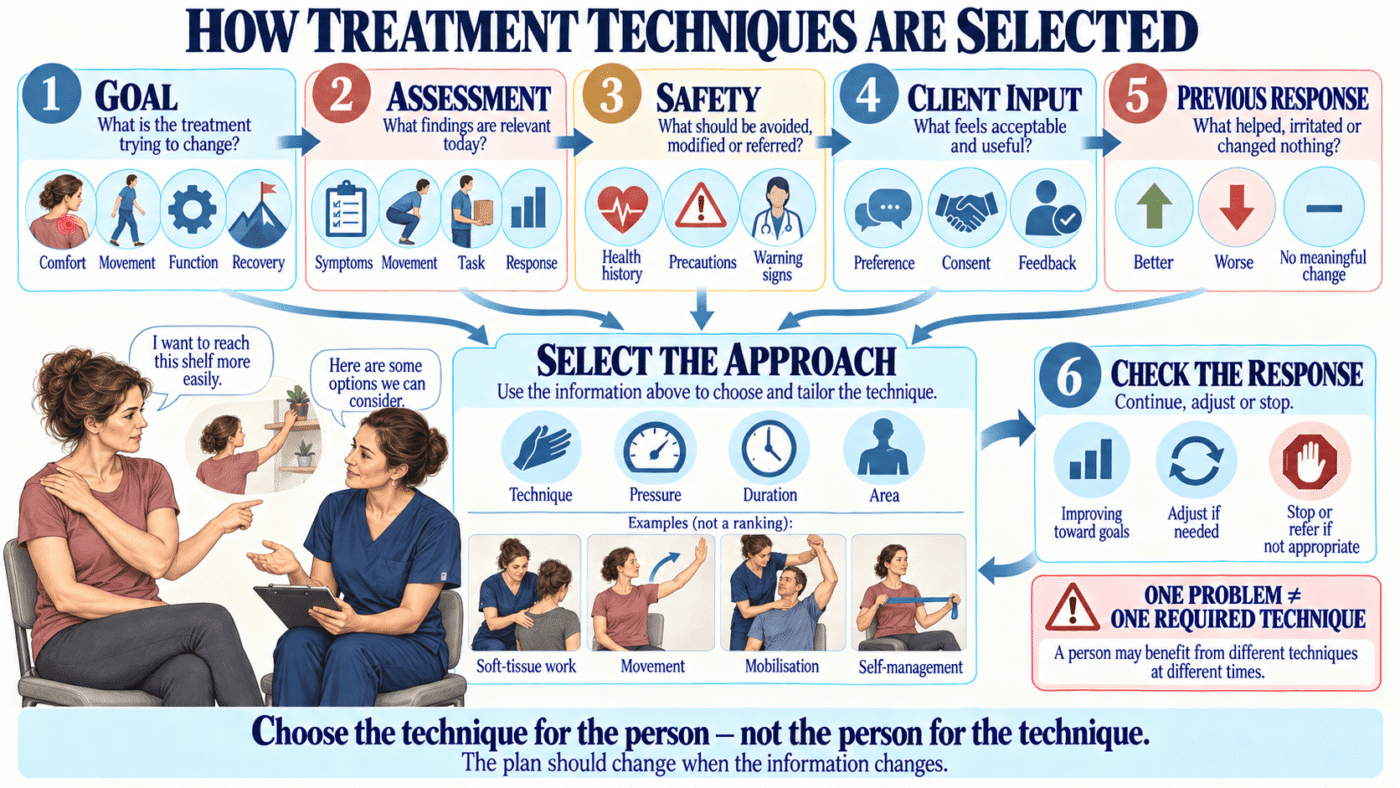
Before selecting a technique, we need information.
What brought you in?
What are your symptoms?
What movement is difficult?
What did we find during assessment?
What are you trying to get back to doing?
And importantly:
Is massage or manual therapy appropriate at all?
Only then does selecting a treatment technique start to make sense. For example, two people may both arrive with shoulder pain. One struggles with reaching overhead after increasing their training. Another has pain with numbness and weakness travelling into the arm.
Same location. Very different presentation. They shouldn’t automatically receive the same treatment simply because both pointed to their shoulder.
Treatment selection may be influenced by several things:
- health history and precautions
- symptoms
- assessment findings
- range of motion
- functional movement
- tissue sensitivity
- treatment goals
- client preference and tolerance
- response to previous treatment
- evidence and clinical experience
This also means the treatment plan may change from one appointment to another. Your body isn’t required to present exactly the same problem every Tuesday at 3:00 pm. We reassess. Then we decide again.
This deserves repeating. Intensity is not the same thing as effectiveness. Sometimes firmer pressure may be appropriate. Sometimes lighter work makes more sense. Sometimes we may work directly around the symptomatic area. Sometimes other relevant areas need assessment too.
The question isn’t: “How deep can we go?” It’s: “What are we trying to achieve?”
And treatment should remain within what is appropriate and tolerable for the client. You’re not supposed to win a bravery competition on the massage table.
Clinical reasoning doesn’t mean the therapist gets to make every decision alone. You are part of the process. If a technique feels uncomfortable, tell us.
If something helped previously, tell us.
If you don’t want cupping, that’s useful information.
If you’re worried about a particular technique, ask why it’s being recommended.
A therapist should be able to explain the reasoning behind a treatment choice. Treatment should be a conversation, not something simply done to you.
Suppose your neck rotation is restricted before treatment. We choose a technique because we think it may help. Afterwards: Turn your head again.
Better?
More comfortable?
Further?
No difference?
All of those responses give us information. If something improved, excellent. If nothing changed, simply doing more of the same technique isn’t automatically the answer. We may need to modify the treatment, reconsider our original idea, look at another factor or decide that manual therapy isn’t the most useful next step.
That’s why technique selection and reassessment belong together.
Don’t Fall in Love With the Technique
Therapists can have favourite techniques. Clients can too. There’s nothing wrong with that. The problem begins when every condition starts receiving the same solution. If the only tool we believe in is a hammer…the human body starts looking suspiciously full of nails.
Good treatment should remain flexible.
Assess → Choose → Treat → Reassess → Adapt
Sometimes the right choice is deep tissue work. Sometimes it’s a gentler approach. Sometimes movement or exercise needs to become part of the plan. Sometimes another healthcare professional is more appropriate.
And sometimes the best decision is not to treat yet. The name of the technique isn’t what makes treatment clinical. The reasoning behind choosing it does.
So next time someone recommends a treatment technique, there’s nothing wrong with asking. “Why this one?” A good answer should involve more than:
“Because that’s what I always do.”
Your Body Talks. Learn to Listen.
And if you see a treatment technique online that apparently fixes everything from headaches to your neighbour’s lawnmower…
maybe ask a few questions before booking it.
Ask it. Even if you think it’s a ridiculous question.
Someone else has probably wondered exactly the same thing.
