
There’s a knot right there.
You know the spot.
The therapist presses it.vYou immediately say: “Yep. THAT one.”
Sometimes the discomfort even seems to travel somewhere else.
This is often described as a trigger point.
But what exactly is a trigger point? And does pressing harder until it disappears really fix the problem? Not quite.
What Is a Trigger Point?
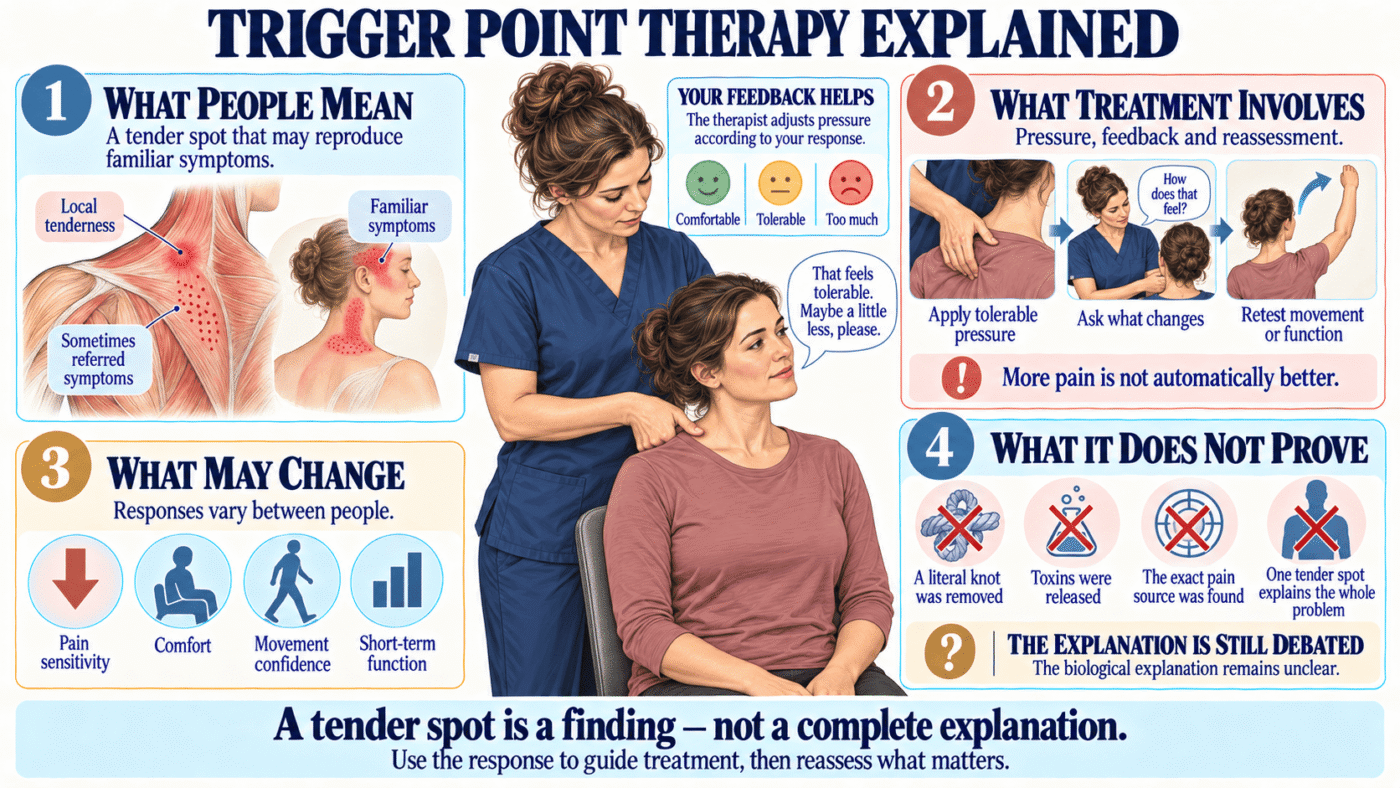
In manual therapy, a trigger point is commonly described as a sensitive area within muscle tissue that may be painful when pressed and may sometimes reproduce familiar symptoms.
A therapist may notice an area that feels:
- locally firm or different from surrounding tissue
- tender to pressure
- familiar to the client’s usual symptoms
- associated with discomfort locally or elsewhere
These findings can be useful.
“Knot” is a convenient word. You can picture it immediately. But muscles aren’t shoelaces. We shouldn’t imagine a literal knot sitting inside the muscle waiting for someone to untie it.
There are different theories about what produces these sensitive areas, and the biology of trigger points isn’t completely settled. So claims such as: “This is trapped lactic acid.” or “I can feel exactly what’s wrong inside this muscle.” go further than the assessment can reliably tell us.
What we can say more confidently is: “This area is sensitive, and pressure here reproduces something meaningful to you.” Then we investigate whether that finding actually matters.
Trigger point therapy generally involves applying pressure or other manual techniques to a sensitive area for a period of time. The pressure may be sustained or adjusted depending on the technique and the client’s response.
Some people experience reduced tenderness, less discomfort or easier movement afterwards.
But the goal shouldn’t be:
“Press until the knot surrenders.”
Pain isn’t proof that the technique is working. More pressure isn’t automatically more effective. And you’re still not competing in a bravery competition on the massage table.
Some sensitive muscular areas may produce discomfort somewhere other than exactly where pressure is applied. This is often described as referred pain.
That can provide useful clinical information. But a trigger-point chart isn’t a GPS map of the human body. If pressing one area reproduces your headache, for example, that doesn’t automatically prove:
“This muscle is the cause of your headaches.”
We still need the rest of the story.
History.
Symptoms.
Movement.
Function.
Other possible explanations. And appropriate medical assessment when indicated.
Reproducing a symptom is a clue not a diagnosis.
We reassess. Suppose turning your neck was painful before treatment. We identify a relevant tender area and use trigger point therapy.
Then: Turn your neck again.
Does it move more comfortably?
Has the familiar pain changed?
Is the movement easier?
Nothing changed?
That’s useful too. The success of trigger point therapy shouldn’t be measured by how painful the pressure was or whether the therapist felt the tissue become softer. It should be connected to something meaningful for the client.
Trigger Point Therapy Is a Tool
Trigger point therapy may be useful as part of a broader treatment approach. But it isn’t the answer to every pain problem. Not every tender spot needs treatment. Not every pain comes from a trigger point.
And not every recurring trigger point means you need increasingly aggressive massage. Sometimes manual treatment helps. Sometimes movement, strength, workload management or recovery deserves more attention. Sometimes the presentation needs further assessment.
The important part isn’t finding as many painful spots as possible. It’s understanding whether the finding relates to the problem you’re actually trying to change.
So when your therapist finds that spectacularly tender little spot and says: “Feel that?” Yes. Absolutely. We felt it. Now comes the more important question:
“Does it matter?”
Your Body Talks. Learn to Listen.
And if someone tells you they can remove every trigger point from your body permanently…you may have just discovered a different kind of sensitive spot.

Ask it. Even if you think it’s a ridiculous question.
Someone else has probably wondered exactly the same thing.
