
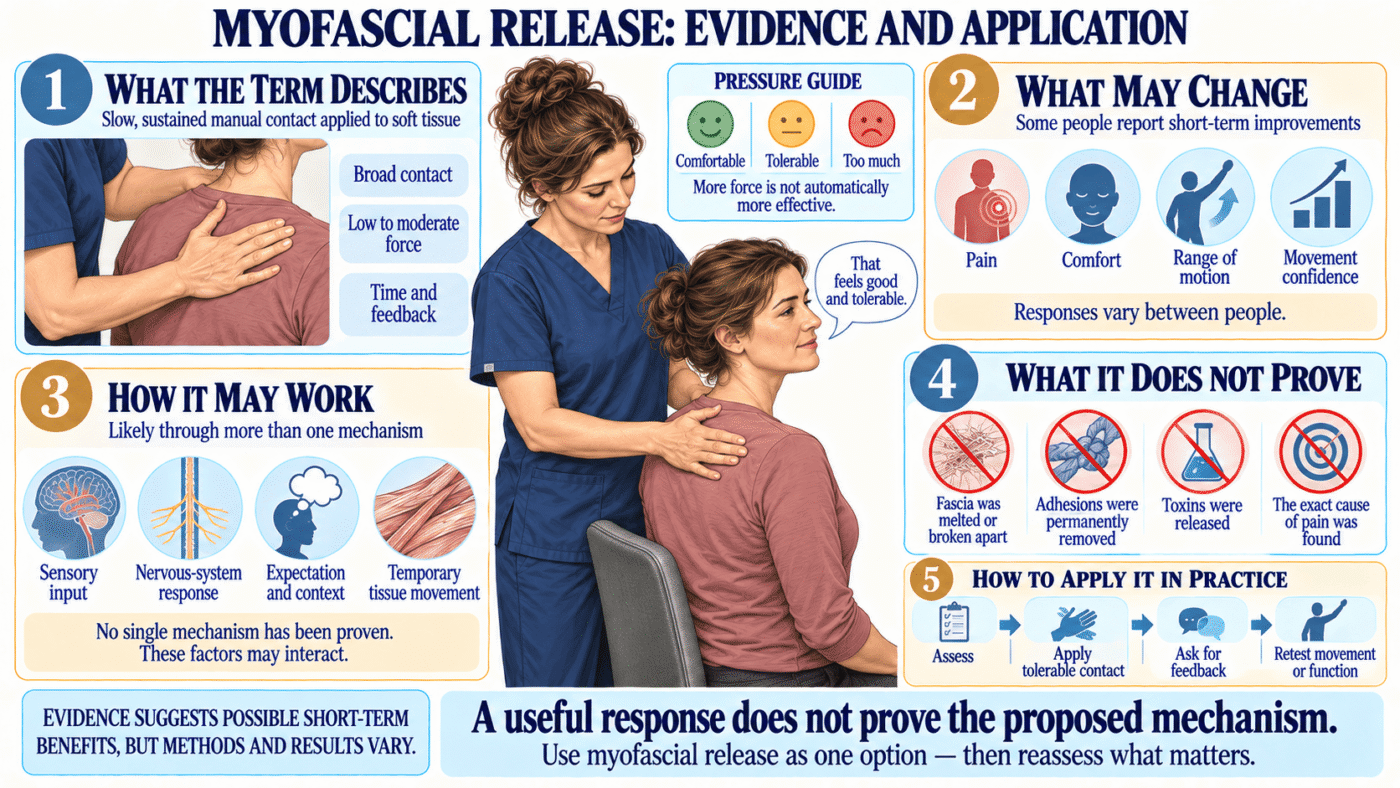
You may have heard this before.
“My fascia is really tight.” Or perhaps:
“Your fascia is stuck.” “We need to break up the fascia.” Fascia is real. Myofascial techniques are real.
But some of the explanations surrounding them can become much more dramatic than the evidence allows.
So what is myofascial release, and what might it actually do?
First — What Is Fascia?
Fascia is connective tissue found throughout the body. It surrounds, supports and connects muscles and other structures, contributes to force transmission, and allows different tissue layers to interact during movement.
So yes — fascia matters. But fascia isn’t a mysterious wrapping that suddenly becomes responsible for every ache, restriction or movement problem.
Pain is rarely explained by one tissue alone.
Myofascial release is a broad term used for manual techniques that apply pressure, stretch or sustained contact to muscles and surrounding connective tissues. Some approaches use slow sustained pressure.
Others involve movement while the therapist maintains contact with the tissue. The exact technique can vary considerably between therapists. Clients may experience changes such as:
- reduced discomfort
- reduced feelings of tightness
- improved ease of movement
- temporary changes in range of motion
- relaxation or altered tissue sensation
Those can all be useful outcomes. But explaining why they happen requires more caution.
This is where things get interesting. After treatment, an area may genuinely feel softer or move more comfortably. The client may feel less restricted.
The therapist may notice a change under their hands. Something changed. But that doesn’t necessarily mean we physically broke apart, unstuck or permanently reshaped the fascia.
Manual therapy also provides sensory input to the nervous system and can influence pain, muscle activity, movement and the way an area feels. Several mechanisms may contribute at the same time.
So instead of confidently saying: “I released your fascia.” a more accurate interpretation may be: “The treatment changed how this area feels or moves. Now let’s see whether that change is useful.”
Less exciting? Perhaps. More defensible? Absolutely.
Research into myofascial release has reported potential improvements in areas such as pain, flexibility and range of motion in some populations and conditions. But results vary. Studies also differ in treatment methods, duration, populations and how outcomes are measured.
That makes broad claims difficult. So the evidence doesn’t justify saying: “Myofascial release fixes fascia and therefore fixes pain.” A more reasonable position is: Myofascial release may be useful for some people as one part of a broader treatment approach.
And that’s enough. A treatment doesn’t need a magical explanation to be clinically useful.
Technique selection should come after assessment. Suppose someone reports: “My shoulder feels restricted when I reach overhead.” We assess the movement.
We consider their history, symptoms and function. If a myofascial technique seems appropriate, we may use it. Then comes the important part: Reach overhead again.
Did the movement change?
Does it feel easier?
Has discomfort changed?
Can the person perform the activity more comfortably?
That’s much more useful than simply saying: “The fascia feels looser now.”
This is where we need to look beyond the treatment table. If someone repeatedly feels tight or restricted, more myofascial release isn’t automatically the answer. We may need to consider:
Workload.
Movement.
Strength.
Training.
Recovery.
Previous injury.
Pain sensitivity.
Daily activity.
Or whether we’re even dealing primarily with a musculoskeletal problem. Manual therapy may help create a useful window where movement feels easier. What we do with that window may matter just as much as the technique itself.
Sometimes that means movement.
Sometimes exercise or rehabilitation.
Sometimes changing workload.
Sometimes simply observing what happens next.
Fascia is normal tissue. We don’t need to make people afraid of it. Your fascia isn’t quietly plotting against you while you sleep. And finding a tender or firm area doesn’t automatically mean something needs to be “released.”
The better clinical process remains:
Assess → Choose → Treat → Reassess
Did symptoms change?
Did movement improve?
Did function improve?
Did the change last long enough to matter?
Those questions are more valuable than trying to prove that we physically changed one particular tissue. Myofascial release can be a useful manual therapy technique. But the technique should remain a tool, not become the explanation for every problem.
So if someone tells you: “Your fascia is stuck.” there’s a perfectly reasonable question to ask: “How do we know?” That’s not challenging the therapist. That’s asking for clinical reasoning.
Your Body Talks. Learn to Listen.
And don’t worry. Your fascia doesn’t need to be perfectly “released” before you’re allowed to move.
It has been coming along for the ride your entire life.

Ask it. Even if you think it’s a ridiculous question.
Someone else has probably wondered exactly the same thing.
