I want deep tissue massage.
How deep?…As deep as you can go.
This is where we need to have a conversation.
Because somewhere along the way, deep tissue massage became associated with one simple idea:
More pressure = better treatment.
But that’s not how good manual therapy should work.
What Is Deep Tissue Massage?
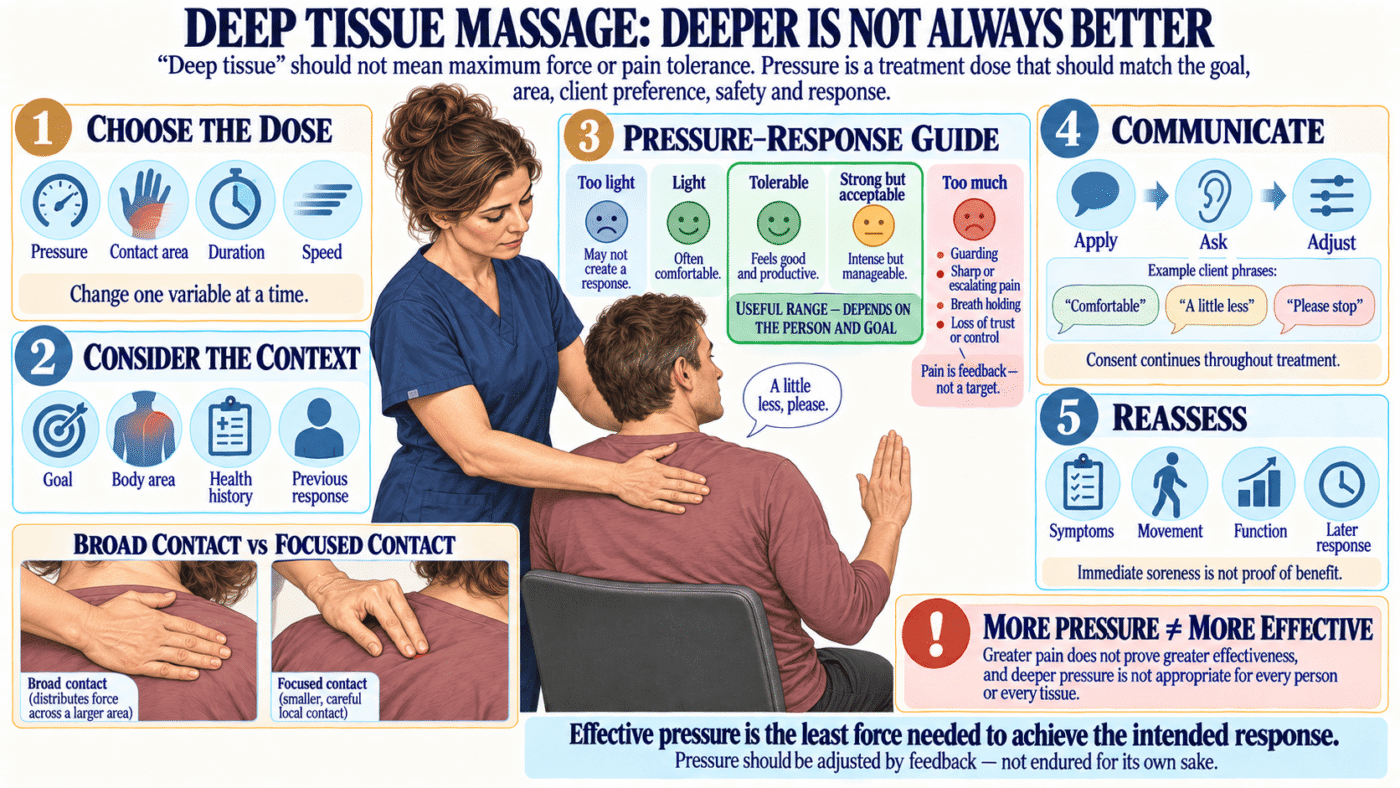
The term deep tissue massage is commonly used to describe massage techniques intended to work with deeper muscles and soft tissues, often using slower, more focused pressure. But “deep” doesn’t necessarily mean: Press as hard as possible.
The amount of pressure that makes sense depends on the area being treated, the client’s sensitivity, the treatment goal and what we’re actually trying to change. Sometimes firmer pressure is appropriate. Sometimes it isn’t. Depth should have a reason. Pain Is Not a Measure of Quality You’ve probably heard: “No pain, no gain.”
Not a particularly good rule for a massage table. A treatment doesn’t become more effective simply because you can tolerate more pain. In fact, if you’re holding your breath, clenching your fists and trying desperately not to move while telling yourself:
“I can handle it…”
we should probably communicate. You’re not supposed to win a bravery competition during treatment. The Deepest Structure Isn’t Always the Problem Suppose your lower back hurts. Does that mean we need to reach the deepest muscle possible? Not necessarily.
Pain may involve multiple factors, including muscles, joints, movement, workload, previous injury and the nervous system. Even when deeper tissues are clinically relevant, simply applying more pressure doesn’t tell us whether we’ve identified the important factor. That’s why treatment should begin with assessment.
What movement is difficult?
What reproduces the symptoms?
What did we find?
What are we trying to change?
Then we decide whether deeper work makes sense.
Not the other way around.
This is important too. “Deeper isn’t always better” doesn’t mean deeper treatment is always wrong. There are situations where a therapist may decide that working with deeper tissues is appropriate.
Pressure may gradually increase as the therapist observes how the area and client respond. The difference is intent. We’re not going deeper to prove that the treatment is powerful. We’re going deeper because there’s a clinical reason to work there. And if less pressure achieves the outcome we want?
Excellent.
There is no bonus point for making it hurt more. Communication Changes the Treatment Pressure shouldn’t be something the therapist decides alone. If something feels too intense, tell us. If the sensation feels sharp, unusual or completely different from what you expected, tell us.
If you want less pressure, say so. You don’t need to apologise. And please don’t wait until the end of the session to announce: “That was actually unbearable.” We could have used that information about forty minutes ago.
Treatment should be a conversation, not an endurance test. Soreness Doesn’t Prove the Treatment Worked. You may feel some temporary tenderness after more intensive manual therapy.
That can happen. But waking up the next morning feeling as though you’ve been hit by a truck doesn’t automatically mean: “Wow. That therapist really fixed me.”
Post-treatment soreness isn’t the goal. Neither is bruising. Neither is surviving the session. The better question is: What improved?
Did movement become easier?
Did the symptom change?
Can you perform the activity that was difficult before?
And what happened over the following days?
Those outcomes tell us much more than how painful the treatment felt.
Some people genuinely prefer firmer massage. Some respond well to it. Others don’t. And even the same person may need different pressure depending on the problem, area and stage of recovery. That’s why we shouldn’t build treatment around: “I always need deep tissue.” We should build it around: “What does my body need today?”
Sometimes the answer may involve deeper work. Sometimes trigger point techniques. Sometimes gentler manual therapy. Sometimes movement or exercise. Sometimes recovery.
The goal isn’t to reach the deepest tissue we possibly can. The goal is to use the appropriate amount of treatment to create a meaningful outcome.
So next time you’re asked: “Would you like more pressure?” don’t automatically think that saying yes makes you tougher. Ask yourself: “Would more pressure actually make this treatment better?”
Sometimes yes.
Sometimes no.
That’s why we assess.
Deeper is not automatically better. Appropriate is better.
Your Body Talks. Learn to Listen.
And if your therapist asks whether the pressure is okay… you are allowed to say “less.”
Your massage table has no leaderboard.
Ask it. Even if you think it’s a ridiculous question.
Someone else has probably wondered exactly the same thing.
