My joint feels stuck.
It’s a phrase therapists hear quite often.
Maybe your neck won’t turn comfortably. Your ankle feels restricted. Or your shoulder simply doesn’t move the way it normally does. So does the joint need to be “put back into place”? Usually, that’s not a useful way to think about it. This is where joint mobilisation needs a little explanation.
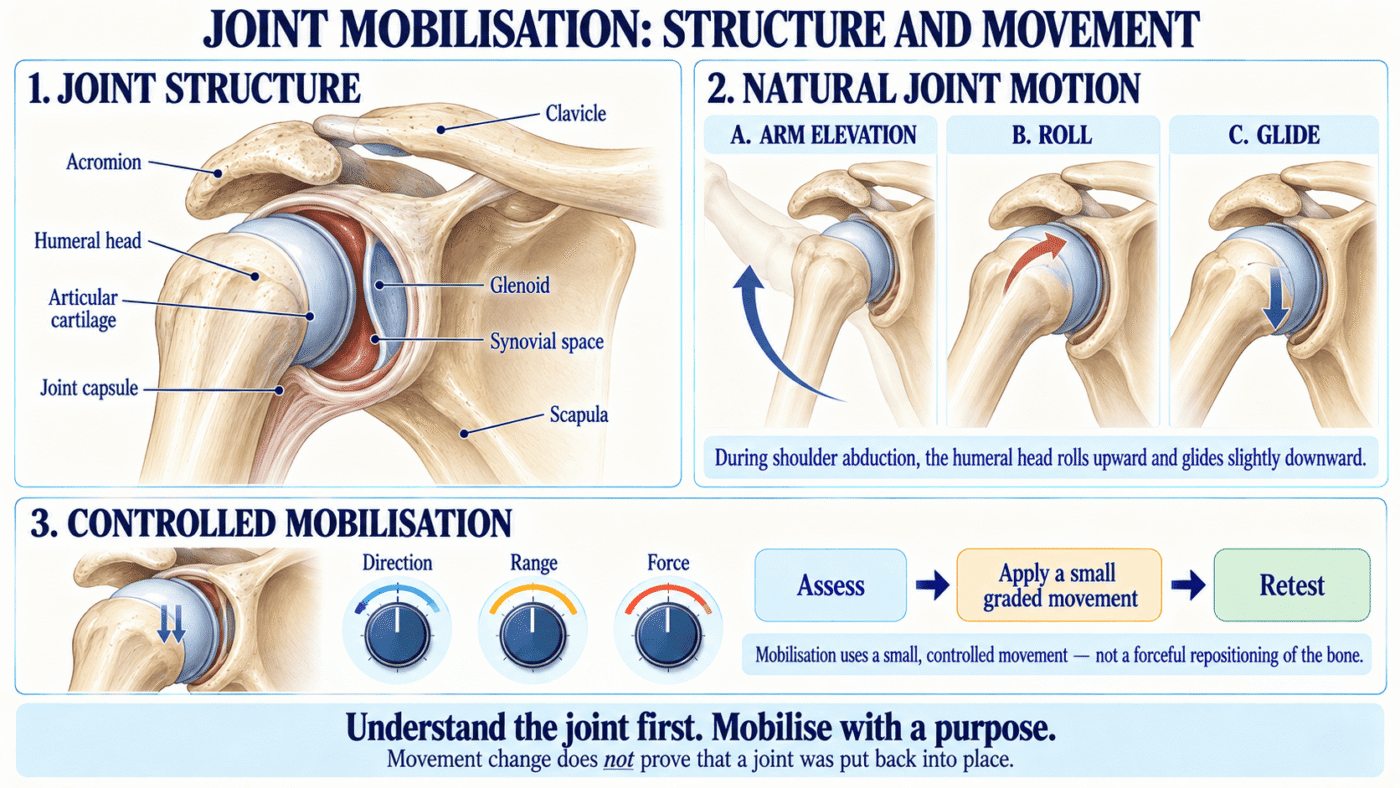
Joint mobilisation is a manual therapy approach involving controlled movement applied to a joint within an appropriate range.
Depending on the joint, assessment and therapist’s training, the movement may be gentle and rhythmic or somewhat firmer. The purpose may be to help with things such as:
- pain or discomfort
- joint movement
- stiffness
- range of motion
- confidence with movement
- preparing an area for further movement or exercise
But joint mobilisation isn’t simply about making something move further.
The goal should relate to the client’s problem.
A Joint Isn’t Necessarily “Out” This is an important distinction. When movement feels restricted, people sometimes describe the joint as: “Out.” “Misaligned.” or: “It needs to be put back.”
But ordinary musculoskeletal pain and stiffness usually shouldn’t be explained as bones casually moving out of position. If a joint were genuinely dislocated, that’s a very different medical situation. A joint can feel stiff or painful for many reasons. Pain itself can change movement.
Muscles can alter how they work around the joint. Previous injury, swelling, workload, joint structures and the nervous system may all influence what someone experiences.
So rather than immediately saying:
“This joint is out.”
a better question is:
“Why isn’t this movement comfortable right now?”
Assessment comes first. Suppose you have difficulty turning your neck. We might assess:
How far can you turn?
Where do symptoms begin?
Is one direction different?
Are there neurological symptoms?
Was there an injury?
Does the presentation appear appropriate for manual treatment?
Only after considering the available information should we decide whether joint mobilisation might be useful. Technique follows reasoning. Not the other way around.
No.
A click or pop isn’t the goal of joint mobilisation. And the absence of a sound doesn’t mean nothing happened. The outcome we’re interested in is much more useful: Does movement feel different afterwards?
Can you turn further?
Is the movement more comfortable?
Can you perform the activity that was difficult before?
That’s what we reassess. Your joints don’t give bonus points for sound effects. More Movement Isn’t Automatically Better We’ve already seen this with range of motion. Maximum mobility isn’t the goal for every joint or every person.
Some people naturally move more than others. Some activities require greater mobility. Others require considerable stability and control. So if mobilisation increases movement, that doesn’t automatically mean we’ve created a better outcome.
We still need to ask: Did the change improve function? A few extra degrees on an assessment may be interesting. Being able to comfortably turn your head while driving may matter much more.
Sometimes mobilisation may make movement feel easier. That can create a useful opportunity. But what happens next? Perhaps we reassess the movement. Perhaps the client needs to practise moving through the newly comfortable range.
Perhaps strength or rehabilitation matters. Perhaps workload needs attention. Or perhaps the improvement doesn’t last and we need to reconsider the original problem. Manual therapy can be part of the process. It doesn’t need to be the entire process.
Not every stiff or painful joint should be mobilised. Recent significant trauma, suspected fracture or dislocation, certain stages of healing, significant instability, some medical conditions, or concerning neurological symptoms may change whether or how manual therapy should be performed.
The therapist also needs to work within their training and professional scope of practice. Sometimes treatment needs modification. Sometimes we wait. Sometimes another healthcare professional should assess the problem first.
Knowing when not to mobilise is part of knowing how to mobilise.
The process remains familiar:
Assess → Choose → Mobilise → Reassess
Did pain change?
Did range of motion change?
Did function improve?
Did nothing happen?
All of those outcomes provide information. Joint mobilisation isn’t successful because the therapist performed the technique perfectly. It’s useful when it contributes to an outcome that matters to the client.
So if someone tells you: “Your joint was out, but I put it back in.” it’s reasonable to ask: “What changed, and how did we measure it?” Good treatment shouldn’t make you afraid that your body is constantly falling out of alignment. Your body is considerably more robust than that.
Your Body Talks. Learn to Listen.
And if nothing clicked? Don’t worry.
Your joints aren’t required to provide applause after treatment.

Ask it. Even if you think it’s a ridiculous question.
Someone else has probably wondered exactly the same thing.
