
“My hamstrings always feel tight.”
“So I should stretch them more, right?”
Maybe. But first, there’s a better question: Why do they feel tight?
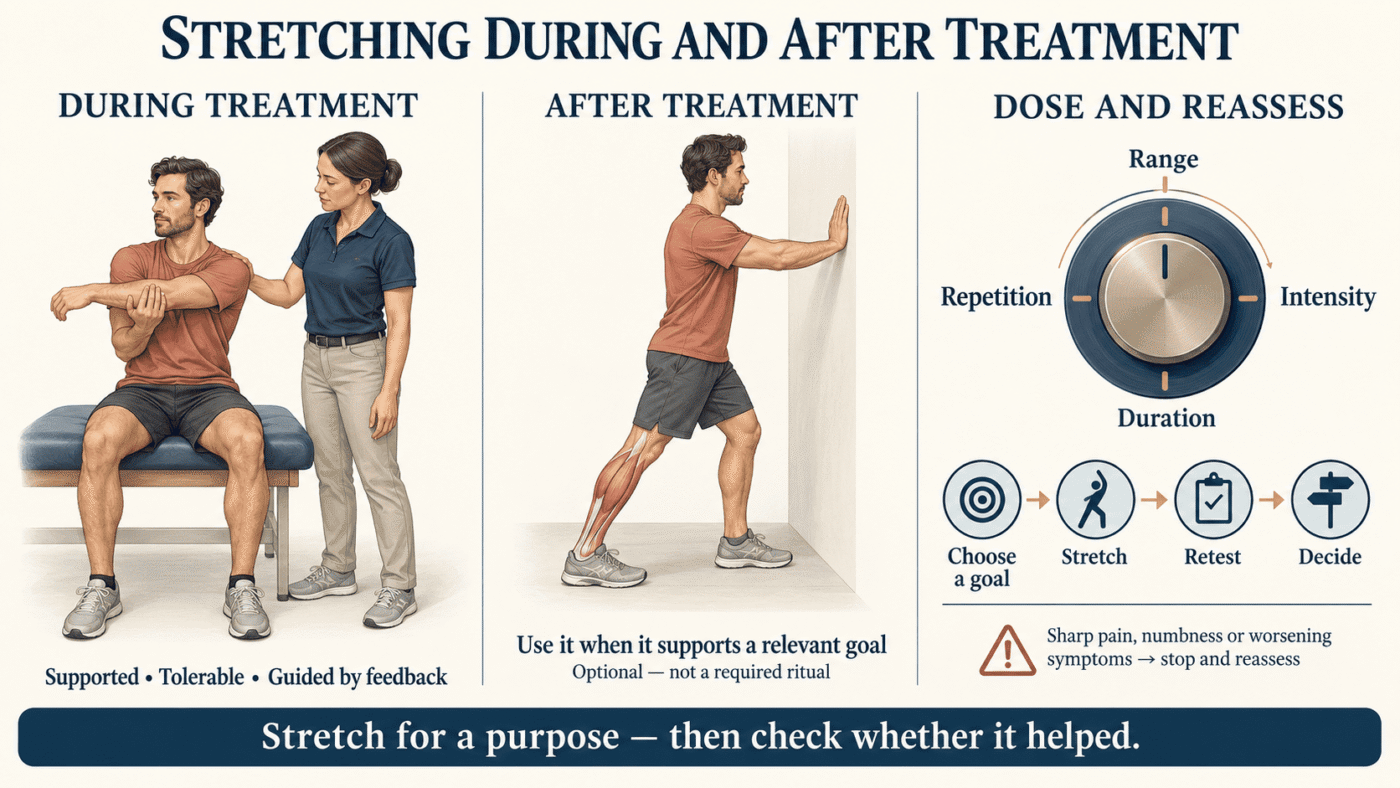
Stretching can be useful during and after treatment. But like every other technique, it works best when there’s a reason for using it not simply because something feels tight.
Stretching generally involves moving a muscle and surrounding tissues into a position that increases tension and challenges the available range of motion.
Depending on how it’s performed, stretching may help temporarily improve:
- flexibility
- range of motion
- comfort with movement
- tolerance to certain positions
- confidence moving into a previously uncomfortable range
Those can be useful changes. But stretching doesn’t automatically mean we’re permanently “lengthening” a short muscle. Changes in flexibility can involve several factors, including how comfortable and tolerant the body becomes at the end of a movement.
So if you suddenly reach further after stretching, something changed. We just shouldn’t assume we know the entire biological explanation from that result alone.
Stretching Shouldn’t Be a Pain Competition
A stretch may create a pulling or tension sensation. That doesn’t mean you need to force yourself further. Sharp pain, unusual symptoms, numbness, tingling or increasing pain aren’t things to chase because:
“I just need to loosen it up.”
And bouncing aggressively into a painful range isn’t automatically going to make the result better. Your body doesn’t award flexibility points for suffering.
During a remedial massage session, stretching may be used alongside other manual techniques. For example, we assess shoulder movement and notice that reaching overhead feels restricted. After some treatment, we may introduce an appropriate stretch or assisted movement.
Then we test the original movement again. Did anything change? That’s the important part. Stretching isn’t there because every massage session needs a dramatic final pull. It’s there because we have a reason to see whether changing movement tolerance or available range helps the problem we’re assessing.
This distinction matters. A muscle can feel tight without necessarily being physically shortened.
That sensation may occur after unfamiliar exercise, prolonged activity, increased workload, pain or changes in how the body is using the area. So: “It feels tight” doesn’t automatically lead to: “Stretch it harder.” Sometimes stretching feels excellent.
Sometimes strengthening or movement may be more relevant.
Sometimes recovery matters.
Sometimes we need to understand why the sensation keeps returning. And occasionally, stretching an already sensitive area simply makes it more irritated.
The sensation gives us information. It doesn’t prescribe the treatment.
Touching your toes is impressive. Unless touching your toes has absolutely nothing to do with the problem you’re trying to solve. Different people need different amounts of mobility.
A dancer, runner, tradesperson and office worker may place very different demands on their bodies. Some people are also naturally more mobile than others. The goal isn’t: “Become as flexible as possible.” It’s: “Have enough comfortable, controlled movement for what you need to do.”
Mobility without appropriate control isn’t automatically an advantage.
This is where people are often given instructions such as: “Make sure you stretch tonight.” But a useful recommendation should be more specific.
Which movement?
Why are we doing it?
How should it feel?
How often?
And what are we trying to improve?
If we identified a movement that responds well to stretching, continuing an appropriate version afterwards may be useful. But you don’t necessarily need a full stretching routine simply because you’ve had a massage.
Sometimes normal comfortable movement is enough. Sometimes exercise or strengthening is more important. Sometimes the best thing to do after treatment is simply observe how your body responds.
Suppose bending forward was uncomfortable before treatment.
We assess it.
We treat.
We use an appropriate stretch.
Then: Try the movement again.
Can you move more comfortably?
Has the range changed?
Does the original activity feel easier?
And later:
Did that improvement last?
That’s much more meaningful than saying: “Your hamstrings feel looser.”
Because ultimately we’re not treating someone to win a flexibility contest. We’re trying to improve something that matters in their life. Stretching can be useful. But it should remain a tool not an automatic prescription for every tight-feeling muscle.
So next time something feels tight, instead of immediately asking: “What stretch should I do?” try asking: “Why does this keep feeling tight, and what am I actually trying to improve?” That’s a much better place to start.
Your Body Talks. Learn to Listen.
And if you can’t touch your toes?
Don’t panic.
Your toes weren’t planning to go anywhere.

Ask it. Even if you think it’s a ridiculous question.
Someone else has probably wondered exactly the same thing.
