
“Wow. That mark is really dark.”
“So that means I had a lot of toxins in there?”
No. But this is probably one of the biggest misunderstandings about cupping therapy. Those circular marks can certainly look dramatic. What they tell us, however, is much less dramatic than many social-media explanations would have you believe.
So what does cupping actually do? And more importantly: Does it help?
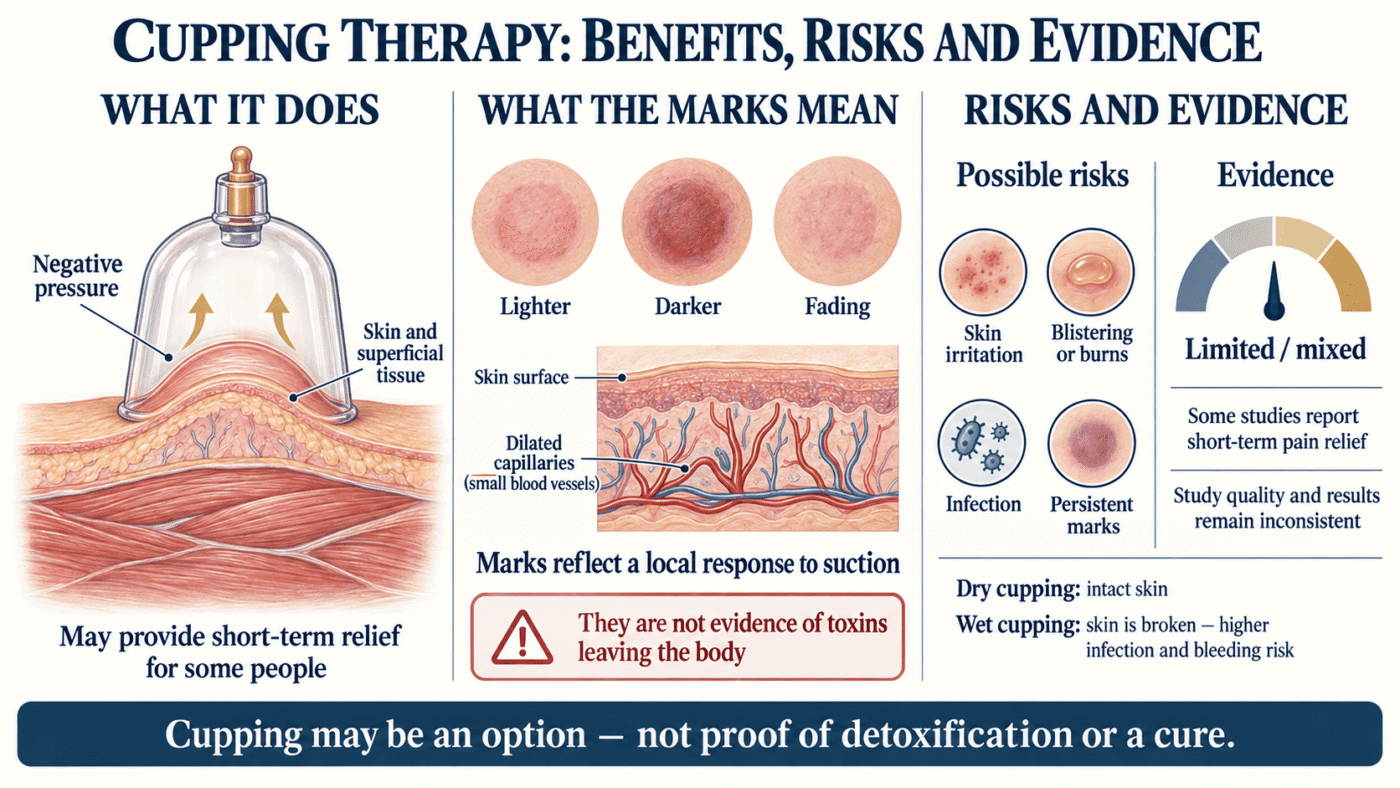
Cupping uses cups placed on the skin to create negative pressure or suction. Depending on the method, cups may remain stationary or be moved across the skin.
In remedial massage, cupping may be used alongside other manual therapy techniques when appropriate. People commonly seek it for problems such as:
- muscle soreness
- feelings of tightness
- musculoskeletal pain
- restricted or uncomfortable movement
- recovery after physical activity
Some clients love the sensation. Others take one look at the cups and immediately reconsider their life choices. Both responses are acceptable.
What Does Cupping Actually Do?
Unlike massage, where pressure is generally directed into the tissues, cupping creates suction at the skin. This affects the skin and superficial tissues beneath the cup and produces local mechanical and sensory stimulation.
It can also cause temporary changes in local circulation and the appearance of the skin. Some people report feeling: lighter, looser or more comfortable afterwards.
Those experiences are real and clinically relevant. But we need to separate what someone experiences from what we claim caused it.
This deserves its own section. The circular red, purple or darker marks sometimes left by cupping are primarily related to the physical effects of suction on superficial blood vessels and tissues. They are not a map showing where toxins were stored in the body. A darker mark doesn’t prove: “This area had more toxins.”
It also doesn’t prove that an area was more injured, more blocked or more in need of treatment. The colour and intensity of marks can vary depending on factors such as suction intensity, duration, location and individual tissue response.
So please don’t compare your circles with your friend’s circles and decide whose body was more “toxic.” That’s not a competition either.
Cupping has been studied for a variety of musculoskeletal pain conditions. Some research suggests that cupping may help reduce pain and improve function in certain people or conditions, particularly in the short term.
But there’s an important limitation. The quality of research is variable. Studies use different cupping methods, treatment schedules, comparison groups and outcome measures, which makes strong conclusions difficult.
Blinding is also challenging in a treatment where it’s fairly obvious whether someone has had a cup attached to them. So the evidence doesn’t justify claims such as:
“Cupping removes toxins.”
“Cupping breaks up scar tissue.”
“Cupping permanently improves circulation.”
or:
“Cupping fixes the underlying cause of pain.”
A more defensible position is: Cupping may provide symptom relief or changes in movement for some people, but it should be considered one treatment option rather than a cure.
That’s less spectacular. It’s also much more useful.
Imagine someone has discomfort around the shoulder and difficulty reaching overhead. We assess the movement first. Perhaps cupping is one appropriate treatment option. We apply it.
Then what?
We don’t simply admire the circles. Reach overhead again.
Did the pain change?
Does the movement feel easier?
Did range of motion change?
Can the person perform the activity more comfortably?
This gives us something meaningful to work with. The mark isn’t the outcome. The client’s response is.
Not necessarily. Just as deeper massage isn’t automatically better massage: More suction isn’t automatically better cupping. Increasing suction may increase discomfort and skin marking without necessarily creating a better clinical outcome.
Treatment intensity should be appropriate to the person, the area and the goal. If you’re lying there thinking: “This feels like an octopus is trying to take my shoulder home…” say something. Treatment can be adjusted.
Cupping is not risk-free simply because it doesn’t involve medication or surgery. Possible effects can include:
- temporary circular marks or discolouration
- tenderness or soreness
- skin irritation
- bruising
- blistering, particularly with excessive suction or duration
- dizziness or feeling light-headed in some people
Hygiene also matters. Poor infection-control practices can create unnecessary risk, particularly when skin integrity is compromised.
And wet cupping, which involves intentionally breaking the skin, is different from the dry cupping commonly incorporated into massage therapy and carries additional risks.
Cupping shouldn’t automatically be placed wherever something hurts. Treatment may need to be avoided or modified around areas with:
- broken or damaged skin
- active skin infection
- significant inflammation or acute injury
- unexplained swelling
- significant bruising
- recent surgery or wounds
- conditions or medications that increase bleeding or bruising risk
There may also be other individual medical considerations. That’s why health history and assessment still matter. A cup doesn’t bypass clinical reasoning.
Cupping Is a Tool — Not the Treatment Plan
The technique should support the goal. The goal shouldn’t become receiving the technique. So if you leave your appointment covered in perfectly symmetrical purple circles, remember:
They may look impressive. But they aren’t your treatment report. The important question remains: “What actually changed?”
Assess → Choose → Treat → Reassess
That’s how cupping becomes part of clinical treatment rather than simply an interesting collection of circles.
Your Body Talks. Learn to Listen.
And no — the darkest circle doesn’t win.

Ask it. Even if you think it’s a ridiculous question.
Someone else has probably wondered exactly the same thing.
