
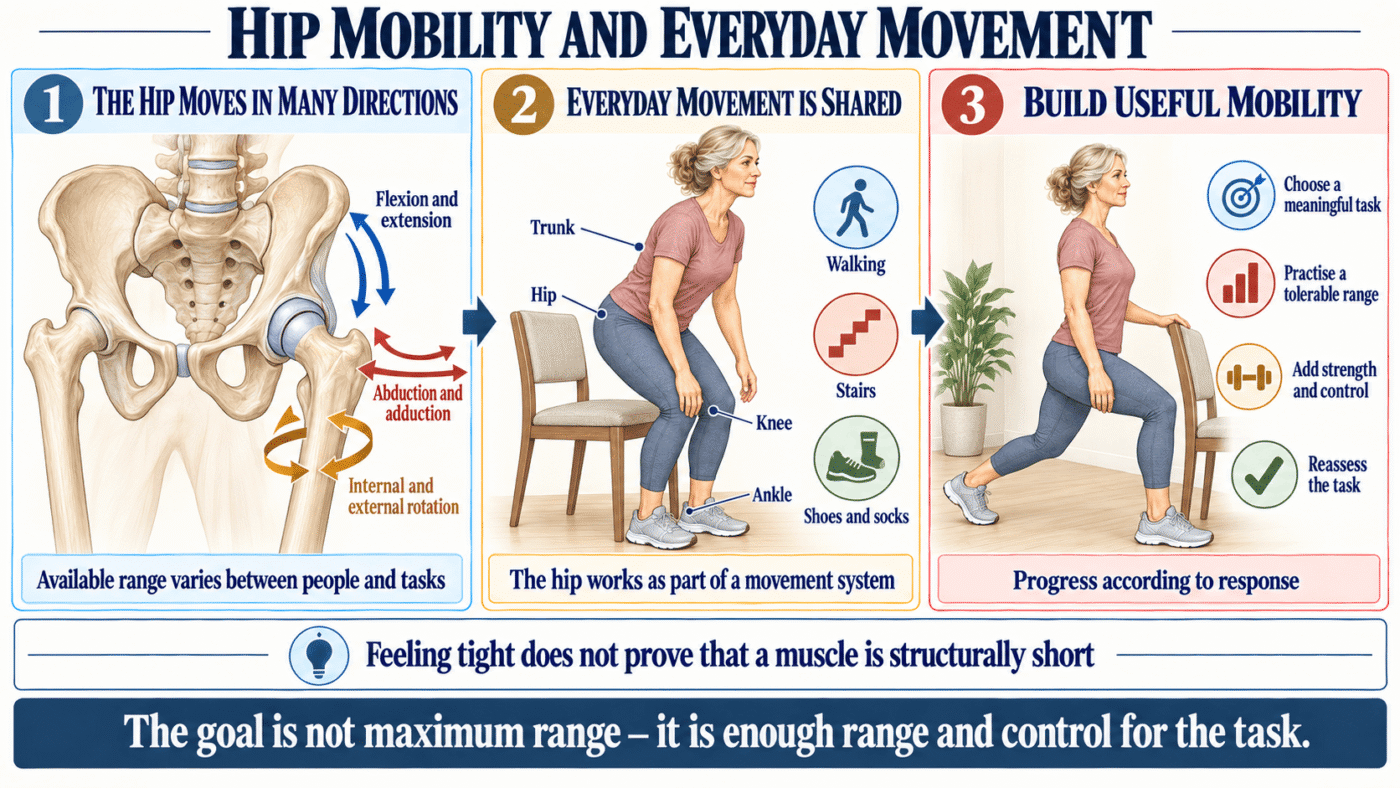
“My hips are really tight.”
Okay.
But what does that actually stop you from doing?
Walking?
Squatting?
Getting out of a chair?
Putting your shoes on?
Climbing stairs?
Or sitting comfortably on the floor?
Hip mobility isn’t just something we need for yoga, deep squats or impressive gym exercises. We use it throughout everyday life.
And when hip movement becomes uncomfortable or restricted, the answer isn’t automatically: “Stretch your hip flexors.” Let’s look at the bigger picture.
Where Does Massage Fit?
Massage and other manual therapy techniques may help reduce discomfort or feelings of tension around the hips for some people. That may make movement feel easier. Useful. But then we reassess.
Can you squat more comfortably?
Does walking feel different?
Can you move the hip through the previously restricted direction?
Can you perform the activity that originally bothered you?
If manual therapy creates a more comfortable window for movement, that may be an opportunity to use it. Treatment may help change how movement feels. Movement helps us discover what the body can do next.
The hip is designed to move in several directions. It allows the thigh to move:
- forward and backward
- out to the side and back toward the body
- inward and outward through rotation
- through combinations of these movements
But we rarely use these movements individually. Walking requires the hips to repeatedly accept and produce movement. Getting out of a chair requires the hips, knees, ankles and trunk to work together. Putting on your shoes may require hip movement, balance and control.
Even getting into a car can become surprisingly educational when one hip doesn’t want to cooperate. Everyday movement is a team effort.
Remember our framework:
Range → Control → Function
First, is enough movement available?
Then, can you control it?
Finally, can you use it for the task that matters?
Someone may have excellent passive hip flexibility but struggle to control that range during a squat. Another person may have less range but function perfectly well for everything they need to do. So the goal isn’t: “Create maximum hip mobility.” It’s: “Develop enough comfortable, controlled movement for your life.” “My Hips Feel Tight” This is one of the most common complaints. Especially after sitting.
The natural conclusion is often: “My hip flexors have shortened.” But a feeling of tightness doesn’t prove that a muscle has physically become too short.
That sensation may be influenced by many things, including:
- prolonged time in one position
- unfamiliar activity
- increased workload
- muscle fatigue
- pain or sensitivity
- changes in movement
- reduced physical activity
Stretching may feel useful. But if you’ve been stretching the same “tight” hip every day for months and the sensation keeps returning, it’s worth asking: “What else might this hip need?”
Your hip muscles don’t simply need to be flexible. They also need to produce and control force. Think about standing up from a chair. You need enough hip movement to get into position. But then you need enough strength to actually stand.
The same applies to stairs, walking, running, lifting and many other activities. This is why improving hip mobility may sometimes involve strengthening rather than continually trying to create more range. Available range needs to become usable range.
If you work at a desk, you may have heard: “Sitting is shortening your hip flexors.” That’s an oversimplification. Sitting is a normal position.
The bigger issue may be spending a large proportion of the day with relatively little movement variety. Instead of becoming afraid of sitting, try giving your hips more opportunities to do different things.
Stand.
Walk.
Change position.
Use stairs.
Move through comfortable ranges.
Participate in regular physical activity.
You don’t need to declare war on your chair.
You just don’t need to spend your entire movement vocabulary sitting in it.
Mobility work doesn’t always need a yoga mat. Consider ordinary movements: Getting up from a chair.
Walking.
Climbing stairs.
Squatting to pick something up.
Stepping over an object.
Getting down to the floor.
Getting back up again.
These are opportunities to use movement, strength and control together. And importantly, they’re connected to real function. If someone’s goal is to comfortably get down on the floor to play with their children, that’s probably a more meaningful mobility outcome than achieving an arbitrary number on a flexibility test.
Measure what matters to your life.
Should You Stretch Your Hips?
Sometimes.
If a particular stretch feels comfortable and helps improve a movement you’re working on, it may be useful. But don’t stretch simply because someone told you that every desk worker has “short hip flexors.” Ask:
What movement am I trying to improve?
Does this stretch change it?
Can I control the new range?
Does the improvement matter?
And does it continue to help over time?
Now stretching has a purpose.
Not every restricted hip simply needs more mobility work. Significant trauma, inability to bear weight, severe or rapidly worsening pain, substantial weakness, neurological symptoms, unexplained swelling, fever or feeling seriously unwell alongside hip pain deserve appropriate assessment.
Persistent hip or groin pain that continues to limit function may also need further investigation.
And pain during movement isn’t automatically something to push through because: “My hips just need opening.”
Your hips aren’t locked doors. We don’t need to attack them until they surrender.
If you’ve been relatively inactive, don’t expect your hips to immediately tolerate everything they once did. Start with your current capacity.
Move regularly.
Explore comfortable ranges.
Build strength.
Gradually increase movement or load.
Then observe how your body responds.
Move → Challenge → Recover → Adapt
Mobility develops through using the body not simply forcing it further.
Mobility Should Make Life Easier
Ultimately, we don’t need better hip mobility because hip mobility sounds healthy. We need it because hips help us do things: Walk, Work, Lift, Exercise, Sit, Stand, Climb, Play, Get down, And, importantly…get back up.
So instead of asking: “How flexible should my hips be?” ask: “Is my hip movement sufficient for what I want and need to do?”
That’s the question that connects mobility to real life.
Range → Control → Function
Not maximum range. Useful range.
Your Body Talks. Learn to Listen.
And if you can comfortably get down onto the floor but require furniture, two hands and a detailed escape plan to get back up…we’ve probably found the more interesting part of the assessment.

Ask it. Even if you think it’s a ridiculous question.
Someone else has probably wondered exactly the same thing.
