
“My shoulder doesn’t move like it used to.”
So naturally, you start stretching it.
Higher.
Further.
Harder.
Because if the shoulder feels restricted, surely the answer is to force more movement into it. Not necessarily.
Improving shoulder mobility isn’t about winning a competition to see how far your arm can travel. It’s about developing enough comfortable, controlled movement for what you need to do.
Explore — Don’t Force
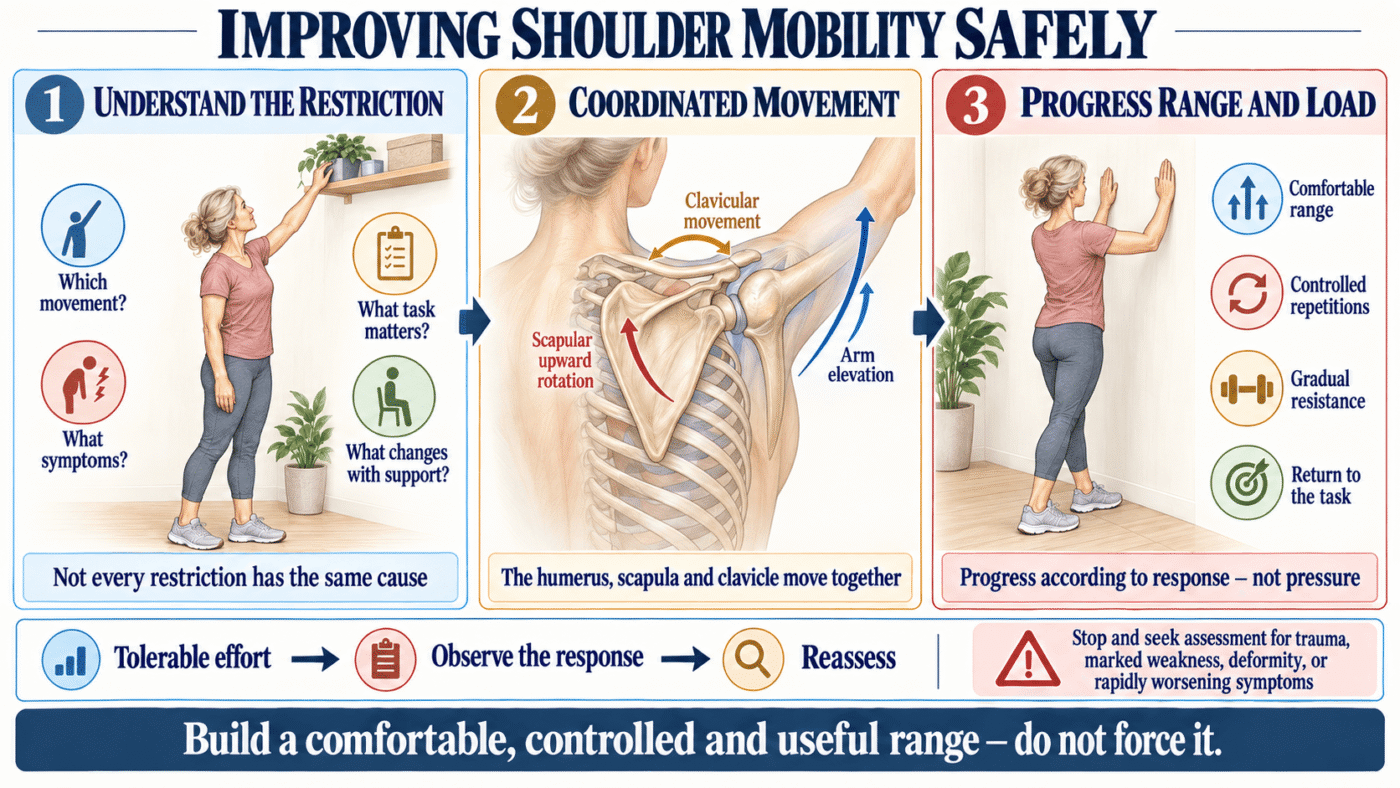
When working on shoulder mobility, begin with movement you can tolerate. Move gradually through a comfortable range. Notice: Where does the movement begin to feel restricted? Is it stiffness? Pain? Weakness? Apprehension?
Does the shoulder behave differently in another direction?
Does repeated comfortable movement make it easier?
You’re gathering information. You’re not trying to defeat your shoulder in an argument. Mobility work should explore movement, not punish it.
Try reaching overhead. Now reach behind your back. Reach across your body. Rotate your arm. Your shoulder can move in many directions because it isn’t just one simple hinge.
Movement involves the shoulder joint, shoulder blade, surrounding muscles and other parts of the upper body working together. So when someone says: “My shoulder is tight.” we still don’t know exactly what the problem is.
The better question is: “Which movement is difficult?”
Before trying to improve mobility, identify what you’re actually trying to improve.
Maybe you struggle to:
- reach into a high cupboard
- put on a shirt or jacket
- reach behind your back
- wash your hair
- lift something overhead
- perform a movement at work
- swim, throw or play sport
- sleep comfortably in certain positions
This gives us a functional starting point. Because improving a shoulder measurement that makes absolutely no difference to your life isn’t necessarily meaningful progress. Measure what matters to your life.
This is one of the most important ideas in this series. Reduced shoulder movement can be influenced by many things.
Pain.
Muscle function.
Strength.
Joint movement.
Previous injury.
Current workload.
Sensitivity.
Confidence with movement. And sometimes specific shoulder conditions. So if your arm doesn’t move as far as you’d like, the answer isn’t automatically: “Stretch the tight muscle.”
Sometimes stretching may help.
Sometimes strengthening matters.
Sometimes manual therapy may help symptoms.
Sometimes gradual movement exposure is useful.
And sometimes the shoulder needs further assessment before we decide what to do.
Stretching may improve range of motion for some people. That’s useful. But remember our earlier distinction: Available range isn’t always usable range.
Imagine someone can move your arm further when you’re relaxed, but you struggle to actively reach that position yourself. More stretching may not be the only thing you need.
Strength and control may also matter.
This gives us our familiar framework:
Range → Control → Function
Can the shoulder reach the position?
Can you control the movement?
Can you use it for what you actually need to do?
This is particularly important around the shoulder. The muscles surrounding the shoulder and shoulder blade help produce and control movement. So improving mobility may sometimes involve strengthening through an appropriate range rather than endlessly trying to make the shoulder more flexible.
For example, reaching overhead isn’t simply about whether the arm can physically reach the position.
Can you control it?
Can you tolerate load there?
Can you repeatedly use that movement when required?
That’s mobility in real life.
Where Can Massage and Manual Therapy Help?
Massage, joint mobilisation and other appropriate manual therapy techniques may sometimes reduce discomfort or make shoulder movement feel easier. That can be useful. Suppose you can raise your arm to a certain point before treatment.
We treat. Then: Raise it again.
Did the range change?
Does it hurt less?
Does the movement feel easier?
Excellent. But that’s not necessarily where the process ends. If treatment creates a more comfortable range, we may have an opportunity to use that movement.
Depending on the situation, that might involve gentle movement, strengthening, rehabilitation or gradually returning to the activity that matters.
Manual therapy may help create the window.
Movement helps us explore what we can do with it.
Your left and right shoulders don’t necessarily need to move identically. Small differences between sides can exist without being a problem. Instead of automatically trying to correct every asymmetry, ask:
Does the difference relate to symptoms?
Does it limit function?
Has it changed?
Does it matter for this person’s activity?
If not, we may simply have discovered that humans aren’t manufactured with identical spare parts.
Interesting?
Yes.
Automatically a problem?
No.
Shoulder pain and stiffness are common, but not every shoulder should simply be stretched through discomfort. Further assessment may be appropriate when there has been:
- significant trauma
- sudden substantial weakness
- inability to raise or use the arm normally after injury
- obvious deformity
- significant swelling
- progressive weakness
- numbness or tingling
- severe or rapidly worsening symptoms
- unexplained symptoms or feeling generally unwell
Persistent or progressively restricted shoulder movement may also deserve assessment rather than months of increasingly aggressive stretching.
“It won’t move, so I’ll force it harder” isn’t a treatment plan.
Shoulder mobility doesn’t need to change overnight. Start with what you can currently do. Practise comfortable movement. Build strength where appropriate. Gradually increase range, control or load according to your goal and response.
Then reassess.
Move → Observe → Adapt → Progress
Some days movement may feel easier. Other days it may feel different. That’s normal. We’re interested in the overall direction, not whether your shoulder performs exactly the same way every morning at 8:07.
The Goal Is Useful Movement
Ultimately, shoulder mobility isn’t about achieving the biggest possible number on a range-of-motion test. It’s about function.
Can you reach the shelf?
Put your shirt on?
Work overhead?
Return to swimming?
Lift comfortably?
Sleep better?
Do the activity that brought you here in the first place?
That’s what gives mobility meaning. So instead of asking: “How do I make my shoulder more flexible?” start with: “What do I need my shoulder to do that it can’t comfortably do right now?”
Then we have something useful to assess. Something useful to work on. And something useful to measure afterwards.
Range → Control → Function
Not maximum movement. Useful movement.
Your Body Talks. Learn to Listen.
And if your other shoulder reaches three centimetres further behind your back…
congratulations.
You’ve discovered that you have two shoulders.
They were never required to submit identical exam results.

Ask it. Even if you think it’s a ridiculous question.
Someone else has probably wondered exactly the same thing.
