
“I really need to work on my mobility.”
So you find a routine online.
Twelve exercises.
Three sets each.
Hold every stretch for 45 seconds.
Do it every morning.
You begin enthusiastically on Monday.
Tuesday goes reasonably well.
Wednesday gets busy.
By Friday, your new mobility program has quietly become something you used to do. Sound familiar? The problem may not be motivation.
The routine may simply be too difficult to fit into your actual life.
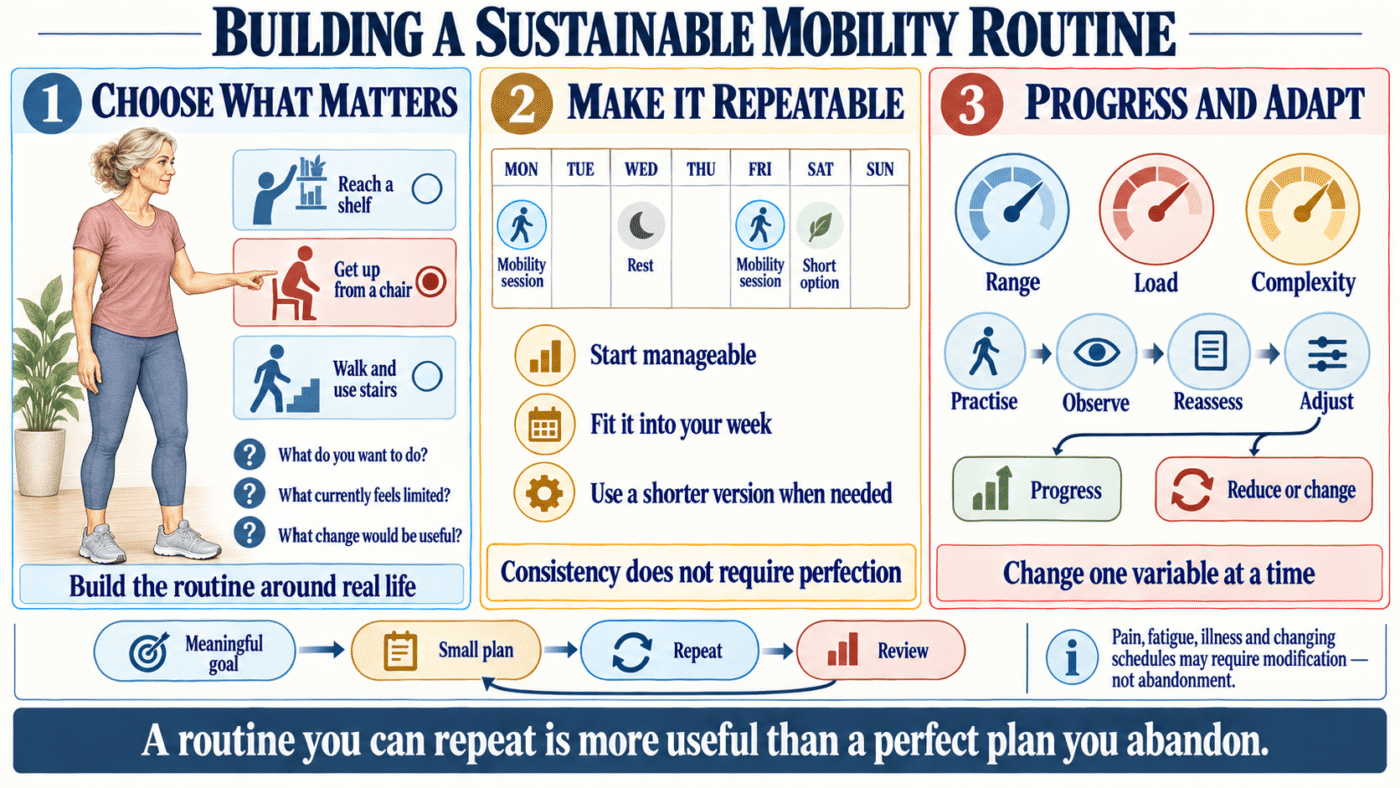
A mobility routine shouldn’t exist just because “mobility is good for you.”
Start with a purpose.
What do you want to move better?
Maybe you want to:
* reach overhead more comfortably
* turn your neck while driving
* squat more easily
* get down to the floor
* put your shoes on
* move better at work
* return to exercise
* feel less restricted after sitting
Now we have something meaningful to work toward. Because the goal isn’t: “Become more mobile.” It’s: “Improve the movement I actually need.”
Start With What You Need Not Everything You Can Find
You don’t need a mobility exercise for every joint in your body. If shoulder movement is your priority, begin there. If getting into a squat is difficult, look at what limits that particular movement. If sitting all day leaves you feeling stiff, perhaps movement variety throughout the day deserves more attention than one enormous stretching session at night.
A useful routine may contain only a few movements. That’s not a weakness.
A routine you actually do is more useful than a perfect routine you avoid.
This is one of the main ideas we’ve developed throughout this series. Mobility can involve:
Range → Control → Function
Stretching may help with available range. But depending on the person and goal, a mobility routine may also include:
- active movement
- controlled range-of-motion work
- strength through available range
- balance or coordination
- gradual exposure to a difficult movement
- practising the actual task you want to improve
Sometimes the answer to better mobility isn’t another stretch. Sometimes it’s learning to control the movement you already have.
You don’t necessarily need an hour. For many people, shorter sessions that can be repeated consistently are more realistic. Five or ten useful minutes may fit into your life much more easily than an ambitious 45-minute routine.
You can also distribute movement throughout the day. A little movement after waking. A few movements between work tasks. Some mobility work before training. A short session later in the day.
The exact schedule isn’t the important part. Consistency matters more than creating the most impressive routine possible.
You should know why you’re doing an exercise. If someone gives you a mobility drill, ask: What movement is this supposed to help?
What should I feel?
What shouldn’t I feel?
How will we know whether it’s working?
If nobody can answer those questions, we may simply be collecting exercises. And collecting exercises is remarkably similar to collecting massage techniques. More doesn’t automatically mean better.
Mobility training isn’t a daily test of how far you can push your body. A stretching sensation may be expected with some movements. But sharp pain, increasing symptoms, unusual numbness or tingling aren’t things to chase simply because: “I need more mobility.”
Work within an appropriate range. Then gradually progress according to your response. Your body is adaptable. It doesn’t need to be bullied into changing.
Build Strength Into Your Range
Suppose stretching allows your shoulder to reach further overhead. Excellent. Now can you actively reach that position?
Can you control it?
Can you use it during the activity that matters?
This is where strength may become part of mobility. The same applies to hips, ankles and other areas. Creating range can be useful. Learning to use that range makes it functional.
You don’t necessarily need heavy resistance. The appropriate challenge depends on the person, movement and goal.
Not all mobility work needs to happen on an exercise mat. If getting out of a chair is difficult, practising an appropriate version of that movement can be relevant. If you want to comfortably get down onto the floor, gradually practising getting down and back up may matter.
If you’ve been sitting for hours, walking and changing positions may be useful. If overhead movement matters for your work, eventually your mobility needs to connect with overhead function.
Practise movement for life — not just movement for the routine.
There isn’t one perfect schedule for everyone. Frequency depends on:
- your goal
- the type and intensity of movement
- your current capacity
- other exercise and activity
- symptoms
- recovery
- how your body responds
Some gentle movement may be appropriate frequently. More demanding mobility or strengthening work may need different recovery considerations.
Instead of obsessing over the perfect number of sessions, ask: “Can I do this consistently, recover from it and gradually progress?” That’s a much more useful framework.
Otherwise, how do you know whether your routine is helping? Choose something meaningful before you begin.
Maybe:
I can turn my neck this far comfortably.
I can’t reach the top shelf without discomfort.
Getting down to the floor is difficult.
My squat becomes uncomfortable here.
Then reassess later.
Did it change?
Did the movement become easier?
Did your confidence improve?
Can you tolerate more load?
Can you perform the activity more comfortably?
If nothing changes after repeatedly doing the same routine, that’s useful information too. Don’t continue something forever simply because it has “mobility” written in the title.
A mobility routine isn’t a lifetime contract. As your body adapts, your needs may change. A movement that was useful six weeks ago may no longer be necessary.
Something may need progression. Something may need to be replaced. Something may simply be removed. That’s normal. Remember:
Assess → Practise → Reassess → Adapt
The routine serves you. You don’t serve the routine.
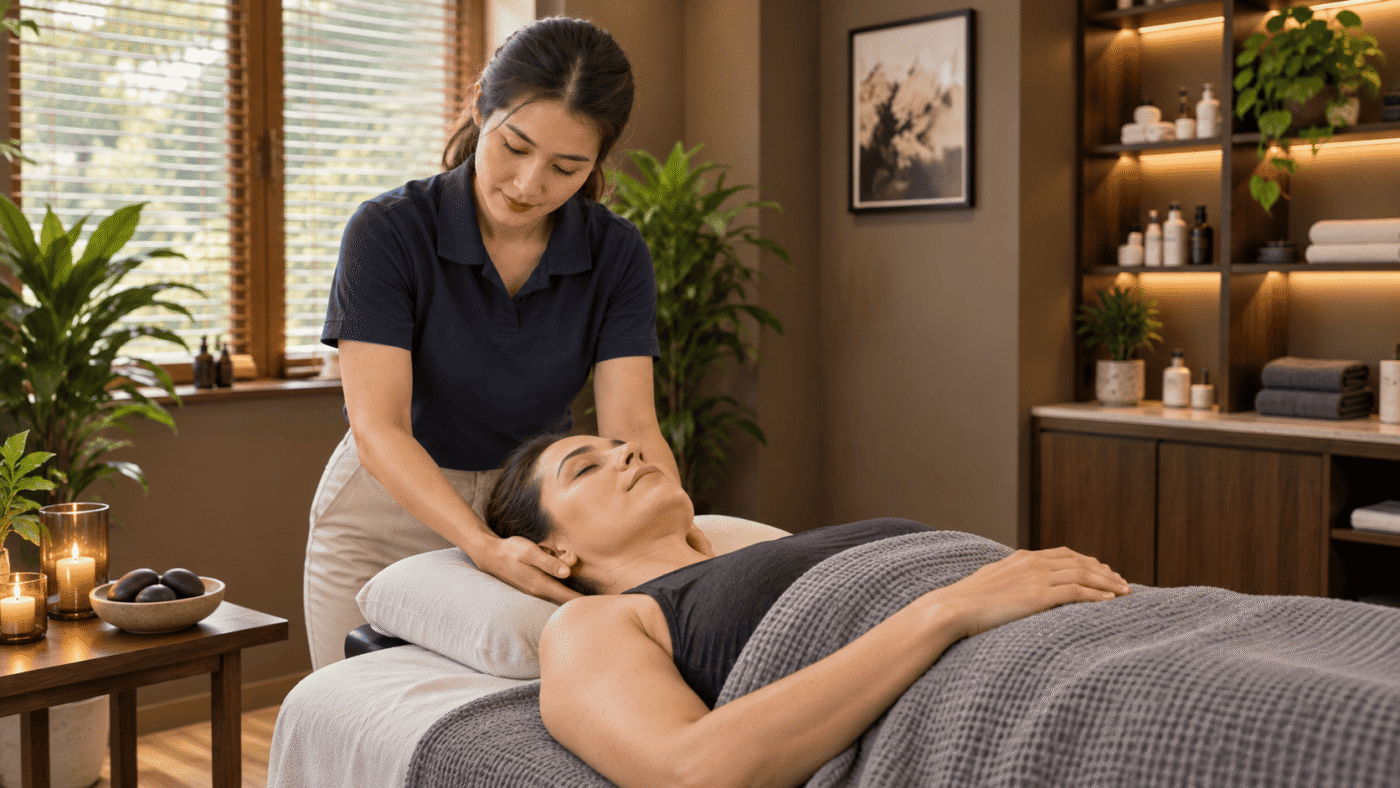
Massage and other manual therapy techniques may sometimes reduce discomfort or make movement feel easier. That can create a useful opportunity.
But if you repeatedly need someone else to create movement for you, it may be worth asking what you can gradually develop yourself. Manual therapy may support the process. It shouldn’t automatically become the process.
Movement, strength, physical activity and gradual exposure can help build your own capacity. And that’s ultimately what sustainable mobility is about.
Make It Boring Enough to Continue
This may sound like terrible marketing. But your mobility routine doesn’t need to be exciting. It needs to be useful. A few movements. A clear purpose. Appropriate challenge.
Something you can realistically repeat. Then:
Move → Observe → Adapt → Progress
That’s enough. You don’t need perfect flexibility. You don’t need a 30-day mobility challenge every month.
And you definitely don’t need to feel guilty because someone online can sit comfortably in a position that makes your hips file a formal complaint.
Build the mobility your life requires.
Use it.
Strengthen it.
Reassess it.
And let the routine evolve as you do. So before adding another exercise, ask: “What am I trying to improve — and is this helping me improve it?” If you can answer that, your routine already has something many complicated programs don’t: Direction.
Your Body Talks. Learn to Listen.
And if your mobility routine requires a spreadsheet, three resistance bands, two foam rollers and 47 minutes of preparation before you can begin…perhaps our first exercise should be simplifying the routine.
Ask it. Even if you think it’s a ridiculous question.
Someone else has probably wondered exactly the same thing.
