“My hamstrings are tight.”
So you stretch them.
They feel better.
A few hours later…
tight again.
So you stretch harder.
Still tight.
Eventually, stretching becomes part of your daily negotiations with the same muscle. At some point, it’s worth asking:
What if stretching isn’t the solution?
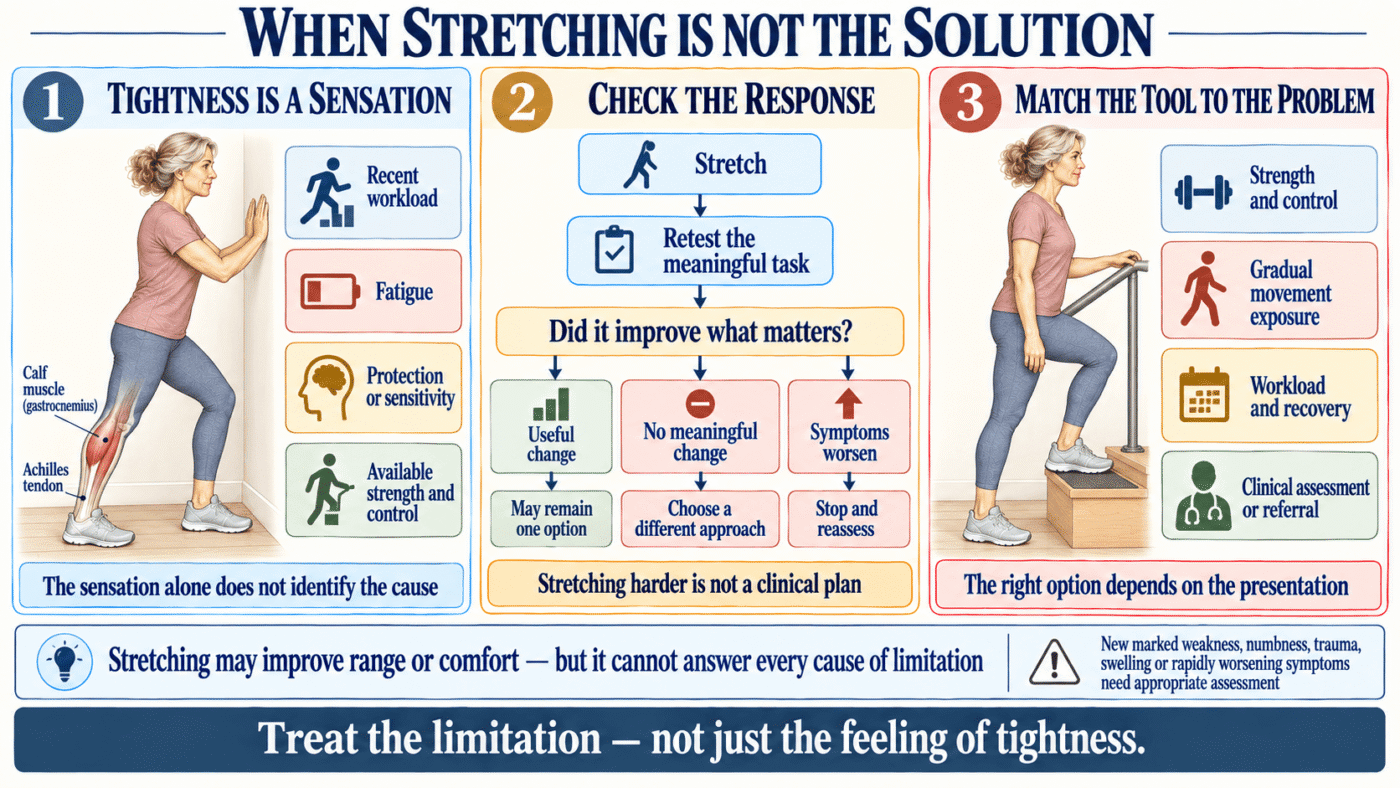
Stretching can absolutely be useful. But feeling tight doesn’t automatically mean something needs to be stretched.
When Stretching Helps
Stretching can improve flexibility and range of motion. For some people, it also feels good. If you’ve been sitting for a while, standing up and moving into a comfortable stretch may feel excellent.
If a particular movement requires more range, stretching may form part of a program designed to improve it. There’s nothing wrong with that. The problem begins when stretching becomes the automatic answer to every sensation of tightness.
When someone says: “This muscle feels tight.” They’re describing a sensation. That sensation is real. But it doesn’t tell us exactly why it’s happening. A muscle that feels tight isn’t necessarily physically shortened. The feeling may be influenced by:
- prolonged time in one position
- unfamiliar or increased activity
- muscle fatigue
- pain or sensitivity
- reduced movement
- strength or capacity
- previous injury
- stress and recovery
- the way you’re currently using the area
So before immediately stretching it, ask: “Why does this keep feeling tight?” That’s a much more interesting question.
Imagine your hamstrings feel tight. You test the movement. Your available range is actually quite good. So what exactly are we trying to improve by stretching further?
If you already have sufficient range for the activity you need, creating more flexibility may not solve the complaint. Perhaps the question should change from: “How do I make this muscle longer?” to: “Why does this movement still feel uncomfortable?” Those are very different questions.
Remember: Available range isn’t always usable range. You might be able to move into a position passively but struggle to control yourself there.
In that situation, continuously increasing flexibility may not be the priority. Strength through the available range may be more relevant. Think about lifting your leg. Someone else can lift it quite high for you.
But when you try to hold it there yourself…your leg suddenly remembers an urgent appointment somewhere lower. That’s not necessarily a flexibility problem. You may need greater active control or strength within that range.
After several hours at a desk, your back or hips may feel stiff. You could perform a long stretching routine. Or perhaps your body simply needs to move.
Walk.
Change position.
Squat comfortably.
Move your hips.
Rotate your trunk.
Use your shoulders.
The body doesn’t always need a specialised corrective exercise. Sometimes it has simply spent too long doing one thing. Movement variety can matter more than finding the perfect stretch.
Imagine someone repeatedly develops calf tightness while running. They stretch. The tightness settles temporarily. Then every run brings it back. Maybe the calf doesn’t simply need to become more flexible. We might need to consider:
How much running are they doing?
Has the workload recently increased?
How strong is the area?
How well does it tolerate repeated load?
How is recovery?
Are there other symptoms?
Now we’re moving from: “Where is it tight?” to: “What is this area being asked to tolerate?” That’s an important shift. A useful way to think about this is: Capacity vs Demand
If the demands of an activity repeatedly exceed what the body is currently prepared for, adding more stretching doesn’t necessarily solve that mismatch. Sometimes we need to build capacity.
Sometimes Recovery Matters
Not every uncomfortable muscle needs another intervention. Training, physical work and unfamiliar activity can temporarily leave the body feeling tired, sore or stiff. Sleep, recovery, appropriate activity and time may all matter.
This doesn’t mean: “Do nothing.” It means treatment decisions should match the situation.
Sometimes the body needs movement.
Sometimes it needs progressive loading.
Sometimes it needs recovery.
And yes, sometimes stretching is useful. The skill is knowing why you’re choosing it.
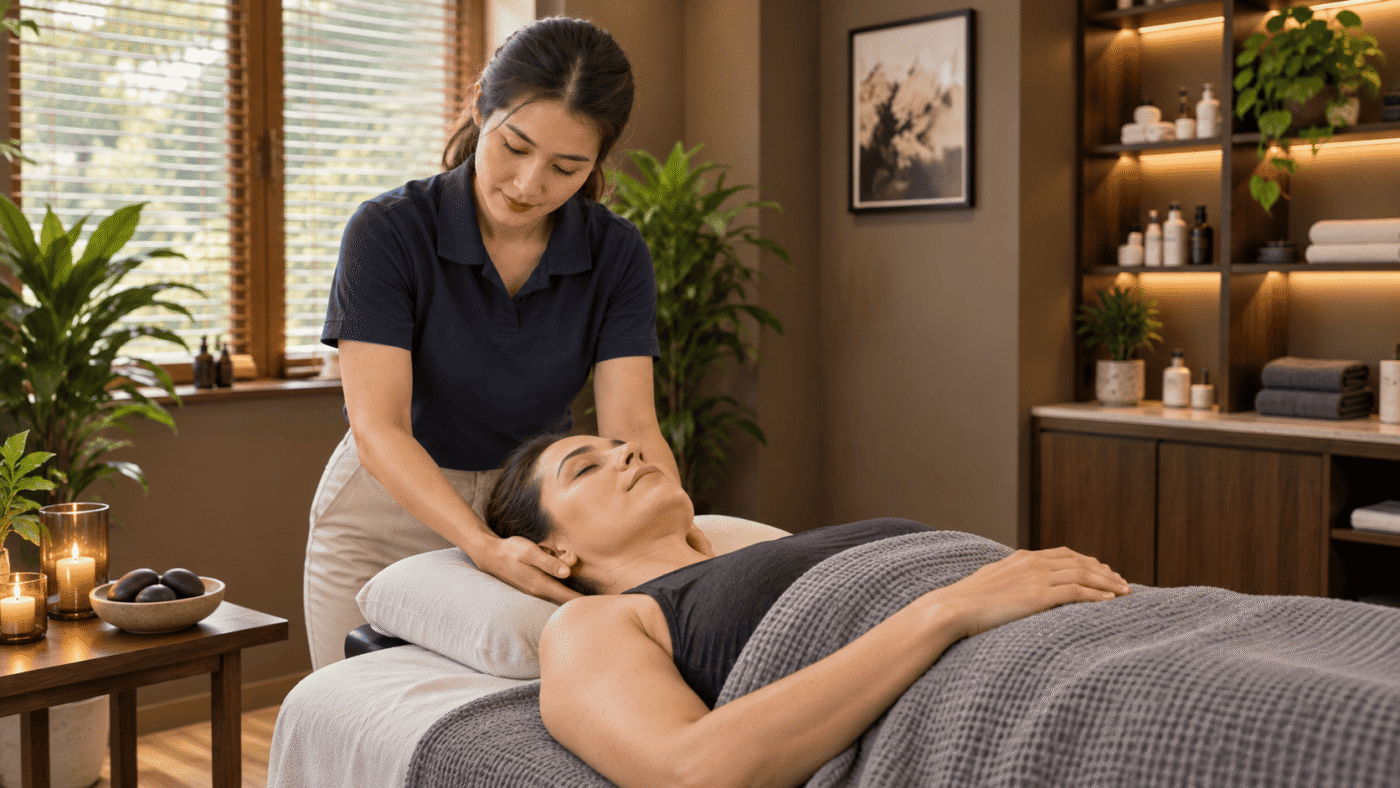
The same principle applies to massage. If an area repeatedly feels tight, massage may temporarily make it feel more comfortable. That can be valuable. But if the same problem returns again and again, we shouldn’t automatically respond with: “It needs another massage.” We should reassess.
Has movement changed?
Has function changed?
What happens between treatments?
What activities trigger the symptoms?
Does strength matter?
Has workload changed?
Are we actually improving anything?
Massage and stretching can both be useful tools. Neither should become an automatic answer.
There are also situations where aggressively stretching into symptoms isn’t appropriate. Be cautious when movement produces:
- sharp or severe pain
- increasing numbness or tingling
- significant weakness
- symptoms following substantial trauma
- rapidly worsening symptoms
- unusual swelling or inflammation
- symptoms that consistently worsen with stretching
Persistent or unexplained symptoms may deserve further assessment rather than simply stretching harder. Especially when neurological symptoms are involved, the feeling of “tightness” may not necessarily represent a muscle that needs lengthening. Don’t force a symptom simply because you’ve labelled it tightness.
Try asking:
What movement am I trying to improve?
Do I actually lack range?
Can I control the range I already have?
Does this area need more strength?
Has my workload changed?
Am I recovering adequately?
Does stretching actually improve the problem?
Then reassess. This gives us a much more useful process:
Assess → Identify the limitation → Choose the strategy → Reassess
Maybe the answer is stretching.
Maybe it’s strengthening.
Maybe it’s more general movement.
Maybe it’s adjusting workload.
Maybe it’s recovery.
Maybe manual therapy helps. And sometimes the appropriate answer is further clinical or medical assessment.
Stretch With a Purpose
Stretching doesn’t need to disappear from your routine. It simply needs a reason to be there. If it helps you achieve useful range, excellent. If it feels good and you enjoy it, that’s fine too.
But if you’ve been stretching the same “tight” muscle every day for months without meaningful change…you don’t necessarily need a stronger stretch. You may need a better question. Instead of: “What should I stretch?” try: “What does my body actually need to do better?”
That takes us back to the principle behind this entire mobility series:
Range → Control → Function
Not every tight feeling needs more range. Not every restricted movement needs stretching. And not every problem needs another technique. Sometimes the most useful thing we can do is stop repeating the same solution and reassess the problem.
Your Body Talks. Learn to Listen.
And if you’ve been stretching the same hamstring since 2019 and it’s still sending you the same complaint…perhaps the hamstring would like to request a second opinion.
Ask it. Even if you think it’s a ridiculous question.
Someone else has probably wondered exactly the same thing.
