
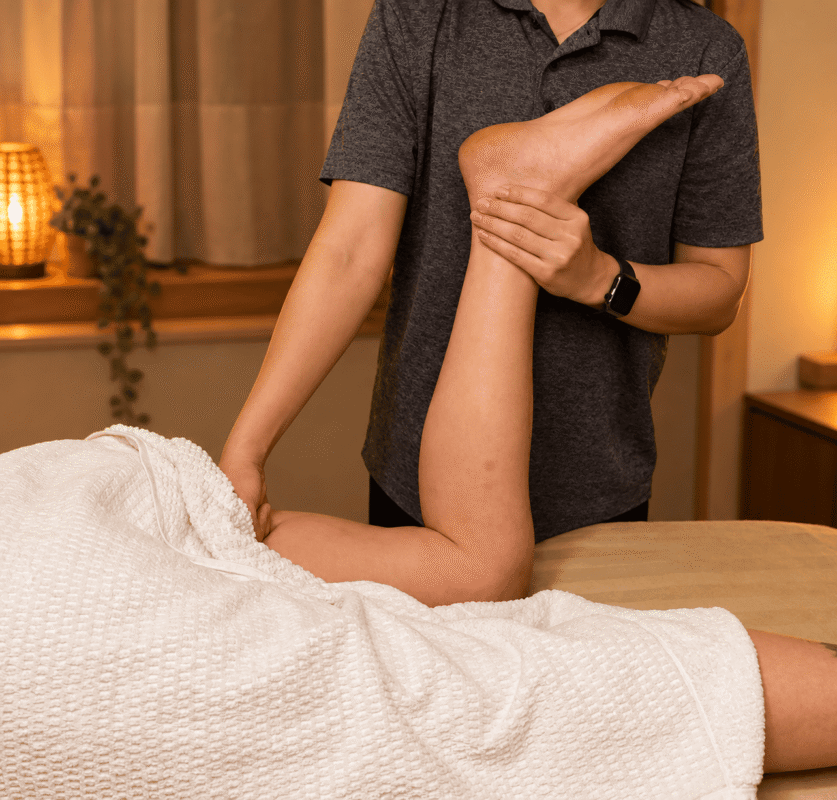
Thai Massage
You Do Not Have to Be Flexible
I hear the concern. People often picture Thai massage as a series of dramatic stretches. Some worry they will be pushed too far; others hope the therapist will somehow make them flexible in one session.
“I’d like to try Thai massage, but I can barely touch my toes.”
Thai massage should meet the person in front of us. Tell us how you move, what feels comfortable and what you would prefer to avoid. Then we can choose pressure and movements that suit you.
What is Thai massage?
Traditional Thai massage, also called Nuad Thai, is a practice from Thailand that may combine pressure, compression and assisted movement. It has a cultural history of its own; it is more than a collection of stretches. UNESCO recognises Nuad Thai as intangible cultural heritage.
A session may differ between practitioners. For example, some work on a padded floor mat, while others adapt techniques for a treatment table. Before booking, ask what the session involves if clothing, positioning or mobility is a concern.
This person expects to be moved into positions they cannot reach on their own. As a result, they may avoid Thai massage altogether.
You do not need to pass a flexibility test. Assisted movement can be made smaller, changed or left out. Before starting, explain any movement that feels difficult and let the therapist know about relevant injuries or health conditions.
Another person wants the therapist to push until they feel a strong stretch. They assume that reaching further means the treatment is working.
However, distance is not a measure of quality. A movement should be guided by your comfort and response. If you tense up, feel pain or want to pull away, say so. The therapist can reduce the range or choose something else.
This person is curious about the pressure, movement and pace of the session. They may enjoy some assisted stretches but prefer gentle work around a sensitive area.
That conversation helps the therapist adapt the treatment. You do not need to know the names of any techniques. A simple “that feels comfortable” or “please go more gently” gives useful guidance.
*********
What if I do not want a particular technique?
Say so. You can decline any stretch, pressure or position, even after the session has begun. A skilled therapist can explain the options and work within the boundaries you set.
Traditional Thai massage is commonly performed with the recipient clothed. However, services can vary, so check what the practitioner offers and wear clothing that lets you move comfortably.
Assisted movement is common, but it should never be a surprise or something you must endure. Tell the therapist about areas you do not want moved. During the session, you can ask them to reduce or stop a stretch.
No. Firm pressure or a stretch may feel unfamiliar, but pain is not a requirement. If something feels too intense, speak up immediately. Your therapist should adjust the technique.
Relaxation massage commonly uses flowing strokes and centres on the experience of rest. Thai massage may include more pressure through clothing and more therapist-guided movement. Still, a Thai massage can be gentle, and your preferences should influence the session.
Share relevant health conditions, recent injuries, pregnancy, areas that feel vulnerable and any difficulty getting onto a mat or changing position. This helps the therapist decide what to adapt and whether the planned session is appropriate.
One session cannot promise a lasting change in flexibility. You might notice that a movement feels different afterwards, but that response varies. If improving a particular movement is your goal, describe it before treatment and check it again later.
Your Body Talks. Learn to Listen.
Thai massage is something you take part in, not something you have to survive. Your comfort, feedback and health information should shape the experience from beginning to end.

Ask it. Even if you think it’s a ridiculous question.
Someone else has probably wondered exactly the same thing.
