
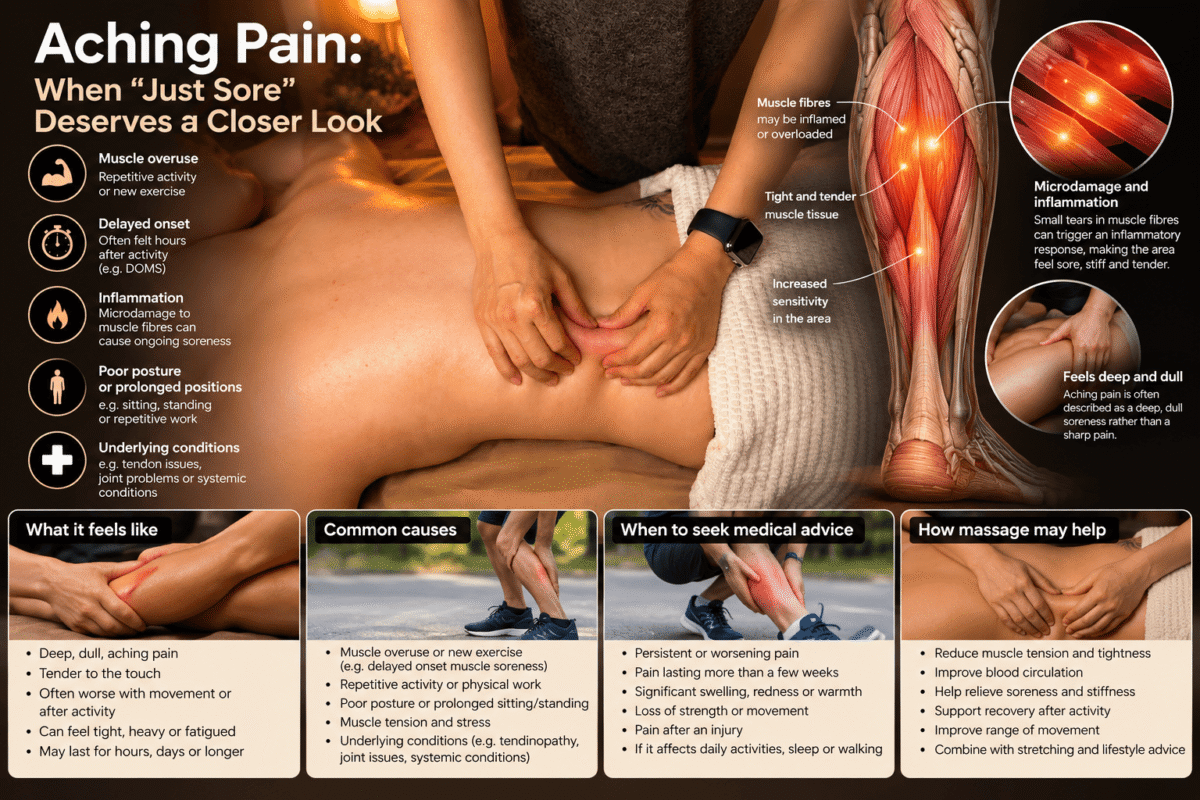
Aching Pain
When “Just Sore” Deserves a Closer Look
You can still move, but the discomfort follows you through the day. Perhaps it appeared after a workout. Perhaps it has been there so long that you have stopped mentioning it.
“It’s not sharp. It just aches all the time.”
As a therapist, I want to know what the ache prevents you from doing and whether its pattern is changing. An aching feeling is common, but the word alone cannot tell us which tissue is involved or whether massage is the right treatment.
What does aching pain feel like?
People often use aching for a dull, steady or hard-to-pinpoint discomfort. It may sit in one area, affect several muscles or seem to come from a joint. The intensity can change with activity, rest or time of day.
To describe it more clearly, consider:
- Where is it? One muscle, a joint or several areas?
- When did it begin? After a new activity, an injury or without an obvious reason?
- What changes it? Movement, rest, sleep or a particular task?
- What comes with it? Stiffness, swelling, weakness, fever or unusual fatigue?
- How does it affect you? Can you still work, exercise and sleep?
The effect on your daily life matters as much as the pain score. A mild ache that steadily limits movement may deserve more attention than brief soreness that improves as expected.
What may cause aching pain?
Muscle aches commonly follow physical activity, overuse, tension or an injury. Joint conditions can also cause aching, sometimes with stiffness or swelling. Illnesses and other health problems may produce more widespread aches. The sensation does not prove that a muscle is “tight” or that a particular joint is damaged.
Context provides better clues. An ache that begins after an unfamiliar workout and gradually settles differs from pain that appears without explanation, gets worse or repeatedly returns.
When should you seek medical care?
See a doctor if the ache is severe, affects daily life, does not improve, or continues without a clear explanation. A new red, hot, swollen joint, especially with fever, needs prompt medical assessment.
After intense exercise or an injury, muscle pain with marked weakness, swelling and dark urine requires urgent medical attention. Do not treat that combination as ordinary workout soreness.
What are the treatment options?
Treatment depends on the cause and on what you need to return to doing. For an uncomplicated ache after activity, adjusting the amount of exercise and allowing recovery may be enough. Ongoing pain may benefit from a clinical assessment and a plan that considers movement, strength, workload and any underlying condition.
A useful plan also includes something to reassess. Can you turn your neck more comfortably? Walk farther? Sleep without waking from pain? “It feels a bit looser” can be useful feedback, but a change in function tells us more about whether care is helping.
If pain persists or worsens, the next step is to review the working explanation rather than repeating the same treatment indefinitely.
Can massage help aching pain?
Massage may offer relief for some musculoskeletal aches, including certain back or neck pain presentations. However, benefits may be short term, and the strength of the evidence varies by condition. Massage cannot identify or resolve every cause of an ache.
A therapist should ask how the ache began, check relevant movement and agree on a treatment goal with you. Pressure should be adjusted to your response. If an area is unusually painful, swollen or inflamed, working harder on it is not a sound substitute for assessment.
From the therapist: “Tell me what this ache has changed in your day. That gives us a better goal than simply trying to make the area feel less tight.”
Your Body Talks. Learn to Listen.
Aching pain can be ordinary and temporary, or a sign that something needs further assessment. Its duration, pattern and effect on daily life help determine the next step.

Ask it. Even if you think it’s a ridiculous question.
Someone else has probably wondered exactly the same thing.
