
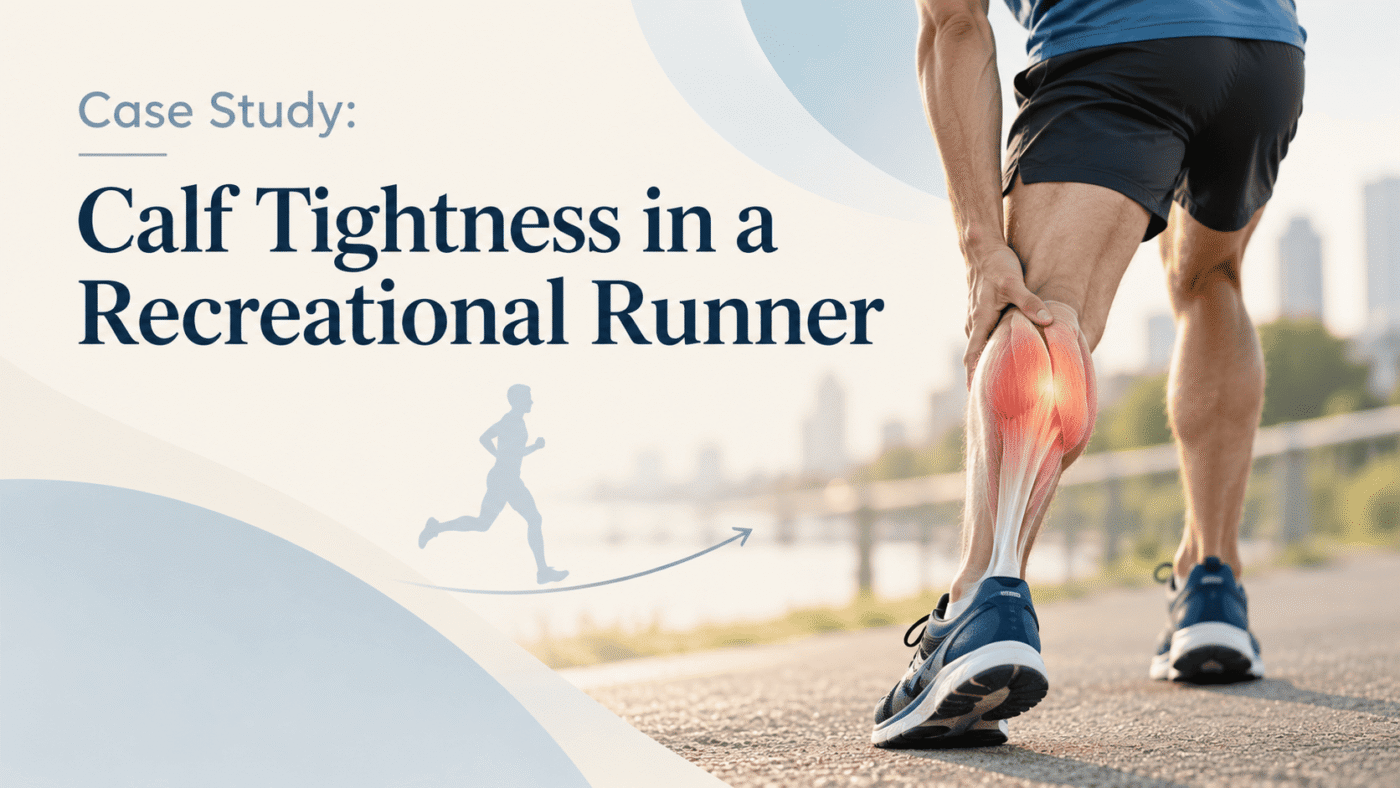
Calf Tightness in a Recreational Runner
Case Study
A recreational runner comes into the clinic and says:
“My calf is always tight when I run.”
They’ve already tried stretching. Foam rolling. Massage guns. More stretching. And then, naturally…some more stretching. It feels better temporarily. But after a few kilometres, the tightness returns. So perhaps the first question shouldn’t be: “How do we loosen the calf?” Maybe it should be: “Why does the calf keep feeling tight when you run?”
This educational case study follows a hypothetical recreational runner with recurring calf tightness. And as usual, the interesting part isn’t which massage technique we use. It’s what happens before and after it.
Client Presentation
Imagine a 38-year-old recreational runner preparing for their first half marathon. They normally run two or three times per week. Over the past month, they’ve noticed increasing tightness in the right calf during longer runs.
Walking is comfortable. Daily activities are unaffected. Short runs usually feel fine. But around 6–8 kilometres, the calf begins to feel increasingly tight.
The client says: “It feels like the muscle is going to seize up.” They stop. Stretch. The sensation settles slightly. Then returns when they continue running. Their conclusion? “My calf must be really tight.” Maybe. But tight describes what they feel. It doesn’t yet tell us why they feel it.
For a runner, the health history is only part of the story. We also need the training history. Ask:
How often are you running?
How far?
Has your weekly distance changed?
Have you added hills?
Speed work?
Longer runs?
Different surfaces?
New shoes?
Another sport?
Strength training?
How much recovery is there between sessions?
Has anything changed recently?
This is where the story becomes interesting. Imagine the client previously ran around: 15–18 km per week. But while preparing for the half marathon, they’ve increased to approximately: 28–32 km per week. They’ve also added a weekend hill run. Now we have useful context.
That doesn’t prove the training increase caused the symptoms. But it certainly deserves attention.
When someone says: “My calf is tight,” it’s tempting to assume: The muscle is physically shortened. It needs stretching. It needs releasing. It has a knot. Maybe. But the sensation of tightness can occur for different reasons.
It may relate to muscular fatigue. Load. Sensitivity. Protective muscle activity. Previous injury. Movement demands. Or other factors.
Sometimes the muscle may not even demonstrate particularly restricted flexibility. So instead of translating: “It feels tight” into: “The muscle is too short,” keep the original information intact. The client experiences calf tightness during running. That’s what we actually know.
*********
Screen Before Treating
Calf symptoms deserve appropriate screening. Not every painful or tight calf is simply a massage problem. We need to understand whether there has been:
A sudden injury.
A pop or tearing sensation.
Significant swelling.
Bruising.
Redness or unusual heat.
Marked weakness.
Difficulty walking.
Unexplained swelling.
Neurological symptoms.
Or other concerning features.
A swollen, hot, painful calf particularly when the presentation raises concern for a vascular problem should not simply be treated as a tight muscle. In our hypothetical case, imagine there was:
No sudden injury.
No swelling.
No bruising.
No redness or unusual heat.
No neurological symptoms.
No significant pain during normal walking.
The symptoms develop predictably during longer-distance running. We continue.
The client might initially say: “I want my calf loosened.” But that’s not really the goal. Ask: “What do you want to be able to do?”
They answer: “Run 10 kilometres comfortably and keep building toward the half marathon.” Excellent. Now we have a functional outcome.
The goal isn’t: Make the calf feel softer. It’s: Improve the runner’s ability to tolerate the running distance they need without calf symptoms becoming limiting. That changes the entire assessment.
We may assess relevant ankle movement. For example, ankle dorsiflexion. Perhaps the symptomatic side has slightly less available range. Interesting. But don’t immediately conclude: “That’s the cause.”
Maybe it’s relevant. Maybe it isn’t. We need context. And suppose both sides actually have similar ankle range. Now what? The client still feels tight while running. This demonstrates an important principle: Feeling tight and having limited range of motion are not the same thing.
Perhaps we assess calf flexibility. Again, maybe there’s a difference. Maybe there isn’t. If the client already has adequate range for the task, repeatedly trying to create more flexibility may not address the actual limitation. This is where we need to distinguish: Available Range from Usable Capacity
The runner may have enough movement. The question may be whether the calf can repeatedly tolerate the forces required during running.
*********
Strength Changes the Conversation
Running isn’t simply a flexibility activity. The calf complex contributes to controlling and producing force repeatedly while running.
Step.
After step.
After step.
After step.
A 10-kilometre run involves thousands of loading cycles.
So we may consider relevant strength and endurance.
Can the client perform repeated calf raises?
How does the symptomatic side compare with the other?
What happens as repetitions increase?
Does the familiar sensation appear?
Suppose the client can perform: 25 comfortable single-leg calf raises on the left but begins to fatigue much earlier on the right. That’s interesting. It doesn’t automatically establish the cause. But now we have another piece of information.
Maybe the problem isn’t simply: “Not enough flexibility.” Maybe capacity deserves attention.
One challenge with this case is that the client feels fine standing in the clinic. No tightness. No significant pain. Normal walking. If we only assess them at rest, we may never see the problem they actually came in with.
Remember: Their symptoms appear after several kilometres. So the clinical question becomes: What happens under load? Depending on the setting and professional scope, relevant functional testing might include:
Repeated calf raises. Walking. Hopping or other appropriate loading tasks. Running-related movement. The goal isn’t to exhaust the client unnecessarily. It’s to understand whether increasing demand changes the presentation.
Now our previous framework becomes particularly useful. Think: Current Capacity ↔ Running Demand
The runner’s training demand has increased rapidly.
Their calf symptoms appear mainly when distance increases.
Their daily activities remain comfortable.
Their available movement may be reasonable.
And perhaps calf endurance differs between sides. One possible working hypothesis is: The current running demand may be exceeding what the calf is presently prepared to tolerate. Notice the language. May be. We aren’t claiming certainty. We’re creating something we can investigate.
Suppose palpation finds tenderness in part of the calf. Maybe the client says: “That’s exactly where I feel it after running.” Useful. But tenderness doesn’t automatically mean: “There’s the knot causing everything.”
And the firmness of the muscle doesn’t tell us how many kilometres it can tolerate. Palpation may help identify sensitive areas and guide treatment. But running capacity needs to be understood through function.
Again: What I felt → What I think it might mean → What I can demonstrate
*********
Form a Working Hypothesis
Our hypothetical findings now include: Recurring calf tightness during longer runs. A recent increase in running volume. Additional hill training. No obvious acute injury. No concerning swelling or neurological symptoms.
Reasonable ankle mobility. Possible difference in calf endurance. Symptoms related more strongly to running demand than everyday activity. Our working hypothesis might be: “The calf symptoms may be related to a mismatch between current running demand and the runner’s present load tolerance, with local sensitivity and calf capacity potentially contributing.”
That’s very different from: “Your calf is tight because it needs stretching.” And it gives us more options.
Massage may still be useful. Perhaps the calf feels more comfortable afterwards. Perhaps tenderness decreases. Perhaps ankle movement feels easier. Perhaps the runner enjoys the recovery effect.
Good. But massage doesn’t automatically increase the calf’s ability to tolerate thousands of repeated running loads. Manual therapy may help with symptoms. Capacity may require something active.
That’s an important distinction. Feeling better and being prepared for more load are not necessarily the same thing.
Suppose we provide appropriate manual therapy to relevant areas. Afterwards, reassess.
How does the calf feel?
Has tenderness changed?
Has ankle movement changed?
How do repeated calf raises feel?
Does the runner report a difference?
Perhaps calf raises now feel easier. Useful. Perhaps dorsiflexion improves slightly. Also useful. But we still haven’t answered the main question: What happens at kilometre seven? Some outcomes can be measured immediately.
Others require the client to return to the activity that produces the problem.
This is where observation over time matters. Instead of simply saying: “Come back next week and we’ll loosen it again,” we might ask the runner to observe their next appropriate run.
When does tightness begin?
At what distance?
How intense is it?
Does it change running mechanics?
Does it settle after the run?
How does the calf feel the following day?
Can the runner complete the planned session?
Now we have much more useful information. Imagine before treatment the calf consistently became limiting around: 6 km. After appropriate changes to treatment and training, the runner reaches: 8 km then later: 10 km with manageable symptoms. That’s functional progress.
*********
Don’t Change Everything at Once
Suppose we simultaneously:
Massage the calf.
Change the shoes.
Reduce running volume.
Remove hills.
Add strength exercises.
Change running technique.
Add stretching.
Add recovery days.
And buy a foam roller large enough to qualify as furniture.
Then symptoms improve. Excellent. But: What actually helped? We don’t always need perfect experimental control in clinical practice.
But changing everything at once can make it difficult to learn from the response. Where possible: Make sensible changes.
Observe.
Reassess.
Adapt.
Treatment can function as a series of small experiments.
Suppose the runner’s calf tolerates 20 km per week reasonably well. They increase rapidly toward 30+ km while adding hills. Symptoms appear. The answer isn’t necessarily: “Never run more than 20 km.”
Perhaps capacity needs time to adapt. Training is itself a stress. Recovery allows adaptation. Then capacity may increase. A useful framework is:
Demand → Recovery → Adaptation → Capacity
The goal isn’t to avoid demand forever. It’s to apply demand that the body can progressively adapt to.
Not automatically. Complete rest may sometimes be appropriate, particularly with certain injuries or medical presentations. But for uncomplicated load-related symptoms, the choice isn’t always: Run normally or Stop completely. Activity may be modified.
Distance.
Intensity.
Hills.
Frequency.
Speed.
Recovery.
These variables can all change. Think:
Full Training → Modified Training → Light Activity → Relative Rest
The appropriate level depends on the presentation. Recovery can be a dial, not a switch.
The runner has been stretching several times every day because: “The calf feels tight.” But if flexibility isn’t the primary limitation, more stretching may not be the answer. Stretching may feel good. It may temporarily change range or sensation.
That’s fine. But ask: What are we trying to change? If the main limitation appears after repeated loading, perhaps endurance or load tolerance deserves more attention.
Remember: Tight doesn’t always mean short. Sometimes the better question isn’t: “How much more can we stretch this?” It’s: “What does this calf need to tolerate?”
*********
Strength and Capacity
Depending on the assessment and appropriate scope of care, progressive calf strengthening may become relevant. That might eventually involve different forms of calf loading and progression appropriate to the runner’s needs.
But again: More exercise isn’t automatically better either. The amount needs to fit alongside running demand and recovery. If we add a large strengthening program on top of already excessive training demand, we’ve simply created…more demand.
The plan needs to make sense as a whole.
This is common. The runner says: “Massage works. My calf feels amazing afterwards. But then the tightness comes back.” That doesn’t mean massage failed.
Perhaps it provides useful short-term symptom relief. But if the goal is running 21.1 kilometres, we need to ask whether anything is changing in the runner’s ability to tolerate running. Short-term relief can be valuable.
But it shouldn’t distract us from the longer-term goal. Symptom relief and capacity building are related but they aren’t the same outcome.
Imagine three treatment sessions later: The calf still becomes tight at exactly 6 km.
Running tolerance hasn’t changed.
Strength hasn’t changed.
Training hasn’t changed.
The only difference is that the calf feels nice for a day after massage.
Now we need to ask: Is the current plan actually moving toward the client’s goal? Maybe massage remains something the runner values. Fine. But perhaps the broader strategy needs to change. No meaningful progress should trigger reassessment not automatic repetition.
Suppose the runner suddenly develops: Significant swelling. Increasing pain during walking. Marked weakness. Bruising after a sudden event. Neurological symptoms. Or another substantial change in presentation.
Then the original hypothesis may no longer apply. Clinical reasoning isn’t: “We decided it was muscular three weeks ago, therefore it’s muscular forever.” New information changes decisions. Reassess the person in front of you today.
*********
Measure What Matters to the Runner
Pain scores can be useful.
ROM can be useful.
Palpation can be useful.
Strength testing can be useful.
But ultimately this runner came in because: They want to run.
So meaningful outcomes might include:
Distance before symptoms begin.
Running duration.
Ability to tolerate hills.
Training consistency.
Calf endurance.
Recovery after running.
Ability to complete planned sessions. Confidence while running. That’s where clinical measurements reconnect with real life.
Measure what matters to your life.
Let’s summarise the hypothetical case.
Client Presentation
Recurring right calf tightness during longer-distance running.
Functional Limitation
Symptoms become limiting around 6–8 km while preparing for a half marathon.
Relevant History
Recent increase in weekly running volume and addition of hill training.
Safety Screening
No obvious acute injury, significant swelling or neurological warning signs in this example.
Assessment Findings
Reasonable mobility with possible difference in calf endurance and symptoms primarily related to repeated running load.
Working Hypothesis
Current running demand may be exceeding the calf’s present load tolerance.
Treatment
Appropriate manual therapy may be used for symptom management while training load and physical capacity are considered.
Immediate Reassessment
Tenderness, movement and relevant loading tasks are retested.
Functional Reassessment
Distance and running tolerance are observed during subsequent training.
Longer-Term Goal
Progressively tolerate the running demands required for the client’s half-marathon preparation.
Now we’re treating a runner. Not simply a calf.
Calf tightness sounds like a muscle problem. Sometimes it may largely be one. But the sensation alone doesn’t tell us what the solution should be.
The useful sequence is: Listen → Screen → Assess → Understand the Load → Form a Hypothesis → Treat → Reassess → Progress → Adapt
For runners, we can make it even simpler:
Demand → Recovery → Adaptation → Capacity
And when symptoms repeatedly appear at a particular running distance, ask: “What happens when demand begins to exceed current capacity?”
That question may lead somewhere more useful than another ten minutes of stretching.
Massage can be part of the answer.
Stretching can be part of the answer.
Strength can be part of the answer.
Training modification can be part of the answer.
Recovery can be part of the answer.
Sometimes further assessment is part of the answer.
The correct combination depends on the person.
So when a runner says:
“My calf keeps getting tight. Can you loosen it?” we can certainly assess the calf.
But let’s also ask: “Tell me what happens during your run.” Because sometimes the most important finding isn’t sitting underneath the therapist’s thumb. It’s hiding somewhere around kilometre seven.
Your Body Talks. Learn to Listen.
And if the calf only complains after 7 km…perhaps we should interview the 7 kilometres too.
Ask it. Even if you think it’s a ridiculous question.
Someone else has probably wondered exactly the same thing.
