
I need to improve my mobility.
Okay.
What would you like to move better? “My hamstrings are tight.” That’s useful information. But it also introduces a common misunderstanding:
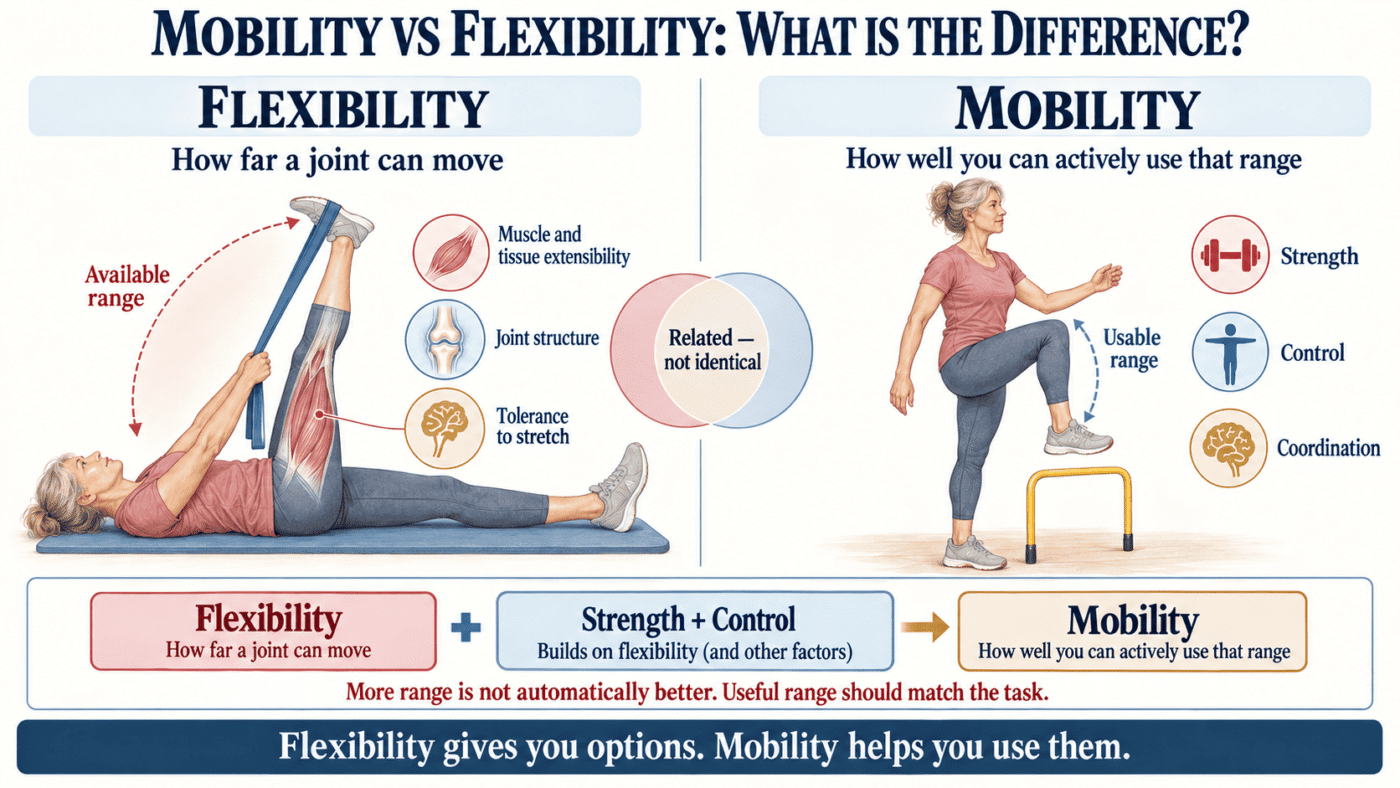
Mobility and flexibility are related but they aren’t exactly the same thing.
And being able to stretch further doesn’t automatically mean you move better.
Manual therapy may sometimes help reduce discomfort or feelings of restriction and make movement easier. That can be valuable. But if massage creates a temporary improvement in mobility, we should ask:
What do we do with that opportunity? Perhaps move through the newly comfortable range. Perhaps practise a relevant movement. Perhaps strengthening is appropriate. Perhaps gradually returning to an activity matters more.
Massage doesn’t need to create permanent structural changes to be useful. Sometimes creating a period where movement feels easier can be enough to help the next part of the process.
Flexibility Is Part of Mobility Not the Whole Story
A simple way to remember the difference is:
Flexibility = How much range is available.
Mobility = How well you can actively use the range you need.
And then there’s another important piece:
Control = What you can do with that movement.
None of these needs to be maximised. They need to be appropriate for you and what you want your body to do. So instead of asking: “How can I become more flexible?” try asking: “What movement do I actually want to improve?”
That question gives us somewhere much more useful to start.
Assess → Move → Observe → Progress
Because the goal isn’t to create the most flexible body possible. The goal is to build a body that can move well enough for the life you want to live.
Flexibility generally describes the ability of muscles and surrounding tissues to tolerate being lengthened through a range. Think about bending forward and reaching toward your toes.
How far you can comfortably reach may partly reflect flexibility. Stretching can temporarily improve this range in some people. But flexibility tells us only part of the story.
Because there’s a difference between: “My body can reach this position.” and: “I can actively move into this position and control it.” That’s where mobility becomes important.
Mobility is broader. It describes your ability to move through an available range in a way that is useful for the task you’re trying to perform. That can involve:
- joint movement
- muscle function
- strength
- coordination
- control
- flexibility
- confidence and comfort with movement
So mobility isn’t simply: “How far can I stretch?” It’s closer to: “How well can I use the movement I have?”
Imagine lying on your back while someone gently lifts your leg. Your leg reaches quite high. That’s useful information about your available range.
Now stand up and actively lift the same leg. Suddenly, you can’t reach anywhere near the same position.
Interesting. The flexibility may be available. But actively controlling that range is a different challenge. This is why stretching alone doesn’t answer every movement problem. Sometimes we don’t need to create more range.
We need to learn how to use the range that’s already there.
This is worth repeating. Being more flexible doesn’t automatically mean being healthier, less likely to experience pain or better at movement.
Different bodies and activities require different ranges. A gymnast may need extraordinary flexibility. Someone working at a desk probably doesn’t need to put their ankle behind their head before answering an email.
And some people naturally have much greater joint mobility than others. For them, chasing even more flexibility may not be particularly useful. They may benefit more from strength and control within the range they already have.
Not by how far someone can stretch just for the sake of stretching. Start with something meaningful. Before treatment: “Turning my head while reversing the car is uncomfortable.”
After treatment or movement work: Try it again. Can you turn more comfortably?
Is the movement easier?
Has the range changed?
Later, does the improvement remain useful?
That’s a meaningful outcome. Touching your toes may be useful if touching your toes matters to you. Otherwise… your toes are probably doing perfectly well without the attention.
Your Body Talks. Learn to Listen.
And if you still can’t touch your toes?
They’re still down there.
No emergency.

Ask it. Even if you think it’s a ridiculous question.
Someone else has probably wondered exactly the same thing.
