
Return to Sport
Example Case
A 34-year-old recreational runner visits the clinic with sudden pain in the back of the right thigh.
“I was running when I suddenly felt something pull at the back of my thigh. It was like someone had kicked me, but nobody was there. I stopped immediately because it hurt to walk. I thought it was just a cramp, but the pain hasn’t gone away. Did I tear something?”
The injury occurred while accelerating during a short sprint. Initially, the client felt a sharp pulling sensation, followed by tightness and difficulty walking normally. Unlike ordinary muscle soreness, the pain began at a specific moment.
So, was this simply a muscle cramp, or did the muscle fibres sustain an injury?
That difference matters.
Subjective Symptoms
The client reports:
- Sudden, sharp pain during running
- A pulling sensation behind the thigh
- Difficulty continuing the activity
- Pain when walking or extending the leg
- Local tenderness after the incident
- No previous symptoms earlier that day
Interestingly, the client describes the muscle as feeling extremely tight. However, tightness does not necessarily mean the muscle needs stretching. Following an acute injury, that sensation may be associated with injured tissue and protective muscle guarding.
What It May Feel Like
People with muscle strains may notice:
- Sudden pain during physical activity
- A pulling, tearing or snapping sensation
- Localised muscle tenderness
- Pain during contraction or stretching
- Reduced strength
- Swelling or bruising
- Restricted or uncomfortable movement
In mild cases, the person may still walk or perform basic movements. In contrast, more severe injuries may cause considerable weakness, bruising or an inability to continue the activity.
Importantly, bruising may not appear immediately. Sometimes, it becomes visible over the following days.
Objective Findings
During an appropriate assessment, the therapist may identify:
- Local tenderness over the injured muscle
- Pain during resisted contraction
- Reduced pain-free range of motion
- Weakness compared with the unaffected side
- Protective muscle guarding
- Swelling or bruising in more significant injuries
For example, our runner experiences pain when attempting resisted knee flexion. Meanwhile, gently lengthening the hamstring also reproduces discomfort.
These findings raise suspicion of a hamstring strain, although they do not establish the exact location or severity of tissue damage.
If a significant tear or tendon avulsion is suspected, medical assessment and appropriate imaging may be necessary.
*********
What Could It Be Related To?
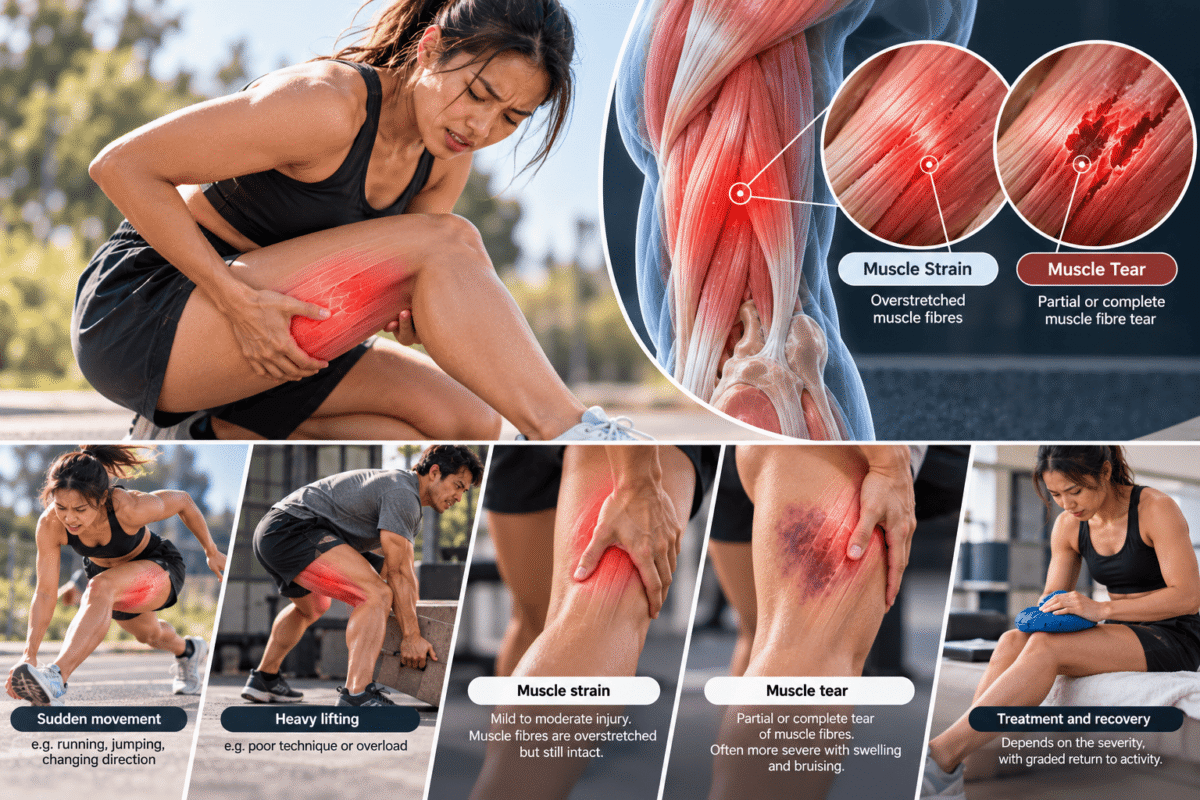
A muscle strain occurs when muscle fibres or their associated muscle-tendon structures are injured, usually during excessive force or rapid lengthening under load. The severity is commonly described in three grades:
- Grade 1 — Mild: A relatively small injury with limited strength loss.
- Grade 2 — Moderate: A partial tear involving greater pain, weakness and functional limitation.
- Grade 3 — Severe: A complete tear or rupture with substantial loss of function.
However, grading systems vary, and symptoms alone cannot reliably establish the grade.
A muscle spasm is an involuntary contraction, whereas a muscle strain involves actual tissue injury.
Similarly, delayed-onset muscle soreness generally develops gradually after unfamiliar exercise rather than causing sudden pain during a specific movement.
Therefore, when and how the pain began can be as important as where it hurts.
Possible factors include:
- Sudden acceleration or sprinting
- High-force muscle contractions
- Rapid increases in training intensity
- Muscle fatigue
- Insufficient conditioning for the activity
- Previous muscle injuries
- Inadequate preparation for demanding movements
For example, our runner recently increased sprinting intensity after several weeks of lighter training. Although this change may have contributed to the injury, it does not prove that training intensity was the sole cause.
In many cases, muscle strains result from several interacting factors rather than one incorrect movement.
The assessment aims to determine:
- Which muscle or muscle-tendon structure may be injured
- The likely severity of the injury
- Whether a major tear or avulsion requires medical referral
- How strength and movement are affected
- Which activities remain safe and comfortable
- When progressive rehabilitation can begin
The therapist also wants to understand the client’s functional limitations.
Can the client walk normally?
Can the muscle contract without significant pain?
Is strength returning?
The goal is not simply to identify a painful muscle, but to determine how safely it can be loaded during recovery.
Management depends on the injury’s severity and stage of healing.
During the early phase, treatment may include:
- Protecting the injured area from excessive loading
- Temporarily avoiding sprinting and painful movements
- Using cold packs or compression for symptom relief when appropriate
- Maintaining comfortable movement
- Monitoring swelling, bruising and strength
Importantly, aggressive stretching or deep massage directly over a newly injured muscle should be avoided, particularly while bleeding or significant tissue disruption is possible.
As symptoms settle, rehabilitation may gradually introduce:
- Controlled muscle contractions
- Progressive strengthening
- Restoration of comfortable range of motion
- Eccentric and lengthening exercises when appropriate
- Functional movement and balance training
- Gradual return to running and faster movements
Manual therapy may sometimes support comfort in later rehabilitation, but it cannot replace progressive exercise or appropriate tissue healing.
Ultimately, treatment should prepare the muscle for the demands it must handle again.
How Does It Usually Recover?
Most mild and moderate muscle strains recover without surgery. However, the time required depends on the location, severity and demands of the activity. A mild strain may improve within days to a few weeks, whereas moderate injuries often require several weeks or longer. Severe tears can take months and may require specialist treatment.
Initially, the priority is allowing the injured tissue to settle without unnecessary immobilisation.
Next, progressive strengthening helps restore muscle capacity.
Finally, functional rehabilitation prepares the person to return to normal activity.
For our runner, this may involve progressing from comfortable walking to strengthening, jogging, faster running and eventually sprinting. Over time, successful recovery means being able to:
- Walk without limping
- Move through a comfortable range
- Regain muscle strength
- Run without recurring symptoms
- Return to sport with confidence
However, pain relief alone is not sufficient evidence that the muscle is ready for high-speed activity. Strength, movement quality and tolerance to progressively greater loads also matter.
A sudden pop accompanied by major weakness, extensive bruising, visible deformity or difficulty bearing weight requires prompt medical assessment to exclude a significant tear or tendon avulsion.
Your Body Talks. Learn to Listen.
A muscle strain can happen in a split second. But recovery takes more than waiting for the pain to disappear. Rest gives injured tissue an opportunity to settle.
Movement helps restore function. And progressive loading rebuilds the capacity to perform.
Healing gets you moving.
Rehabilitation gets you ready.

Ask it. Even if you think it’s a ridiculous question.
Someone else has probably wondered exactly the same thing.
