
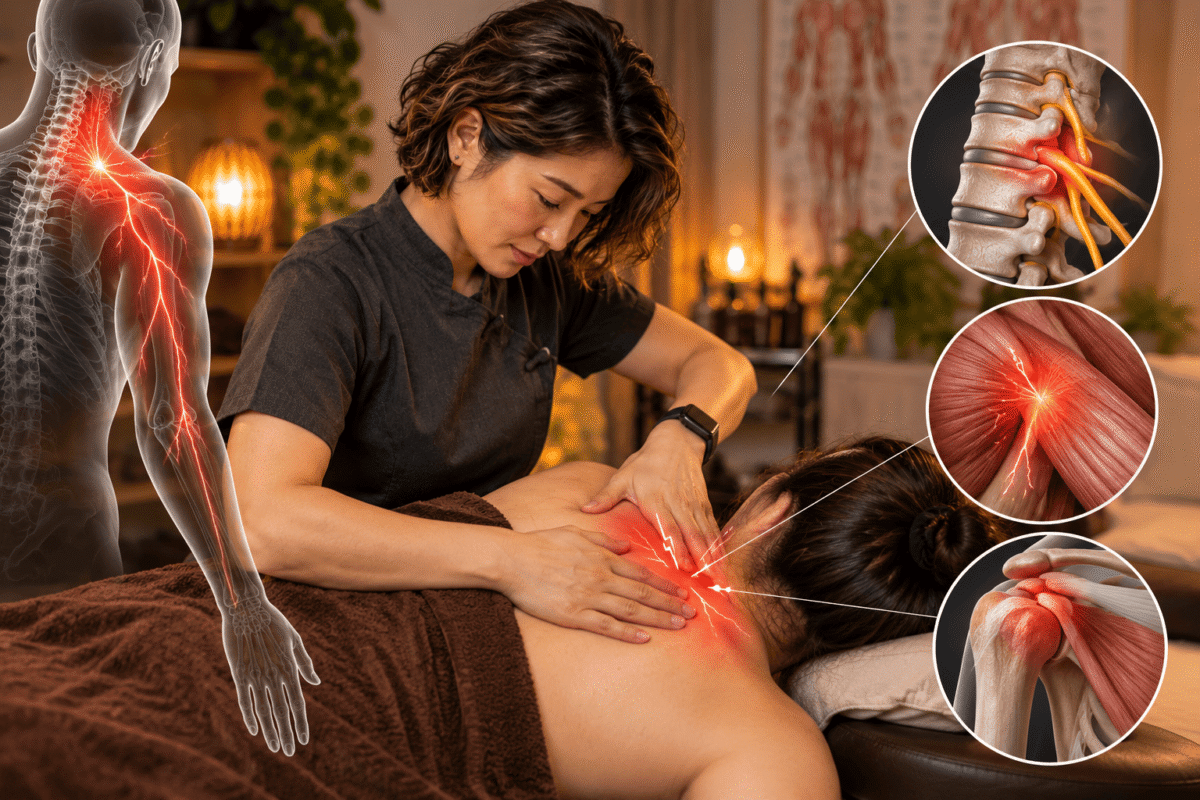
Sharp Pain
A sharp feeling does not identify its cause.
You point to one spot. It might catch when you move, take a breath or reach for something. Naturally, you want to know what is causing it and whether someone can work on that area.
“It’s a sharp pain right here.”
Pain in a muscle, joint, nerve or another part of the body can sometimes feel sharp. Before choosing a treatment, we need to understand where the pain is, when it began, what brings it on and what other symptoms came with it.
What does sharp pain feel like?
People often describe sharp pain as stabbing, piercing, cutting or sudden. It may last for a moment, return with a particular movement or remain present for longer. Some people can point to a small area; others feel pain that travels.
Those details help guide an assessment, but the word sharp alone cannot tell us how serious the problem is. For example, nerve pain can feel sharp or shooting, while some chest and abdominal conditions can also cause sudden, sharp pain.
If you are describing your pain to a therapist or doctor, try adding:
- Location: Where do you feel it? Does it spread?
- Timing: Did it start suddenly or build gradually?
- Trigger: Does movement, pressure, breathing or an activity bring it on?
- Pattern: Is it brief, constant or becoming more frequent?
- Other symptoms: Is there weakness, numbness, fever, swelling or difficulty breathing?
These answers are more useful than trying to name the affected tissue yourself.
There is no single “sharp pain condition.” Possible causes depend on the body area and the circumstances.
A painful movement after exercise, for instance, may involve a muscle or another part of the musculoskeletal system. Sharp or shooting pain may sometimes involve a nerve. Meanwhile, pain in the chest, abdomen or pelvis may have causes that require medical assessment rather than hands-on treatment. Even within one body area, several different conditions can produce a similar sensation.
Do not assume a sharp spot is simply a “knot.” Pressing harder on the place that hurts will not establish the cause, and it may make a sensitive area feel worse.
Seek prompt medical advice if sharp pain is new, unexplained, worsening, follows a significant injury or is accompanied by concerning symptoms. Severe or worsening chest pain needs emergency assessment; in Australia, call 000 if chest pain is severe, getting worse or lasts 10 minutes. Severe abdominal pain also requires urgent medical care.
A massage appointment should not delay medical assessment when symptoms suggest an urgent problem.
The right approach depends on the cause, not just the way pain feels. A health professional may take a history, examine the relevant area and decide whether further investigation or treatment is needed.
For some musculoskeletal problems, care may involve adjusting an aggravating activity, gradually returning to movement and using appropriate pain management strategies. Other causes may require medical treatment. Therefore, a useful first question is not “Which technique fixes sharp pain?” but “What needs to be assessed before we choose a technique?”
If symptoms persist, recur or interfere with everyday activities, seek an assessment from an appropriately qualified health professional.
Sometimes, but only when massage is appropriate for the person and the suspected problem. Massage may help some people manage musculoskeletal pain or feel more comfortable moving. However, research does not support claiming that massage treats every cause of sharp pain; for many pain conditions, the evidence is limited and benefits may be short term.
A thoughtful massage session starts with questions and assessment. The therapist should ask how the pain began, check what you can do comfortably and adapt the treatment to your response. If direct pressure reproduces a strong, unfamiliar or worsening sharp pain, that is information to act on—not a reason to press harder.
Massage may form one part of care when the presentation is suitable. At other times, the most helpful thing a therapist can do is pause treatment and recommend a medical assessment.
From the therapist:
“Tell me what brings the pain on, not just where it hurts. That helps us decide whether treatment is suitable today and what we should reassess afterward.”
Your Body Talks. Learn to Listen.
Sharp pain is a description, not a diagnosis. Understanding its pattern and accompanying symptoms comes before choosing treatment.

Ask it. Even if you think it’s a ridiculous question.
Someone else has probably wondered exactly the same thing.
