Sprain
What Happens When a Joint Is Twisted?
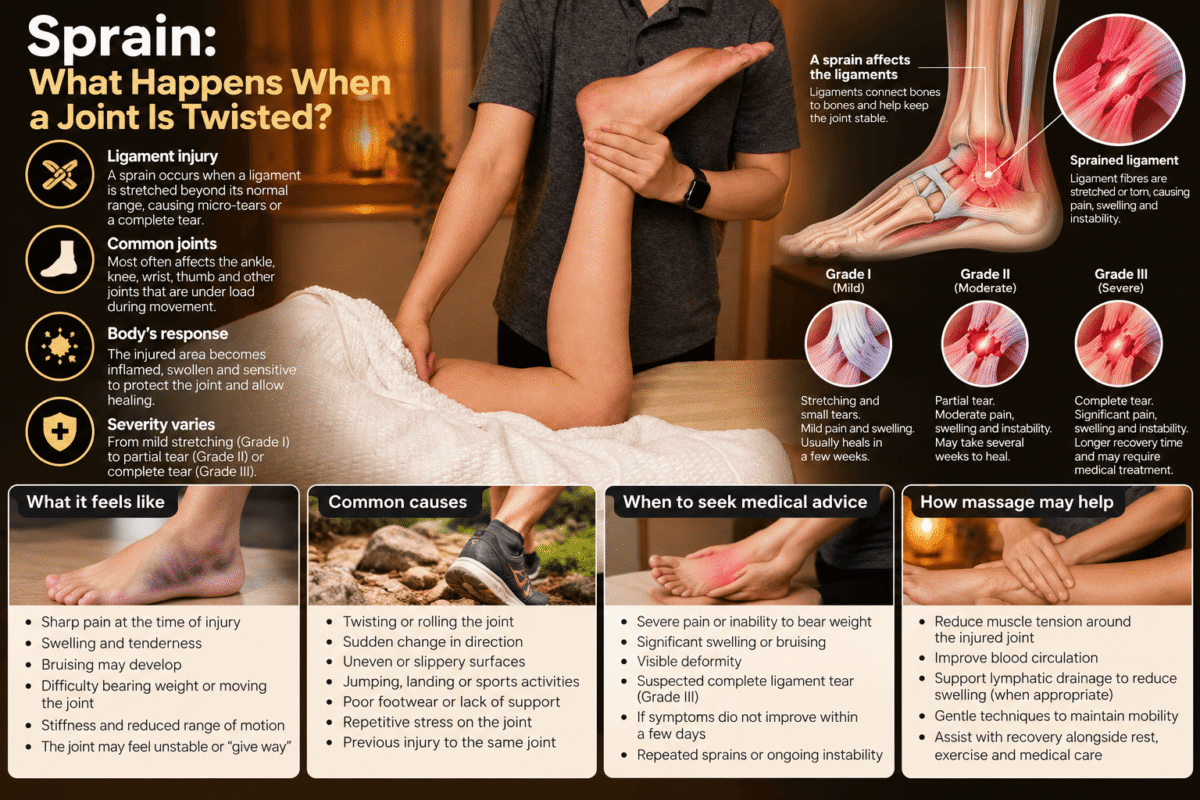
A sprain is not a joint that simply needs pushing or rubbing back to normal. It is an injury involving a ligament, the strong tissue that helps support a joint. In contrast, a strain involves a muscle or tendon.
“I rolled my ankle. Can you massage it back into place?”
The distinction matters because a newly sprained joint needs protection and an appropriate recovery plan not deep pressure over the injury.
What does a sprain feel like?
A sprain may cause pain around a joint, swelling, bruising and difficulty moving or putting weight on it. An ankle sprain commonly follows “rolling” the ankle, but ligaments in other joints, including the wrist and knee, can also be injured.
Tell a clinician:
- What movement or accident caused the injury?
- Could you use the joint or walk immediately afterward?
- Did swelling appear quickly?
- Is there bruising, numbness or a change in shape?
- Is it improving over the following days?
The amount of pain alone does not reliably tell you whether the injury is a mild sprain, a more serious ligament injury or a fracture.
What causes a sprain?
A sprain happens when a joint is forced beyond the movement its ligaments can comfortably tolerate, stretching or tearing one or more ligaments. It may follow a fall, a sudden change of direction or an awkward landing. Previous ankle sprains can also increase the chance of another ankle sprain.
When should you get the injury assessed?
Seek medical assessment if you cannot use the joint normally or bear weight, have severe pain, notice a change in its shape, or have numbness. These features may suggest an injury that needs more than routine self-care.
If the limb becomes pale, numb or cold to the touch, call 000 in Australia.
What are the treatment options?
Early care aims to protect the injured joint and manage symptoms. Depending on the injury, options may include temporarily reducing painful activity, compression, elevation, suitable pain relief, a brace or support, and clinical assessment. Guidance on ice varies between injuries and clinical approaches, so follow advice appropriate to your situation rather than assuming every sprain needs exactly the same routine.
As the joint settles, recovery usually involves gradually restoring movement, strength and confidence. A physiotherapist or other qualified clinician can help plan rehabilitation, particularly if the sprain is significant or the joint repeatedly gives way. A sprain feeling less painful after a few days does not necessarily mean it is ready for full sport or heavy activity.
Can massage help a sprain?
Do not massage directly over a fresh, swollen sprain. For ankle sprains, Better Health Channel advises avoiding massage during the first 48 hours, as it may worsen swelling. Strong pressure cannot reconnect a torn ligament or replace rehabilitation.
Later in recovery, massage may be considered for surrounding muscle discomfort if the injury has been assessed and touch is comfortable. The main measures of progress remain practical: Can you move the joint, bear weight and return to activity safely? Massage should support that plan rather than become the entire plan.
From the therapist: “First, we need to understand what happened to the joint and how well you can use it. Then we can decide whether hands-on treatment has a useful role.”
Your Body Talks. Learn to Listen.
A sprain is a ligament injury. Protect and assess the joint early; then rebuild movement and function as it heals. Massage may have a supporting role later, but deep work on a fresh sprain is the wrong starting point.
Ask it. Even if you think it’s a ridiculous question.
Someone else has probably wondered exactly the same thing.
