
Most aches and pains don’t mean something dangerous is happening.
Pain comes with clues that tell us:
Sometimes you’ve trained too hard.
Sometimes you’ve irritated something.
Sometimes your body simply needs time, movement and appropriate care.
“Don’t just treat this. Investigate it first.”
And sometimes it’s knowing: “This needs to be checked first.” Knowing when not to treat is part of good treatment.
Knowing the difference matters.
Don’t Ignore the Change
You know your normal better than anyone. So pay attention when something is suddenly, significantly or unusually different. Not every ache needs a scan. Not every pain needs medication. And certainly not every pain needs massage.
Sometimes the most useful response to pain is treatment. Sometimes it’s movement and recovery.
It’s tempting to assume that pain around the neck, shoulder or back must be muscular. Especially when the area feels tight.
But pain location doesn’t tell us the diagnosis. A painful area can involve muscles, joints, nerves and other structures — and occasionally pain may be related to something outside the musculoskeletal system altogether.
So before treatment, we should ask:
What happened?
When did it start?
What else has changed?
Sometimes those answers are more important than where the pain is.
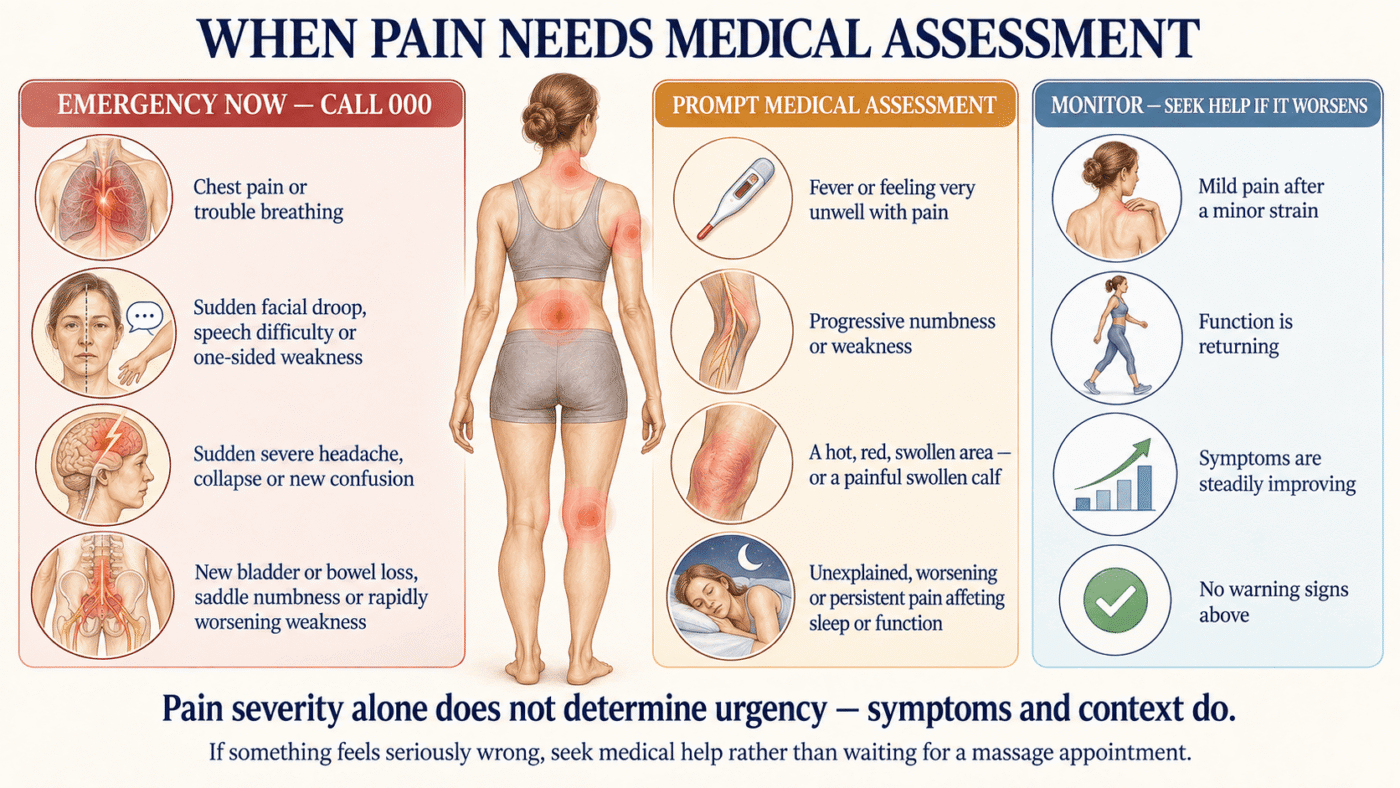
Medical assessment may be appropriate when pain is associated with symptoms such as:
- significant trauma, such as a serious fall or accident
- sudden or progressively worsening weakness
- significant or increasing numbness or loss of sensation
- new difficulty walking, balancing or coordinating movement
- unexplained swelling, redness or unusual warmth
- fever or feeling seriously unwell alongside significant pain
- severe pain that is rapidly worsening or unusually different from previous symptoms
- unexplained pain that persists or doesn’t behave as expected
- symptoms that raise concern following recent surgery or a significant medical event
This isn’t a checklist for diagnosing yourself. And having one symptom doesn’t automatically mean something serious is wrong. It means the situation may deserve more investigation before treatment continues.
Certain combinations of symptoms require more immediate attention.
For example, back or leg pain accompanied by new bladder or bowel dysfunction, numbness around the groin or genital area, or significant/progressive weakness in the legs requires urgent medical assessment.
Sudden neurological symptoms — such as new facial weakness, difficulty speaking, severe loss of coordination or weakness affecting one side of the body also require urgent medical attention. Severe chest pain, significant difficulty breathing, collapse or other symptoms suggesting a medical emergency should not be treated as a massage problem.
Call emergency services when symptoms appear life-threatening or time-critical.
Sometimes the most professional treatment involves not treating. If something doesn’t fit the expected pattern, a therapist may modify treatment, postpone it or recommend medical assessment first.
That isn’t refusing to help. It’s recognising the limits of what massage can safely address. A good therapist should be comfortable saying:
“I’m not confident we should treat this until it’s been checked.”
Because our job isn’t to prove that every problem can be treated with our hands. Our job is to make an appropriate decision for the person in front of us.
This is important. Being referred to a doctor doesn’t automatically mean your therapist thinks you have a serious disease.
Sometimes we simply don’t have enough information to confidently explain the symptoms as a musculoskeletal problem. Getting something checked can help rule out concerns and guide what happens next.
And if medical assessment confirms that massage, movement or rehabilitation is appropriate? Great. Now we can move forward with more information.
Your Body Talks. Learn to Listen.
And if you’re ever unsure whether a symptom is appropriate for massage, ask.
There are no silly questions when it comes to deciding whether treatment is safe.

Ask it. Even if you think it’s a ridiculous question.
Someone else has probably wondered exactly the same thing.
