More pain doesn’t always mean more damage.
You touch something hot.
Your hand moves away.
Fast.
You probably didn’t stop to think:
“Hmm… perhaps I should remove my hand now.”
Your nervous system was already busy protecting you. But when it comes to pain, things get much more interesting.
Pain Is More Than a Message From the Muscles
We often imagine pain like an alarm wire.
Something gets injured → a pain signal travels to the brain → we feel pain.
Useful explanation.
But not quite the whole story.
Your nerves can detect potentially threatening changes in tissues and send information toward the spinal cord and brain. Your nervous system then processes that information alongside many other things.
And the experience that may result is pain.
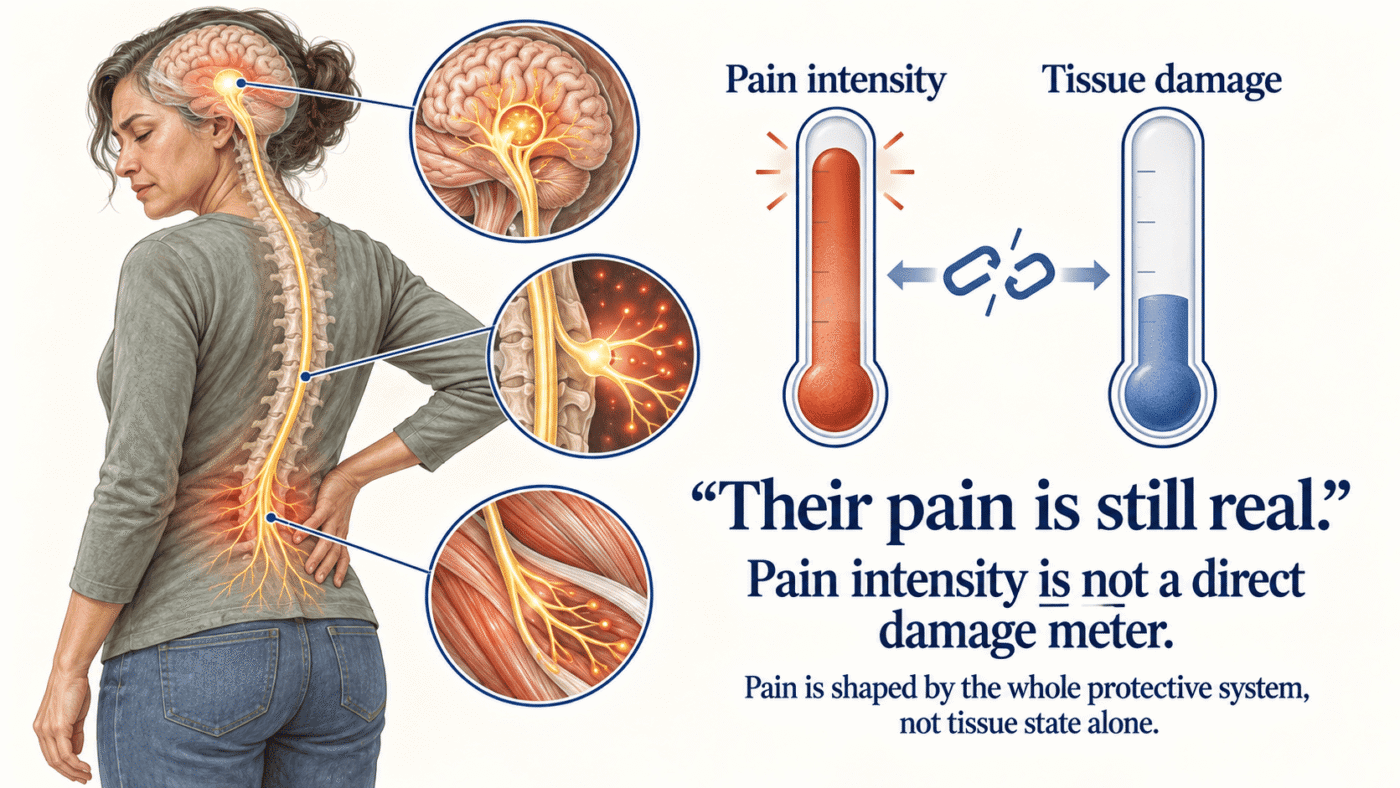
This means pain isn’t simply a measurement of how damaged a muscle or joint is. And less pain doesn’t always mean everything is completely healed.
Your Nervous System Is Trying to Protect You
Pain is protective.
If you sprain your ankle and walking hurts, that pain can encourage you to protect the area.
Very useful. But sometimes pain continues longer than expected. Or something that once hurt starts feeling painful more easily.
The nervous system can change how sensitive it is, particularly when pain has been present for a long time.
That’s one reason two people with apparently similar injuries may experience pain very differently. Their pain is still real.
Their nervous systems are simply not identical.
Massage provides sensory input to the nervous system through touch, pressure and movement. For some people, that may temporarily change how an area feels, reduce pain or make movement feel easier.
But we shouldn’t explain this as:
“I found the painful muscle and fixed it.”
Sometimes what changes after treatment is much more complicated than that. This is why we reassess.
Does it hurt less?
Can you move differently?
Does the change last?
Those questions tell us more than simply finding a tender spot.
Pain deserves attention.
But pain alone doesn’t always tell us exactly what is wrong.
We need context. When did it start? What makes it worse? What makes it easier? Has movement changed? Are there other symptoms?
Sometimes pain may be related to a relatively simple musculoskeletal problem.
Understanding that difference helps us respond to pain rather than simply fear it.
So next time something hurts, instead of immediately thinking:
“What have I damaged?”
Try asking:
“What might my nervous system be responding to?”
That’s often the beginning of a much more useful conversation.
Your Body Talks. Learn to Listen.
Ever had something hurt far more than you expected — or barely hurt when you thought it should?
Tell us below. The nervous system can be surprisingly dramatic.

Ask it. Even if you think it’s a ridiculous question.
Someone else has probably wondered exactly the same thing.
